


Courtesy of mHealth Insight/3G Doctor, David Doherty takes the LIFE magazine approach and delightfully, you feel like you are there. He hosted a get-together at his booth on Monday (many pics), stops by AliveCor, Alere Connect (hello Kent Dicks), the Venture+ Forum (see Lois Drapin’s earlier article; hello Richard Scarfo, director of the Summit and Pat Salber of HealthTechHatch crowdfunder and the DoctorWeighsIn), VNA Health Group, investor in many things Esther Dyson, Google Glass Explorers, Samsung’s Galaxy Gear smartwatch and the ‘panini generation’ courtesy of AT&T ForHealth. But you’ll have to page all the way down to see the last shot of an ‘wild, wooly and yo-ho-ho’ AliveCor demo in My thoughts on the 2013 mHealth Summit as it happens…
Is the ‘last mile’ of app certification efficacy metrics?
News and announcements around app certification definitely were hot topics in the past week or so, but are they more heat than light? Do these certifications adequately address efficacy? Stephanie Baum, in her follow-up to the Happtique kerfuffle in MedCityNews, opens up the discussion with the proposition: “It seems like there needs to be some way to prove that apps actually help people.” Bradley Merrill Thompson of Epstein Becker & Green points out “It’s certainly useful to know that an app works from a software perspective reliably, but it is even more valuable to know that the app can actually improve health.” While Happtique certification standards have a gap here, this Editor would point out that they were evolved nearly two years ago when the reporting/analysis needed for this was largely not available. Newer programs such as Johns Hopkins’ mHealth Evidence and the new IMS Health AppScript [TTA 15 Dec] can dip into the ‘big data’ pool far more effectively. Will Happtique be able to address this, or leave the ‘last mile’ to others? And what is the real and quantifiable demand for app certification anyway? Health app prescribing by physicians is a question mark in this Editor’s observation; the larger market may be health plans and programs such as Partners HealthCare’s Wellocracy, Cigna’s GoYou and Aetna’s CarePass.
IMS Health enters health app ranking, prescribing
Global healthcare informatics provider IMS Health during mHealth Summit announced its entry into mHealth prescribing and evaluation with AppScript. They also are getting into the development standards business with AppNucleus, a hosting platform that from the description, will guide developers in designing secure, HIPAA and HITECH Act compliant apps using IMS Health information and data analytics. AppScript uses a proprietary methodology called AppScore to classify and evaluate apps based on functionality, peer and patient reviews, certifications, and their potential to improve outcomes and lower the cost of care. According to Information Week Healthcare, AppScore includes 25 criteria developed by IMS and its physician advisors (more…)
Is ‘mobile health for seniors’ obsolete?
Perhaps it should be. At the ‘mHealth & Boomers: Reinventing the Dynamics of the Healthcare System’ panel discusssion at the mHealth Summit Monday afternoon, Stephen Johnston, cofounder of Aging 2.0 (and parent of the GENerator accelerator TTA 12 Dec below), and Laurie Orlov, founder of Aging in Place Technology Watch speculated on the future of technology for older adults in an aging market. The most interesting and unique conclusion arrives at the end of the Mobihealthnews article, with Ms. Orlov flatly stating that the category will disappear by 2020. “There will be no aging in place technology market by 2020,” she said. “All technology will be customizable and usable by all categories of people, and we will not have to have technologies that are marketed for seniors.” Hat tips to readers Mike Clark and Luca Sergio via LinkedIn
Rise of the internet and telehealth in India
An interesting post in the British Medical Journal Blog (blogs.bmj.com) yesterday by a former president of the Telemedicine Society of India, K Ganapathy, suggests that India may be leap frogging the West in telehealth. (It is well accepted that many developing countries leap frogged in the telecommunications race when they skipped one or more steps in the process to catch up with the latest mobile telecoms technology.)
Ganapathy says that in a recent survey 48% of those responding in rural India and 72% in urban India had heard of mHealth and 55% overall intended to use mHealth if available. He says that the Indian Government is setting up 100,000 internet centres in rural India and suggests that extending these into remote telehealth access points is a reality. Read the whole posting here.
Health 2.0 Latin America
6-7 December 2013, Hospital Sírio-Libanês, São Paulo, Brazil
The first annual international Health 2.0 meeting in Latin America will be held at the historic hospital founded by the large Christian-Syrian and Lebanese community of São Paulo in 1931. Latin America’s fast-growing–and aging–population presents multiple health challenges and disparities. Yet as a region, it is a world leader in medical schools, internet usage growth (2nd largest for Facebook and Twitter) and the 4th largest mobile market. Topics include:
- What the Health 2.0 movement can do for Latin America
- Who should step up to finance Health 2.0
- What will be the role of incubators in the region
- Sensors and trackers – From quantifying the self to changing behaviors
Opportunities in the mHealth Landscape: Encouraging Integration
27 November 2013, Pinsent Masons LLP, 30 Crown Place, London, EC2A 4ES
A one-hour breakfast seminar focusing on opportunities and challenges being presented by mHealth developments. Presenting: Tim Davies, CEO of mHealth supplier Exco InTouch, Dr Andy Richards, recipient of BIA’s 2013 lifetime achievement award, Collette Johnson of Plextek Consulting, who has had a central role in advancing the adoption of mHealth technologies in the NHS, and Matthew Godfrey-Faussett, a partner at Pinsent Masons specializing in ICT and Healthcare. The seminar will be chaired by David Isaac, Head of Advanced Manufacturing & Technology Services at Pinsent Masons. Breakfast is 8am with presentations 8:30-9:30am. Free. Email megan.hanney@pinsentmasons.com for registration. Additional information here.
Temperature sensing chip implanted in man’s arm
A biohacker called Tim Cannon, has had a computer embedded in his forearm, to allow his bodily data to be monitored. The device called Circadia 1.0 was built by Tim and colleagues from Grindhouse Wetware. In this first version, the chip records body temperature and transfers it in real time via Bluetooth to any Android-powered mobile device. Three LEDs built into the package serve as status lights (which glow visibly under the skin). The device’s battery charges wirelessly.
Because a regular surgeon wouldn’t be allowed to carry out the implant as it is unapproved by medical authorities, Tim relied on the expertise of body modification enthusiasts to implant the device! …Yes, it’s a bit crude, but more likely than not is another small step towards our cyborg future!
[This video is no longer available on this site but may be findable via an internet search]Tech to help blind people navigate… and perform yoga
 A pair of “smart glasses” being developed by researchers at Oxford University could help blind people in unfamiliar surroundings. The majority of people registered as blind have some residual ability to perceive light and motion. With this in mind, the team are developing glasses with mini cameras on either side which detect objects. Enhanced images are then displayed on the lenses. In addition, the cameras can detect how far an object is from the wearer by comparing the distance between the cameras. (more…)
Relax, it’s (not) just a breathing monitor headset
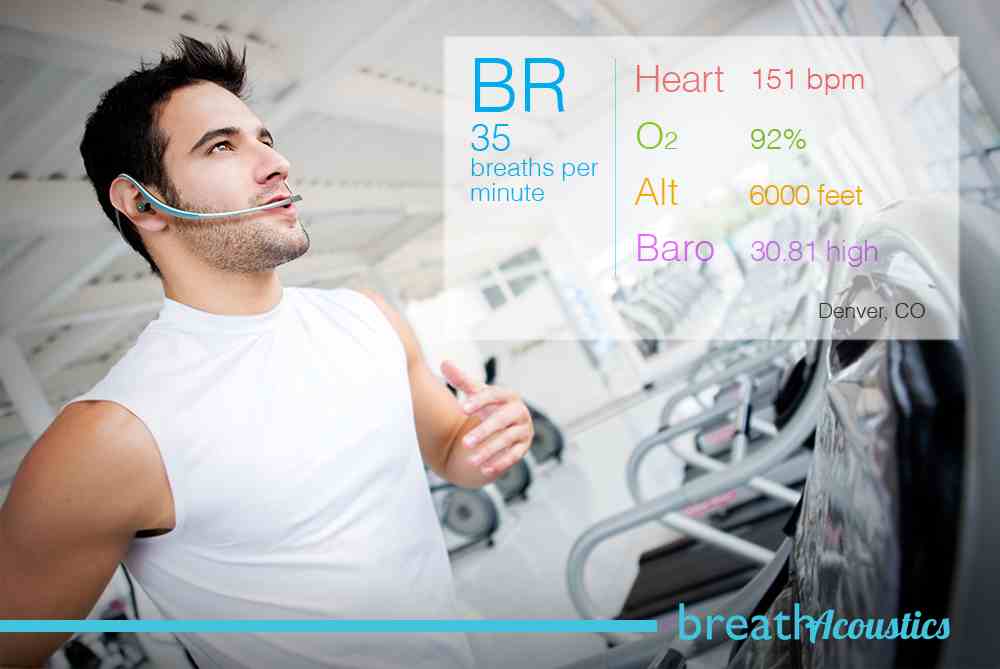 A headset which monitors the quality of your breathing is being developed by BreathResearch, a San Francisco Bay area start-up.
Combined with a mobile app, the ‘Breath Acoustics’ headset listens to your breathing and analyzes the patterns. Sensor-based breath monitoring may be a less commonly monitored biometric pattern but recent studies suggest it could be used to detect stress levels, bacterial infections and other conditions. The headset also presents other biometric data, including heart rate, pulse oximetry, and respiration. (more…)
Another set of forecasts to not believe in?
A sunny day for approaching Fall (Autumn to our loyal UK readers) and a bon weekend at least in this part of the world, and this Editor has to spoil it by waxing downbeat about an up forecast–way up. This week it is Juniper Research’s Mobile Health and Fitness report straight from Hampshire, UK with the big numbers–98 million by that magic year 2018–but that’s users, not revenue. They also forecast beaucoup cumulative savings of $35 billion over the next five years from remote patient monitoring. Want to know the size of the market versus the research2guidance and MarketsandMarkets forecasts? You’ll just have to scramble in your wallet for £2500 to get the scoop. Healthcare Technology Online, Juniper release, Juniper report overview and pricing. Previously in TTA: The ‘ginormous’ hype around forecasts and our very first ‘Blue Blazes’ feature (by Editor Charles).
AAMI/FDA Summit on Healthcare Technology in Nonclinical Settings (US)
9-10 October 2013, Hyatt Dulles Hotel, Herndon VA
The Association for the Advancement of Medical Instrumentation (AAMI) and the US Food and Drug Administration (FDA) have organized a conference on improving the safety and effectiveness of medical technologies used in homes and other nonclinical settings, such as telehealth and mHealth. There are risks and challenges to consider as technology is placed in nonclinical environments, in the hands of individuals who are not medical professionals. There is an impressive roster of supporting international organizations, including the British Standards Institution (BSI), the Wireless-Life Sciences Alliance (WLSA), the Center for Aging Services Technologies (CAST) of LeadingAge, The Joint Commission and Continua Health Alliance. Information, agenda, registration. Hat tip to reader Rob Turpin of BSI Standards Limited.
GSMA Mobile World Congress & mHealth
The GSMA has announced details of its upcoming World Congress in Barcelona on 24-27 February 2014 which will include a significant mHealth stream as part of the new “mPowered Industries” programme.
Meanwhile the mHealth Grand Tour from Brussels to Barcelona is continuing, demonstrating advanced the real-time monitoring of diabetes.
Elsewhere a new (and pricey) report by RnR Market Research on the mHealth market (more…)
Are mHealth apps sharing your data with pharma and insurance companies?
As a further postscript to our recent post on mHealth apps, the Financial Times has just published an article offering a worrying new angle. According to the FT, the “top 20” health & wellness apps are sharing data on you with third parties that, the FT reckons, may include pharmaceutical and insurance companies.
They report that: “Regulations bar the tracking and selling of individuals’ specific medical and prescription records. Yet some companies are figuring out ways around those restrictions by building digital health profiles about people based on their use of the web and mobile apps.”
Perhaps a case of reading those Ts & Cs carefully before pressing ‘accept’?
Audax Health raises $20 million
Breaking News
One very substantial bet was placed today on consumer engagement, with CE/mobile/social media-for-wellness developer Audax Health announcing a $20 million Series B funding this afternoon. Navigy Holdings, Inc. a wholly-owned subsidiary of Florida Blue (Blue Cross Blue Shield, Florida’s largest health plan) led the round, which included current board member Jack Rowe (former CEO and chairman of Aetna) and Dan Rose, VP of partnerships at Facebook. Audax’s main product is Zensey, a mobile-based platform for personalized health content, connection with like minds via online communities, challenges, health assessments and games. The funds reportedly will be used for product development, build out the company’s mobile and engineering teams and expand partnerships with health plans, employers and providers. Previous funding has exceeded $35 million since its 2010 founding ($21 million this past January alone). Corporate partners include Cigna and Cardinal Health, with New Leaf Ventures their leading VC. Press release via Yahoo Finance; Gigaom; Washington Business Journal. Hat tip to reader David E. Albert, MD of AliveCor via Twitter (@DrDave01)
Ford and WellDoc give a new meaning to mobile health (US)
As a postscript to yesterday’s post on mHealth apps, WellDoc Health have introduced BlueStar, a prescription-only, reimbursable app that majors on encouraging improved self-care by those with type II diabetes. Apart from being the first prescription-only app in the US, it is apparently also downloadable directly into a car (Ford).
Editor Donna comments 29 August: Aside from WellDoc being the only mHealthy company I can think of located in Baltimore, MD (for our ex-US readers, a city perched uneasily between Washington and Philadelphia), wasn’t the idea (or one of the ideas) originally behind Happtique a process to certify health apps, with a prescribing tool (along with patient ed) via their mRx platform? In June, they sought primary care physicians to beta test their catalogue, formularies and mRx prescribing tool [TTA 28 June]. With Happtique now firmly under the GNYHA Ventures wing [TTA 17 May] and a much lower profile, there may be plenty of room for a private competitor with an established name and its own FDA-cleared apps to establish a prescription app model.



Most Recent Comments