


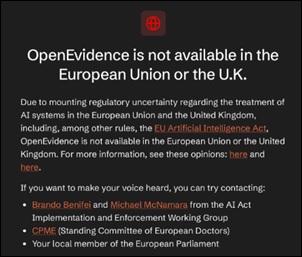
 The hottest doctor reference source withdrew its medical evidence and decision support app from the UK and European markets. The news, reported in HIStalk on 28 April, is shocking–but not surprising. EU sources have predicted that this would be an outcome of the EU Artificial Intelligence Act. While the UK is not technically subject to EU regulation, the regulatory guidance to date has been along the EU Act’s lines; clearly a decision has been made not to enter the UK market accordingly.
The screen at left (courtesy of HIStalk) cites the ‘regulatory uncertainty regarding the treatment of AI systems’ and invites potential users to ‘make their voice heard’.
OpenEvidence is perceived by most to be the ‘up and coming’ platform for physician information. Its momentum was solidified with deals such as with Mount Sinai NY to integrate it within Epic [TTA 9 Apr], a $250 million Series D funding, and a monster valuation of $12 billion, making it the most valuable healthcare AI company in this solar system. It couples a free search engine trained on journals and clinical medical data only with an AI chatbot agent, making it easy to use for doctors. OpenEvidence partners with prestigious sources such as the New England Journal of Medicine and the American Medical Association. It claims a daily average usage by 40% of US doctors in 10,000 hospitals and medical centers, achieving 18 million clinical consults in December alone. It recently added clinical trial matching to its capabilities, filtering trials by study design, enrollment status, and geographic proximity. To the US industry, OpenEvidence fills a gap in clinical intelligence that competitors Doximity (public), Epocrates (athenahealth), and Medscape (WebMD) have not to date, which certainly hurts the latter as tight pharma ad dollars reroute to OpenEvidence, as TTA has previously noted.
The EU and UK constraint will likely not hurt OpenEvidence’s growth, but will hurt physicians in those countries by blocking a reliable source of information. It hits the NHS where it hurts, in its desires for technology advancement and integrating AI in practices. DistilledPost has a more UK-specific discussion of the consequences. Meanwhile, this Editor doubts that OpenEvidence will let this sit, and will eventually find a way towards compliance while growing outside of those markets, such as the Middle East and Asia. They have the resources, the name, and the growth. Hat tip to HIStalk. Letsdatascience,



Loss of OpenEvidence is a very severe setback for reliable evidence based medical practice in Europe.
Agreed. I am fairly sure that it will be worked out.