Update on Shimmer – with video (Ireland)

It’s a year since we flagged up the Shimmer wearable sensors [TA 29 Jan 2010] and now we learn that research is being conducted at the Technology Research for Independent Living (TRIL) Centre on them for monitoring high-intensity exercise. Shimmer was originally developed by Intel Research Labs in 2006 and Shimmer Research was established in 2008 following a worldwide licensing agreement.
Shimmer Provides Real-Time Feedback for Intense Physical Exercise Programme.

Is it just me (Ed. Steve), or does anyone else find that phrases like “Kinematic, Bio-Physical, and Ambient modules – paving the way for the next big wave in computing” get in the way of understanding what may be a significant technology? “Better than the Wii Fit” Dr David McKeown says in the video.

Telecare Aware Policies

Privacy Policy
Cookie Policy
Commenting Policy
Anonymity Policy
Press Release Policy
Conference Publicity Policy
Soapbox Guidelines (for authors)


Privacy Policy

We collect a small amount of information from people who sign up for our news updates mailing, including name and email address (to provide the service), country, if offered, and IP address and date of sign up. We never sell, rent, give or otherwise expose this data to any third parties. The legal basis for this is your consent. The data is stored in a private Amazon S3 account using ‘Sendy‘ as our private email management system.

We keep a record of subscribers who use the automatic unsubscribe link at the bottom of each updates email or whose subscription is suspended owing to repeated hard bounces. This enables us to maintain a ‘clean’ list of active subscribers and email them only. The unsubscribed record will be maintained as long as the alerts emails are sent out.

If you wish not only to unsubscribe but to have your record deleted as if it never existed (the ‘right to be forgotten’) you will need to email to us with ‘Delete’ in the subject line, as we have to do this manually.

Cookie Policy

When you arrived at this site Google Analytics cookies were stored on your computer. If you visit parts of the site that use WordPress (such as the archives and TA In Review) WordPress cookies may also be stored. We cannot personally identify you from these cookies but they are essential to help us understand usage of the site. We think it reasonable to assume that, as a tech-savvy Telecare Aware reader, if you object to this you can easily delete those cookies and stop them being added on future visits. (Google ‘delete and block cookies’ plus the name of your browser.) By not deleting or blocking our cookies you imply your consent to our using them.

Commenting Policy

Readers are encouraged to add comments to items that further debate or elaborate them. All comments are moderated. That is, before they appear on the site they will have been read by one of the editors who may make small unacknowledged edits for matters of grammar but who will indicate with an italicised comment within square brackets [like this] if part of a comment is omitted or substantially altered for any reason.

We approach the task of moderation impartially and subsequent publication should not be interpreted as our implied agreement with the originator of the comment.

Anonymity Policy

The gist is…if you have a serious comment to make anonymously…email it, don’t just post it.

Truly anonymous comments – where the writer is unknown – are not published unless they are unexceptional.

Comments or articles where the authorship is known but are offered for publication anonymously are considered on their merits. (Email editors Steve or Donna in confidence.) There are some circumstances where it is necessary to be close to a particular situation to be able to throw light on it but to write about it publicly would jeopardise the author’s position. In that case, the decision to publish an item anonymously hinges on the question of whether or not it is informed opinion that will add insight to, or might start, a debate on a particular topic.

Unsubstantiated allegations of illegal behaviour or substandard products, for example, would not be posted unless they could be independently verified, in which case we would probably publish them ourselves.

Just because a post, article or comment, etc. is published on Telecare Aware, readers cannot and should not infer that the editors agree with the author, anonymous or not.

Press Release Policy

Unlike some other websites, we do not publish press releases per se – we publish news and may link to a press release that explains that news. Therefore, while we are pleased to receive press releases directly, and will link to them on your website, we are unlikely to report on information that we believe is not ‘news’ of interest to our readers. This generally means we will not be reporting on press releases containing ‘announcement’ material such as:

  • You have routinely acquired a new customer or distributor/reseller
  • You have redesigned your website
  • You are going to present, or have presented, at a conference

Please also note that press releases with ‘news’ that we have to unhype first, or ‘studies’ and ‘research’ which lack basic objectivity and methodology are unlikely to gain a place on the site – unless we use them as bad examples, which we have been known to do from time to time.

Conference Publicity Policy

On request, conferences and events will get a free listing on the Events page.

We select a very few conferences per year for ‘Media Partnership’ arrangements whereby both parties provide mutual publicity. Therefore do not be offended or surprised if we turn down your media partnership request – paid adverts for other conferences are welcome, at normal advertising rates – see the Promote page.

Soapbox Guidelines

The ‘Soapbox’ is a place where you can write about industry-related topics on which you feel strongly. There is no preferred length – it should be just as long as you think necessary to make the point(s). We only ask that it is interesting, passionate or entertaining – and not libellous or defamatory, of course.

Browsing other Soapboxes (under the Opinion menu item) will give the best idea of the approach. References to authors companies are allowable for context but blatant self-promotion is not. Your company, personal website or contact details can be linked to at the end. There may be some light touch editing for consistency of house style but you will be able to review any changes before publication.


Telecare Aware is a feisty, independent B2B review of healthcare technology (telecare and telehealth) primarily in the US and UK (where Steve Hards, EIC, founded it in 2005). We’re opinionated, independent and write about the news and issues important to our international readership of developers, telehealth implementers, policy makers, marketers and funders. We also invite outside opinions (in the Soapbox). We are technology advocates, with an eye to what best works in keeping people of all ages independent and healthier, integrates into care workflow, and has a workable business model.

15 ways to keep up to date with Telecare Aware

When Telecare Aware started in 2005, it was a busy month that saw 20 relevant news items to note. Now we are regularly posting 70 – 100 selected items a month and filtering out many more that repeat old information, etc. Frankly, keeping up with the increasing stream of information and trying to make some sense of it all is hard enough for editors Steve and Donna, and we do wonder how our readers manage.

So…there’s not much we can do about the stream of posts that cascade their way down Telecare Aware’s front page over the course of about two weeks but we have put in place several ways to help you keep track and keep up…

Do this first…

1) Sign up for the FREE Tuesday and Friday email alerts

No one wants to receive more emails, but this is simple and painless and people do so find it invaluable – at the time of writing there are over 200 people who have been receiving these regularly since before the end of 2006. Enter your details in the boxes below, click the ‘Notify Me’ button and you will get a twice-weekly email listing Telecare Aware updates since the previous email. We’ll never pass your details to anyone else and you can easily opt out.

Sign up for Tuesday and Friday news alerts emails

Enter your name

and email address


NOTE: If email alerts you signed up for previously have stopped arriving, read this.

Or you could try these…

2) Follow Telecare Aware via Twitter

3) Follow via Facebook

4) Add to iGoogle

5-14) If you really must…here are 10 other ways to monitor updates (external site link)

The best way…

15) What we eventually realised was that, even if you are coming back to Telecare Aware when alerted by one of the above free methods, it is still hard to pick out from the constant stream of items the ones that are particularly interesting to you. So instead of TA reducing your stress by being your primary source of information in this field, it probably adds to your stress as you still worry about keeping up especially, for example, after a holiday.

We have therefore set up a way to make future news content of the site available to you to sort by topic and/or date and in a print-friendly format. This service, called Telecare Aware In Review comes at a low monthly cost but the facility to read Telecare Aware news items off line, and the amount of time and stress it will save you, is well worth it. Here are the details…

Telecare Aware In Review is an extension to the Telecare Aware website that will help you:

    1. Save time by freeing you from having to be at the computer to keep up to date – read printouts wherever you choose
      Makes it much easier to print out important articles to share with colleagues and read on the move
    2. Reduce stress by knowing that if you are away for a while you can catch up on back articles easily
      Every little bit of de-stressing helps!
    3. Save time and data charges by enabling you to read offline on your mobile device (if you have saved your article selection as a file)
      Download important information to your mobile device and read on the move
    4. Focus on the most interesting developments with the ‘Editor’s Picks’ at the end of each month
      They bring you the best of the bunch every month helping you make better decisions for your organisation and its customers
    5. Become better informed as you discover items that you may have otherwise skipped or forgotten
      You’re less likely to miss ‘golden nuggets’ of information that could help you transform your services

    Check out the Video and the Free Demo

    After watching this video you can experience how the Telecare Aware In Review site actually works, in a demo area using just some of the news items from October 2010 only, click here.

    Purchase access to Telecare Aware In Review

    If you are unfamiliar with making payments via PayPal, please read the following:

    • PayPal accepts payments by credit or debit card. You do not need a PayPal account for the non-recurring payments.
    • For recurring monthly payments only, PayPal requires the creation of a PayPal account if you do not have one, so that it can make the regular payments for you, from your credit card.
    • Payments in currencies other than UK£ will vary with exchange rates.
    • Your payment will be to steve.hards@stevehardsoft.com.
    • After purchase you will see a message from PayPal about returning to this site. Please follow it.
    • Shortly after your payment you will receive a receipt from PayPal and an email from us with your username and password.

    Full Monthly Access
    £4.95 – approximately €6.25, US$7.70

    The subscription for individuals who want to pay monthly. You get access all items for as long as you subscribe.


    20 Day Access Pass
    £9.90 – approximately €12.45, US$15.40

    The choice if you don’t want an ongoing subscription, but want to have short term access.


    One-Year Access Pass (for the cost of 10 months’ subscription)
    £49.50 – approximately €61.70, US$76.25

    Alternative to the monthly subscription or people or organisations that prefer to pay for a year in one go.


    Lifetime Access Pass: (Also available by Purchase Order)
    £179.00 – approximately €223, US$275

    A one-off payment, giving access for as long as the service continues, primarily for people in organisations that can only pay by purchase order rather than by credit card, at a cost that reflects the additional administrative work involved. For a PO purchase, email editor Steve Hards: steve.hards@telecareaware.com. But if you want to purchase by card, click on the button. , giving access for as long as the service continues,


    No Refunds Policy

    Unless it is a problem with the payment system, we have a ‘No Refunds’ policy. First, you have every opportunity to know what you are getting before you subscribe or purchase a pass – watch the demo video above to see if it is something for you, and to see whether the printing facility etc. works for you, try it out on demo site – and second, you could, of course, print all the posts off on the first day, and ask for a refund…!

    Questions / Comments

    Any questions or comments, post below or email Steve.

    Telecare Soapbox: Evaluation of telehealth services: How good is ‘good enough’?

    David Barrett, Lecturer in Telehealth at the University of Hull takes a hard look at how local trials are often evaluated and looks forward to a time when more rigorous approaches will provide solid evidence for the benefits of telehealth.

    Regular readers of TelecareAware cannot fail to notice the frequency with which new evaluations of telehealth services are published. In recent months, we’ve seen documents from, amongst others, Kent, SE Essex and Argyll & Bute. These evaluations are almost always positive, suggesting that further deployments of technology can supply huge savings for health and social care organisations, whilst proving immensely popular with users, carers and practitioners.

    This growing evidence base in favour of telehealth services strengthens the argument that technology can deliver substantial benefits for individuals and organisations. However… (more…)

    Unsubscribe

    If you need to unsubscribe from your Telecare Aware In Review subscription, you can either cancel it from within your PayPal account or click on this button.

    Telecare Aware In Review

    Telecare Aware In Review is an extension to the Telecare Aware website that will help you:

      1. Save time by freeing you from having to be at the computer to keep up to date – read printouts wherever you choose
        Makes it much easier to print out important articles to share with colleagues and read on the move
      2. Reduce stress by knowing that if you are away for a while you can catch up on back articles easily
        Every little bit of de-stressing helps!
      3. Save time and data charges by enabling you to read offline on your mobile device (if you have saved your article selection as a file)
        Download important information to your mobile device and read on the move
      4. Focus on the most interesting developments with the ‘Editor’s Picks’ at the end of each month
        They bring you the best of the bunch every month helping you make better decisions for your organisation and its customers
      5. Become better informed as you discover items that you may have otherwise skipped or forgotten
        You’re less likely to miss ‘golden nuggets’ of information that could help you transform your services

      Check out the Video and the Free Demo

      After watching this video you can experience how the Telecare Aware In Review site actually works, in a demo area using just some of the news items from October 2010 only, click here.

      Purchase access to Telecare Aware In Review

      If you are unfamiliar with making payments via PayPal, please read the following:

      • PayPal accepts payments by credit or debit card. You do not need a PayPal account for the non-recurring payments.
      • For recurring monthly payments only, PayPal requires the creation of a PayPal account if you do not have one, so that it can make the regular payments for you, from your credit card.
      • Payments in currencies other than UK£ will vary with exchange rates.
      • Your payment will be made to Steve Hards (TA owner and editor).
      • Shortly after your payment you will receive a receipt from PayPal and an email from us with your username and password.
      • After purchase you will see a message saying ‘Return to Merchant’ or something similar. Click on it for further instructions.

      Full Monthly Access
      £4.95 – approximately €6.25, US$7.70

      The subscription for individuals who want to pay monthly. You get access all items for as long as you subscribe.


      20 Day Access Pass
      £9.90 – approximately €12.45, US$15.40

      The choice if you don’t want an ongoing subscription, but want to have short term access.


      One-Year Access Pass (for the cost of 10 months’ subscription)
      £49.50 – approximately €61.70, US$76.25

      Alternative to the monthly subscription or people or organisations that prefer to pay for a year in one go.


      Lifetime Access Pass: (Also available by Purchase Order)
      £179.00 – approximately €223, US$275

      A one-off payment, giving access for as long as the service continues, primarily for people in organisations that can only pay by purchase order rather than by credit card, at a cost that reflects the additional administrative work involved. For a PO purchase, email editor Steve Hards: steve.hards@telecareaware.com. But if you want to purchase by card, click on the button. , giving access for as long as the service continues,


      No Refunds Policy

      Unless it is a problem with the payment system, we have a ‘No Refunds’ policy. First, you have every opportunity to know what you are getting before you subscribe or purchase a pass – watch the demo video above to see if it is something for you, and to see whether the printing facility etc. works for you, try it out on demo site – and second, you could, of course, print all the posts off on the first day, and ask for a refund…!

      Questions / Comments

      Any questions or comments, post below or email Steve.

      K-SERA for NAO (Video)

      The University of Kansas’s student newspaper The University Daily Kansan carries an interview with Jim Juola, one of their professors, who is working on the European Comission’s project is called K-SERA: Knowledgable Service Robots for the Aging. Professor helps develop robot to help the elderly. There’s a neat comment by someone who says they would rather be cared for by a real robot than by a human taught to behave like one. The project is using the diminutive (60cm) NAO robots from French company Aldebaran, as seen in the following 3 minute video.

      https://www.youtube.com/watch?v=SpE4pL5lIJM

      TSA 2010: A request, and reflections on the conference

      This report is brought to you with the support of the Telecare Services Association (accommodation) and Tynetec (travel)
      By concentrating on reporting from the exhibition floor on Tuesday and Wednesday I [editor Steve Hards] had some interesting conversations in addition to the published snippets, and these will inform commentary on future developments – just as my observation about Bosch in the UK triggered further observations about Bosch in the US from N. Americas editor, Donna Cusano.

      I hope that spending my time like that will turn out to be more useful to Telecare Aware readers than reporting from the plenary and workshop sessions that I was therefore unable to attend. However, to give a flavour of what those covered, there is a list below.

      Request

      My request is to any readers who attended any of the sessions listed and who thought that particular speakers or topics were significant. Please let me know by email and I will try to contact the speakers to ask if they will produce a short piece for Telecare Aware.

      Alternatively, if you have notes you’d like to share, do send them over.

      (I did attend one plenary session on Tuesday afternoon. It was the presentation given by ex-NHS North Yorkshire and Yorks and ex-strategic health authority Regional Telehealth Lead, Paul Rice. I went in the vain hope that as he holds a doctorate in law and medical ethics he might have addressed some of the matters raised on this site around the NHS NYY project commissioning. However, it was a totally predictable, totally bland presentation of the type that unfairly gets PowerPoint a bad name. If any readers have experienced one of those moments when you suddenly-focus-and-realise-that-you-had-drifted-off-with-your-thoughts-and-you-wonder-if-it-was-actually-the-sound-of-your-own-snoring-that-woke-you-up, then you will forgive me if I use this commentary to say ‘sorry’ if I disturbed people around me.)

      Reflections

      There are a few things I’d like to say after a day’s reflection. First, the very small TSA team that put this together are to be congratulated on another large but, as far as I could see, smoothly run event. Second, the choice of Roy Lilley as Conference Chair (moderator for all the plenary sessions) hit just the right note. His style is not to everyone’s taste, but he was approachable and you could never ignore what he was saying. In a year when one could have expected the attendees to lapse into a state of collective doom and gloom – and have forgiven them for it – he was surely part of the reason the event stayed so upbeat.

      Last year, the TSA was signalling that telehealth is going to be a significant topic for its members. This year the content, which should be giving telecare services much to think about, was almost all telehealth oriented. Next year, if it wants to keep up the exhibitor numbers, the TSA needs to bring in an audience that has a much higher proportion of NHS staff of all kinds, to get the message across to them.

      Did the event tell us something about the state of telecare and telehealth in the UK? Clearly, the supplier companies are ready and waiting for the anticipated boom in demand, but the timing of that depends on many factors – political, cultural and informational – that are outside their control. There were pleas from a number of quarters, including the conference chair, for suppliers to be more active in marketing directly to the public. However, companies that have tried it find it extremely difficult. The message is not the problem but the cost of acquiring a customer is so high that it kills the business model, whereas having health and social care professionals doing the ‘selling’ to clients is cost effective despite the other problems it brings.

      It was great to see a number of newly designed pieces of equipment breaking out of the forms we have become used to. Chief amongst those was Tynetec’s Reach and Touch hub devices of which one frequently heard “I wouldn’t mind that in my own home!” One could write an essay on that response, which is significant on many levels. (See comment, too.) Smaller, lighter, sleeker, easier is clearly the way to go, but suppliers and customers are, of course, looking over their shoulder at the fast-approaching rise in the numbers of smartphones that will soon be in the hands of the end users and are considering how long a future standalone devices have.

      The big companies with deep pockets can afford to play a waiting game until the market and the technology trends clarify, perhaps in a year or two. Will the smaller companies be able to survive? Or will we look back later and say they played a role of softening up the market and getting the learning done before they disappeared? That would be a pity, but their boards are surely thinking about merger or other exit strategies. Aren’t they?

      List of presentations I missed (see ‘Request’ above)

      • Key issues driving change: Trevor Single
      • Fiona Philips talking about her family’s experience of dementia
      • Making change happen [in dementia care, presumably]: Prof. June Andrews
      • Strategic health authority plans for a telehealth service to support the QIPP agenda: Dr Paul Rice [See above]
      • Interoperability – the driver for consumer health in Europe: Dr Petra Wilson
      • The ethics of telecare: Jennifer Francis
      • Prevention is better than cure – a security perspective: Mick Reynolds
      • Guest motivational speaker: Dame Stella Rimington

      List of workshops I missed (see ‘Request’ above)

      • Managing EU funded projects – Soprano Project
      • Lighting at home to help older people and others with sight loss
      • Supporting dignity, independence and well being through telecare technology
      • Can telecare predict recurrent urinary tract infection?
      • Multi award winning low cost telehealth innovation by the NHS for the NHS
      • How can a sceptical, busy GP be convinced?
      • What if? [Disaster recovery plans]
      • Pathway to TSA accreditation
      • Delivering on telehealth
      • Digital connectivity with IP technology
      • Sustainability and bringing healthcare closer to home
      • Telecare and the personalisation agenda
      • Listening to people with dementia getting out and about
      • Usability is not an option
      • Integrated working: Patients and partnerships in telehealth
      • Me’n’Him Teleheath
      • Developing and implementing a telehealth project – learning the lessons
      • Healthy Outlook health forecasting service for COPD
      • Telehealth services for patients with long term conditions
      • When the inspector calls!
      • Tone of voice: saying it like it is
      • Supporting independence – telecare for people with a learning disability
      • Ethics and telecare
      • Set them free – Impact m-Care

      Telecare Services Association 2010 Tuesday 16 Nov

      This report is brought to you with the support of the Telecare Services Association (accommodation) and Tynetec (travel)

      09.00: Today, in the hope of discovering something new, I will be concentrating on the exhibitor’s offerings.

      13:20 Exhibitors; First tranche

      This morning, for want of a better strategy, I’ve made my way around the exhibitors located on the outer walls of the hall, for and this afternoon I’ll make my way around the rest. So in order there’s:

      Intel/GE: The dead hand of corporate bureaucracy says I’m only allowed to give you their press release (and an old one at that)…but here’s what I picked up…Intel is exhibiting its Health Guide, and GE a screen-based demo of QuietCare. The latter is in the process of UK medical device approval so that the new joint company (still unnamed, it seems) will have a product range that covers all the bases. The launch of the new legal entity is scheduled for the New Year.

      Supra UK: Once again the Supra UK team have pulled out the stops to entertain with an attention-grabbing stand based on a US SWAT squad… but it’s the SWAP squad. Back in the summer they had a two-month opportunity for services with stocks of the old KeySafes to swap them for the new police approved C500 key safe, for only the cost difference, and they have reactivated the offer for the duration of the conference only.

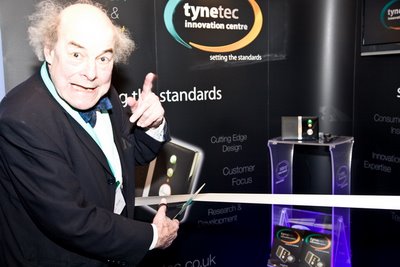
      Tynetec: The Tynetec stand has two new features. First, the Innovation Centre, which will be a feature at all future events they attend, where people will be able to see what developments are in the pipeline and give feedback. (A web-based version is due out in a few months.) The second is a working display of pre-production versions (in black and in white) of their yet-to-be-launched hub called ‘Reach’ and alert trigger called ‘Touch’. Production quantities are expected in early Spring. Both designs are the result of in-depth consultation with potential users. I stood by the stand for a while and people who saw them were genuinely taken aback by the good looks of the items which have the consumer wow factor that people have been asking for for so long. (Pictures on TA soon here now – Friday update.)


      Tynetec Reach (white version – in black, see below)


      Professor Heinz Wolff opening the Innovation Centre

      Also: Be one of the first to see the Reach and Touch demo video on YouTube: http://www.youtube.com/watch?v=Htly5du0oCQ (Gives you a good idea of why this was wowing the visitors.)

      Tunstall: Today Tunstall has quietly (!) dropped something of a handgrenade into the marketplace – they have announced that they will make the specification of their radio receiver and transmitter devices available – for a license fee, of course. This is a smart market-share-preserving move, made in response to pressure from Tunstall system customers that want to be able to use other manufacturers’ sensor devices. Tunstall press release (PDF) listing its other conference launch items, including a preview of the new MyAmie and PNC 6.2.

      STT Condigi: The second year exhibiting here for the Swedish company. Unfortunately, when I went past the bulk of their display material had not arrived.

      Burnside Telecom: The message from Burnside is that no landline or wireless network is actually reliable enough for life-critical monitoring but they are specialists in retrofitting devices into existing systems to increase the reliability by providing automatic fall-back connections. This is likely to be more effective and cost effective than replacing an old system.

      Fold Telecare and S3 Group: Nothing particularly new here, but they are reinforcing their presence as a major service provider in the Northern Ireland context.

      Coventry University: Here to publicise the assistive technology courses they offer, including work-based learning for staff that cannot be released to study full time. They have a Foundation Degree in Assistive Technology; a Masters in Assistive Technology, and an online Assistive Technology Learning Tool. Visit http://www.coventry.ac.uk/at for more information.

      Royal Society of Medicine (RSM): Making the point that it isn’t just for doctors but membership is open to other professionals individually or through their organisations. http://www.rsmmembership.org/

      Carers UK: The carers’ charity – here to put in a plea to suppliers to remember that the majority of people who could benefit from telecare do not have contact with statutory services and that direct marketing to them ‘ought’ to be on their agenda.

      CarelineUK: CarelineUK provided a sneak preview of the real time telehealth service that it is developing with partners CentriHealth, iMetrikus and Volt Delta. This will be a subscription-based service that brings together telecare and telehealth records for people with long term conditions and will enable multiple views of an individual’s health information for themselves, their carers, clinicians, primary care and social services, etc. Using this, CarelineUK aims to promote active involvement and personalisation of healthcare.

      Cirrus: The telecare and life safety integration company’s focus for the conference is to network with customers, existing and new, and to promote its reactive and planned telecare and fire maintenance services.

      Chubb: It is hoped that the just announced linkup between large Chubb and small, nimble Halliday James with its St Bernard GPS location system (first reported on TA from last year’s conference) will mean a more nimble Chubb. The system alerts carers by text message, email or through Chubb telecare, warden or nurse call systems using a new LocaLink remote trigger. Registered carers can ask for the user’s location via SMS and, where appropriate, it can be used as a simple emergency mobile phone enabling the carer to speak with the user. Chubb has also launched here a new ‘Secure Living Solution’ that combines telecare and fire monitoring and can work with a number of other suppliers’ systems. Press release (PDF) has details on both developments.

      Vidyo: [To follow]

      Tallon Monitoring: Tallon is showing its new telecare monitoring product range at the conference for the first time. The devices can be used to send data regularly for trend analysis and presentation to carers and relatives via a web page. The devices, such as one that counts the number of times a fridge door is opened, can also show the results to professionals while in the client’s home, thus minimising gateway and call centre expenditure.

      Eldercare: Stealing the show with its stand, independent telecare monitoring service Eldercare has created a room which has several thousand pounds’ worth of telecare kit embedded. But it is not easy to spot. So they have come up with a ‘spot the telecare’ competition. It’s a great, fresh approach that makes a serious point.


      Updated 23:30

      Honeywell HomMed: Launching a couple of things at the show – a new version of the monitor, the key feature of which is messaging from the monitoring clinician. The back-end Lifescan software has also had a substantial update, with better customised reporting. The other ‘launch’ is that Honeywell HomMed in the UK is no longer being run out of the US, but has a UK base in Leicestershire, indicating a degree of confidence in its prospects here.

      Questmark: A first time exhibitor at the TSA conference, videoconferencing specialists Questmark has a customer base of  NHS organisations and are now looking to expand into the market for connecting health providers with patients at home. They were demo-ing high quality internet-based conferencing that is as simple to set up as a phone call.

      Telehealth Solutions: In addition to the CardioPod, which has had the greatest amount of publicity lately, Telehealth Solutions has been taking a slightly sideways look at the market and is displaying its kit for doctors’ waiting rooms, where people can have a pre-appointment assessment, and it has another setup aimed at occupational health departments of large companies which will help them reduce sickness-related absence.

      BT/Intel Digital Health: BT is showing its telecare/telehealth management software that, like Tunstall’s icp, makes it easier to track and manage the workflows associated with installations – except that it is manufacturer agnostic.

      Solon Security: Solon is new to the exhibition, but it is an established security device wholesaler with many council and housing sector clients. New on the market (and not yet on their website see this web page) is a digital replacement for optical door viewers. On the outside of the door, where the ‘spy hole’ usually is, is a lens with the bell push and a PIR and when someone approaches, the digital camera-sized screen on the inside of the door clearly shows who it is. The clever twist is that stills or video is recorded automatically onto a memory card and can be used as evidence of who visited when, whether they are welcome callers or otherwise.

      Red Alert: Kent-based telecare installation and maintenance service provider, here to reinforce relationships with existing customers and expecting to attract new ones.

      Network Communications Systems (NCS): Door entry systems for housing providers and care homes, and a reseller of Tunstall call alarm systems.

      buddi: the buddi company is doing its tracking thing even more slickly these days and its trial helping the Maudsley locate absconding people with mental health problems has been an even better success than previously reported. UK readers can look out for a ramping up of its publicity efforts after Christmas.

      Alvolution: The product comparison site funded by the West Midlands Regional Development body. Previously mentioned in TA when launched, but interesting enough to have a closer look and an additional report when I’m back from the conference.

      Centre for Housing and Support: Training provider to housing provider organisations.

      Caretech: Swedish company Caretech AB, here reminding people of its CareIP digital care alarm system first shown here last year, but also showing off its new, small fall sensor.

      Age UK: Here to show that it’s business as usual despite the organisational upheavals it has been through lately.

      Pivotell: Have I grown, or have Pivotell’s medication dispensers shrunk in the past few years? I hope it is the latter and not that little white pill…Well, the main Pivotell news is that the company has become the UK distributor for the ‘Minifone’ phone. This is a wrist-worn DECT phone with a sensitive microphone and speakerphone facility. What this means is that an older person who is slow on their feet can answer their landline phone without rushing to answer it (as you do), and risking a fall. It also has a dialout emergency call function which can go to carers or to a monitoring centre. See this webpage

      Bosch: Today I discovered the answer to something that had puzzled me for a while, which is why Bosch hasn’t taken a more aggressive sales position in the UK. It seems that, recognising that there are significant changes in the technology due to bite in the next couple of years they are taking a long view and concentrating on helping services that already have their kit to make more, and more effective, use of it. And the reason they can afford to take that position is that Bosch is 90% owned by the charitable Robert Bosch Foundation, and investing in long term good is in its genes. (Which is why Bosch whitegoods have built the reputation they have for user- and environmental-friendliness.) I suspect that such a strategy might just pay off well in the long term.

      Just Checking: Has introduced here a more compact version of its kit – lighter for staff to take around, and less intrusive, but just as easy to install. It has also taken a step forward in extending to multi-user monitoring which is gaining particular interest in independent living facilities for people with learning disabilities owing to its ability to reduce the need for stay-over night staff which, in turn, is provoking further service redesign. (New website with more facilities coming next week, too.)

      Jontek: The message from Jontek is that it is pleased to see that services are starting, at last, to catch up with the idea that monitoring by mobile phone is a sensible and low-cost option for some people and they will be pleased to talk to any service that wants to extend its offerings in that direction.

      Novalarm: Novalarm, with its oddly named Umo monitoring system is the UK arm of Verklizan, which is big in this market in The Netherlands, Germany and other parts of Europe. It may be the novelty factor, but in the year since it first appeared at this conference Novalarm’s agnostic approach to sensor suppliers and flexible, cost-effective monitoring service arrangements has clearly won it a number of fans, including some big players. (Keep a look out on TA.)

      Possum: Has just started to become the UK supplier for the Swedish NEAT telecare kit. As one might expect from a company that works with many severely disabled people, it has chosen to promote a system with many fail-safe features.

      Philips: Still demo-ing its Motiva system and, like some of the other big companies, appears to be content to play for the long term, slowly extending its customer base and learning with them how best to introduce and implement telehealth monitoring while they develop new devices and systems behind the scenes.

      Grosvenor Telecom: Long established independent telecare kit installation and maintenence company covering Wales, West Midlands and North West England.

      Air Products: A first time exhibitor at this conference, and new to the telehealth field, Air Products main related business is the supply of gasses to patients at home. They have engineers and nurses and could work collaboratively with staff in the field, such as community matrons, because in many cases they are already in contact with them. A key feature is that the commissioner only pays for the service delivered – no capital outlay required.  

      Tribal: Not a new name to many parts of the NHS where Tribal provides services in a number of fields, but it’s a newcomer on the telehealth scene. However, expect to see more about them in the future as they are partnering with Intel/GE to provide one of the main ‘missing ingedients’ in the latter new company’s offering – help and guidance to the system users, both end users and professionals.


      Telecare Services Association 2010 Monday 15 Nov

      This report is brought to you with the support of the Telecare Services Association (accommodation) and Tynetec (travel)

      12.00: The conference is just opening – check back in a couple of hours!

      22:00 The aim of my reports is to give people who are unable to attend a flavor of the conference. Well, for context, with 800 people attending during the three days and over 40 companies exhibiting it is still big by UK standards. It is notable that the numbers are up despite these difficult financial times.

      The opening afternoon’s plenary sessions sent a clear message that telecare call monitoring services should be looking towards telehealth monitoring as a future business opportunity. The TSA is looking to appoint someone to focus on it, and Trevor Single, TSA CEO, announced that they are aiming to produce a Telehealth Code of Practice in 2011.

      Kevin McSorley from Fold Telecare in Northern Ireland gave an overview of developments during the past 15-years of the TSA and its preceding organisation. His conclusion was that 15 years is a long time for a quiet revolution…so now is the time to turn up the volume.

      He was robust on the need for large scale deployments that are not driven by one-off funding, but by the strength of their business cases. People involved in telecare were, he said, reluctant revolutionaries, but he left the audience with the challenging questions: “If not us, who? And if not now, when?”

      James Ferguson, professor of emergency medicine and clinical lead to the Scottish Centre for Telehealth (now part of NHS24) followed with wide-ranging examples of teleconferencing with patients in telemedicine, most of which have been covered in Telecare Aware. The main ‘takeaway’ was that in Scotland the aim is to have a national telehealth service that will focus on: people with strokes; COPD; paediatrics, and mental health. “The most difficult task” he said [speaking as a persuasive person who has experienced it], “is marketing to the organisation, not the patients.” He also added that in the future, healthcare professionals should start to feel nervous if first contact with a patient is not mediated by electronic triaging.

      Chris Crockford opened the throttle on further telehealth thinking with a presentation that explained his interest in remote health monitoring as a pilot, a mountaineer and the ex-Business Development Director for McLaren F1 where the scale and complexity of real time remote sensor monitoring already exceeds anything envisaged for health purposes. He then developed the theme of the read-across to technology that people actually want to use and/or find intrusive.

      He also provided the quote of the afternoon: “Age…appearing in a mirror near you soon”.

      The fourth speaker was Keith Nurcombe, Head of Healthcare for O2, whose three new telehealth projects had publicity recently. (TA item) What was significant about his presentation was that the emphasis was not on the technology despite O2 being part of the Telefonica group which employs over 1,000 people across Europe who are concentrating on developing new technologies. His emphasis was, instead, on listening to the needs of the potential users (“because that’s how O2 got to be so big in the UK so quickly”) in order to make the technology into the enabler and not the driver of developments.

      We learned an interesting snippet about O2’s three projects: the technology was apparently given to their NHS partners “before it was on the open market”, as a learning experience for the partners and for O2. He talked about the project in West Berkshire, where it was observed that people were staying in hospital after knee operations for days just so that they could be encouraged to do their exercises by a physiotherapist for about half an hour each day. Using technology to do the same checking and encouragement from home provides a much better outcome for everyone. [However, one can’t help but wonder whether, in the end, the need to sell services and products means that the ‘tell us what you need to do and we will work out how best to do it’ approach will turn out to be too vague to be marketable.]

      Thanks to the playful and rather provocative style of the Conference Chair Roy Lilley, the afternoon was rounded off with a lively discussion between the panel and audience members, some of whom seemed slightly stunned by the emphasis on telehealth and several of whom noted that disquiet about the design of most currently available kit had been expressed by a number of speakers. Perhaps, at last, the spell of ‘it saves lives, therefore is must be good’ has been broken.

      Tomorrow’s reports will concentrate on the exhibitors’ wares.