TTA’s Royal Visit Week: OpenEvidence goes dark in UK & EU, UK Biobank and Medtronic hacked, RapidSOS’s well-done docu-video, ‘fetching’ fundings, more!


Friday, 1 May 2026

This week saw King Charles III and Queen Camilla on our shores, from Washington to NYC to Virginia, before flying off to (hopefully) warmer Bermuda. Perhaps the pomp made for a quieter healthcare week. Perhaps the three most important stories were almost lost in the circumstance. “IT” clinical info app OpenEvidence stumbled over compliance with the EU AI Act–and chose to go dark in UK and EU. 500K UK Biobank records were hacked–by trusted Chinese researchers. Medtronic had what they depicted as a not-terribly-consequential breach of their corporate IT systems–we’ll see. A well-done docu-video on what happens when you call 911–and emergency services. Some fundings that ‘fetch’. And more!

Please feel free to comment on the articles and pass along this Alert. Let me know if this is worth it to you!

A quickie news roundup: ChatGPT for Clinicians unveiled, UHG to invest $1.5B in AI, Aidoc raises $150M, TriFetch raises $1.9M pre-seed, Boehringer Ingelheim & Eko Health partner on canine heart murmur detection

Breaking: OpenEvidence app access terminated in the UK and EU

(Updated) Medtronic reports corporate IT systems cyberattacked. 500K UK Biobank records breached in inside job. Are med device and research organizations the new hacker happy hunting ground?

‘Behind the Emergency’–a well-done presentation about and approach to a specialized healthcare market

Last Week

Weekend Must Read: The 10 point pattern of failure of healthcare tech companies

News roundup: (breaking) IKS Health finalizes TruBridge buy, Hims shares rise on independent Rx fills, Cala Health scores $50M, Joyful Health $22M, Tava Health $40M, actor Jeremy Renner partners with RapidSOS

Even famous doctors have their identity stolen: Dr. Eric Topol “authors” an apparently fake, AI-generated paper (This Editor’s investigation)

Teleprescriber Zealthy–and CEO Kyle Robertson–accused of asset fraud; DOJ moves to freeze assets and put company in receivership

Chutes & Ladders: Vendor protest filed against VA-OIT, Teladoc stock touted as ‘best buy’, Treehub ‘founder residency’ launches, AcuityMD raises $80M to near-$1B valuation

29th ISfTeH International Conference announced for 11-13 November in Germany–submit your proposal now!

Perspectives: What Healthcare Can Learn from Formula One About AI

 * * *
Advertise on Telehealth and Telecare Aware
Support not only a publication but also a well-informed international community.

Contact Editor Donna for more information.

Help Spread the News

Please tell your colleagues about this free news service and, if you have relevant information to share with the rest of the world, please let me know!

Donna Cusano, Editor In Chief
donna.cusano@telecareaware.com

Telehealth & Telecare Aware – covering news on latest developments in telecare, telehealth and eHealth, worldwide.

Breaking: OpenEvidence app access terminated in the UK and EU

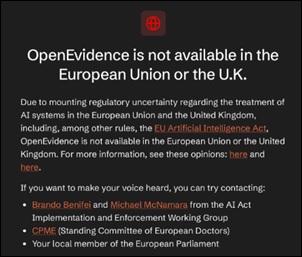
The hottest doctor reference source withdrew its medical evidence and decision support app from the UK and European markets. The news, reported in HIStalk on 28 April, is shocking–but not surprising. EU sources have predicted that this would be an outcome of the EU Artificial Intelligence Act. While the UK is not technically subject to EU regulation, the regulatory guidance to date has been along the EU Act’s lines; clearly a decision has been made not to enter the UK market accordingly.

The screen at left (courtesy of HIStalk) cites the ‘regulatory uncertainty regarding the treatment of AI systems’ and invites potential users to ‘make their voice heard’.

OpenEvidence is perceived by most to be the ‘up and coming’ platform for physician information. Its momentum was solidified with deals such as with Mount Sinai NY to integrate it within Epic [TTA 9 Apr], a $250 million Series D funding, and a monster valuation of $12 billion, making it the most valuable healthcare AI company in this solar system. It couples a free search engine trained on journals and clinical medical data only with an AI chatbot agent, making it easy to use for doctors. OpenEvidence partners with prestigious sources such as the New England Journal of Medicine and the American Medical Association.  It claims a daily average usage by 40% of US doctors in 10,000 hospitals and medical centers, achieving 18 million clinical consults in December alone. It recently added clinical trial matching to its capabilities, filtering trials by study design, enrollment status, and geographic proximity. To the US industry, OpenEvidence fills a gap in clinical intelligence that competitors Doximity (public), Epocrates (athenahealth), and Medscape (WebMD) have not to date, which certainly hurts the latter as tight pharma ad dollars reroute to OpenEvidence, as TTA has previously noted. 

The EU and UK constraint will likely not hurt OpenEvidence’s growth, but will hurt physicians in those countries by blocking a reliable source of information. It hits the NHS where it hurts, in its desires for technology advancement and integrating AI in practices. DistilledPost has a more UK-specific discussion of the consequences. Meanwhile, this Editor doubts that OpenEvidence will let this sit, and will eventually find a way towards compliance while growing outside of those markets, such as the Middle East and Asia. They have the resources, the name, and the growth. Hat tip to HIStalk. Letsdatascience

Epocrates ‘Bugs + Drugs’ infectious disease app inaccurate, should be pulled: reviewer

For clinicians who increasingly rely on major reference apps via smartphone and tablet, this sounds a loud cautionary note. This pharmacist’s detailed analysis of the errors and misinterpretation contained in the recently released and best-selling Epocrates reference app on the highly sensitive topic of infectious disease (including those that plague hospitals such as MRSA) culminates in a call to pull it from the Apple App Store. In several instances, the app pointed to the wrong antibiotic for an organism. The other faults are in using Athenahealth information to create what is called an antibiogram, “to identify what organisms are susceptible to what antibiotics in that locale”. The iMedicalApps analysis by Timothy Aungst, Pharm.D., professor at Massachusetts College of Pharmacy and Health Sciences has created quite a stir in the usual places. FierceMobileHealthcare covers this but decides to further blow up the balloon (or move off the point) in citing the IMS Institute for Healthcare Informatics and Journal of Cancer Education on the plain ineffectiveness and non-validation of the vast majority of healthcare apps–mainly consumer.

WebMD’s Avado acquisition and meaning (US)

Early-stage company Avado’s acquisition by content Goliath WebMD has rocked the small world of New York health tech, with both companies being located (or co-located) here. First is the acquisition price estimated by TechCrunch in the $20-30 million range. Co-founded by Dave Chase (whose Forbes articles we’ve occasionally commented on here), Avado developed its patient portal PRM (Patient Relationship Management) system, including direct messaging and the highly touted Blue Button, on relatively limited funding with a $1 million raise in March plus an earlier $300,000 from New York Digital Health Accelerator in addition to angel funding. Second, for WebMD, it is their first foray into anything that bridges from the patient to their physicians for messaging, reminders, and appointment scheduling. (more…)