A quickie news roundup: ChatGPT for Clinicians unveiled, UHG to invest $1.5B in AI, Aidoc raises $150M, TriFetch raises $1.9M pre-seed, Boehringer Ingelheim & Eko Health partner on canine heart murmur detection

Editor’s Note: Our thrice-weekly Alerts bring TTA stories to your mailbox. Generally Friday, Saturday (for weekenders) and Monday. Subscribe here if you’re not getting it! No spam, promotions, or list selling. And written 100% by a human–ask my fingers!)

ChatGPT moves from healthcare enterprises to the clinician level. This new version of OpenAI’s ChatGPT, ChatGPT for Clinicians, is designed to support clinical tasks like clinical search, documentation workflows, and deep medical research. It will be free for any verified physician, NP, PA, or pharmacist in the US, and is available now via their information page here. With its release, ChatGPT is also introducing HealthBench Professional, described as “an open benchmark for real clinician chat tasks across three use cases: care consult, writing and documentation, and medical research.” Release

ChatGPT for Healthcare was announced in January, but available to only a limited group of healthcare organizations.

UnitedHealth Group is having some better days. Last week on their earnings call, they announced that all units exceeded Q1 expectations. Their Q1 adjusted earnings per share (EPS) of $7.23 was well ahead of expectations, with total revenues of $111.7 billion, up 2% versus Q1 2025. Q1 membership fell slightly to 49.1 million from 49.8 million at the end of 2025. Their medical cost ratio (MCR) decreased to 83.9% from 84.8%, nearly a full point.

UHG is ‘on track’ to invest $1.5 billion in AI this year, especially at Optum with self-service digital scheduling that includes AI-enabled tools guiding patients “to the right appointment in the right setting at the right time”, plus increased digital access for members and providers with AI-enabled tools at UnitedHealth Care. 

UHG has been heavily criticized for its treatment of rural healthcare providers and hospitals. Timothy Noel, CEO of UnitedHealthcare Business, said that “We will accelerate payments in all lines of business by 50% for rural hospitals and exempt rural healthcare providers for most medical prior authorization requirements. And we are building network partnerships between rural providers and leading regional health systems.”  Let’s see if the good news stretches into Q2. Healthcare Finance News

Aidoc’s $150 million Series E brings their total funding to over $500 million. The AI-assisted clinical imaging system for radiology, cardiology, vascular and neurovascular healthcare teams is designed to help them find and triage injuries and other health conditions. It also integrates coordination software for stroke and cardiovascular care. The round for the NYC-based company was led by Growth Equity at Goldman Sachs Alternatives, with participation from General Catalyst, SoftBank Investment Advisors and NVentures (NVIDIA’s venture capital arm). The fresh funds will be used to grow global presence and expand into other clinical areas. FDA clearance for its AI triage tool was gained in January. Mobihealthnews, Release 

TriFetch has a healthy pre-seed round. A $1.9 million pre-seed these days is rather unusual but TriFetch, an AI automation platform built for independent specialty clinics just emerging from stealth, nabbed it from Nexus Venture Partners, with participation from angels with backgrounds at Google, Hippocratic, Mercor, and MIT. TriFetch’s platform automates three workflows that dominate clinic operating costs (the “tri”): patient calls and scheduling, referral processing, and prior authorizations. It’s led by UCLA graduate computer science PhDs  and researchers Varuni Sarwal and Rosemary He. So far results seem impressive, with their pilots at California ophthalmology, cardiology, and gastroenterology clinics with results that save time and money. In one GI practice, with staff processing up to 100 referrals per day, TriFetch handled that workflow end to end, freeing roughly 16 hours of staff time daily, saving the clinic $200,000 per year.  Pulse 2.0/release

And for those who fetch for us, a diagnostic for heart murmurs. Boehringer Ingelheim, the German pharmaceutical company with a specialty in animal health, and Eko Health, a ‘reimagined’ stethoscope for heart and lung disease, partnered to develop a device and app to detect, visualize, and grade heart murmurs in dogs. This combines BI’s CANINEBEAT AI diagnostic algorithm, the Eko Vet+ app, and the Eko CORE Digital Attachment that connects to most single-tube stethoscopes.  Canine heart murmurs and cardiac disease are difficult to detect in early stages, where diagnosis and treatment can be most helpful. Availability of the combined technology through both BI and Eko has started in the US and UK, with Germany up next month. Additional markets will be phased in during 2026 and 2027.  Release 
Breaking: OpenEvidence app access terminated in the UK and EU

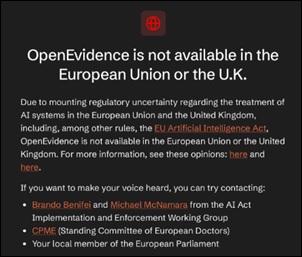
The hottest doctor reference source withdrew its medical evidence and decision support app from the UK and European markets. The news, reported in HIStalk on 28 April, is shocking–but not surprising. EU sources have predicted that this would be an outcome of the EU Artificial Intelligence Act. While the UK is not technically subject to EU regulation, the regulatory guidance to date has been along the EU Act’s lines; clearly a decision has been made not to enter the UK market accordingly.

The screen at left (courtesy of HIStalk) cites the ‘regulatory uncertainty regarding the treatment of AI systems’ and invites potential users to ‘make their voice heard’.

OpenEvidence is perceived by most to be the ‘up and coming’ platform for physician information. Its momentum was solidified with deals such as with Mount Sinai NY to integrate it within Epic [TTA 9 Apr], a $250 million Series D funding, and a monster valuation of $12 billion, making it the most valuable healthcare AI company in this solar system. It couples a free search engine trained on journals and clinical medical data only with an AI chatbot agent, making it easy to use for doctors. OpenEvidence partners with prestigious sources such as the New England Journal of Medicine and the American Medical Association.  It claims a daily average usage by 40% of US doctors in 10,000 hospitals and medical centers, achieving 18 million clinical consults in December alone. It recently added clinical trial matching to its capabilities, filtering trials by study design, enrollment status, and geographic proximity. To the US industry, OpenEvidence fills a gap in clinical intelligence that competitors Doximity (public), Epocrates (athenahealth), and Medscape (WebMD) have not to date, which certainly hurts the latter as tight pharma ad dollars reroute to OpenEvidence, as TTA has previously noted. 

The EU and UK constraint will likely not hurt OpenEvidence’s growth, but will hurt physicians in those countries by blocking a reliable source of information. It hits the NHS where it hurts, in its desires for technology advancement and integrating AI in practices. DistilledPost has a more UK-specific discussion of the consequences. Meanwhile, this Editor doubts that OpenEvidence will let this sit, and will eventually find a way towards compliance while growing outside of those markets, such as the Middle East and Asia. They have the resources, the name, and the growth. Hat tip to HIStalk. Letsdatascience

(Updated) Medtronic reports corporate IT systems cyberattacked. 500K UK Biobank records breached in inside job. Are med device and research organizations the new hacker happy hunting ground?

Medtronic’s cyberattack apparently contained. The company reported in a corporate statement on 24 April that an unauthorized party accessed data in certain Medtronic corporate IT systems. Medtronic has not identified, to date, any effects on, as specified: products, patient safety, patient needs, connections to customers, manufacturing and distribution operations, or financial reporting systems. They are determining any intrusion into patient information. According to their most recent SEC filings, Medtronic does not anticipate any effect on its business or financial needs.

The criminal hacker organization taking credit for it is the interestingly named ShinyHunters (what, not Shiny Stockings?) which claims it exfiltrated 9 million patient records with personally identifiable information (PII), 38 million records in total, as well as “terabytes” of internal corporate data. This immediately contradicts Medtronic’s anodyne corporate statement. However, the leak is no longer published on their dedicated leak website, according to Cybernews reported in TechRadar, which may indicate that some negotiations are going on. We’ll see if Medtronic will be changing their statement.

ShinyHunters is indulging in some chest beating, bragging on its leak website that they’ve stolen data from primarily consumer companies such as Zara, Carnival, 7-Eleven, Pitney Bowes, The Canada Life Assurance Company, and Hallmark. 

This fits a pattern of major healthcare hacking. Orthopedic medical device and robotics company Stryker was caught in a massive breach, wiping tens of thousands of systems and servers across the company’s network including applications such as Intune Company Portal, Teams, and VPN clients often used on personal devices. The perpetrator, Handala, is “linked to Iran’s Ministry of Intelligence and Security (MOIS) that targets Israeli organizations with destructive malware designed to wipe Windows and Linux devices.” This makes it political as a primary reason, economic secondary. [TTA 20 Mar]

Corporate IT is more vulnerable than production or patient-facing systems, according to Ensar Seker, chief information security officer at threat intelligence platform SOCRadar, quoted in MedCityNews. Corporate systems have high-value data but are less rigorously segmented and protected. MedTechDive

Another breach with international repercussions is that of UK Biobank. UK Biobank is a non-profit research database with information on 500,000 British citizens who volunteered their history and data. That data was found for sale on three separate listings on the Chinese e-commerce website Alibaba. Apparently no entity purchased the data. Unusually, the Chinese government assisted in the listings’ removal. (See below for the embarrassing reason why.)

Last Thursday (23 April), science minister Ian Murray told the House of Commons that the charity had informed the government about the data breach last Monday and thanked the Chinese government for assisting with the removal from Alibaba. Biobank has referred itself to the Information Commissioner’s Office. The hacker is not identified.

Dame Chi Onwurah, the Labor chair of the science, innovation and technology committee, scored her own Government, saying that it was “another blow to public confidence”, adding that it showed “little progress had been made” in protecting public data. Mr. Murray had assured her back in February that standards of public sector information security and data hygiene would improve.

The subjects joined the study over four years, 2006-2010, and at that time were between 40 and 69 years old. The information could include gender, age, month and year of birth, socioeconomic status, lifestyle habits, and measures from biological samples. The deidentified  information did not include names, addresses or contact details but what was included–genome sequences, hospital diagnoses, and biological measures–could be cross referenced and re-identified in experts’ view.

According to the Independent (via Yahoo UK), UK Biobank is the world’s most comprehensive dataset of biological, health and lifestyle information. It is used internationally and has been used to achieve improvements in the detection and treatment of dementia, cancers and Parkinson’s. DataBreaches.net

Update: the breach was apparently an Inside Job. The data was leaked dozens of times via GitHub. Three Chinese research institutions with legitimate access violated their data-sharing agreements. FTA: “It was not a hack. It was a contract violation by trusted researchers, and that distinction makes it worse, not better, because it exposes a vulnerability that no firewall can fix: the entire model of open research data sharing assumes that everyone who receives the data will follow the rules.” TheNextWeb

‘Behind the Emergency’–a well-done presentation about and approach to a specialized healthcare market

This is a follow up–and a short review–of last week’s mention of RapidSOS’s premiere of their ‘Behind the Emergency’ video. Your Editor viewed this today, along with most of the panel discussion following, which was aired as part of RapidSOS’ Innovation Day in Reno, Nevada. I have an interest in emergency services and first responders, having delved into their complex world during my time as the marketing director of the (now-defunct) Viterion Digital Health, and with a friend who is former EMS. Otherwise, I have zero connection to RapidSOS.

Being the cynical marketer and writer I am, I expected something more salesy, more commercial, more pitchy. This mercifully was not. It was informative. It used actor and endorser Jeremy Renner, plus testimonies from emergency service dispatchers and first responders, in a professional, low-key, and semi-documentary fashion. It was a video with real production values, increasingly a rarity. Not selling their AI assisted platform–the name wasn’t even mentioned–but in the circumstances of what public safety is, the people, what they do, and what they face, such as responding to emergencies in the rural backcountry of Nevada. Time is everything. It was about the problems they face and what emergency services need to be more effective. 

Why Mr. Renner? He was in a horrible accident in a snowcat three years in that backcountry, and became interested in emergency response as a result. While the benefit was clear–tech cuts the time for 911 public safety centers’ dispatchers and responders to coordinate multiple resources needed to respond to a call, and RapidSOS has the AI tech to connect the pieces more seamlessly and faster–it didn’t bang you over the head with The Brand or The Product even at the end. It may have been a 12 minute commercial, but it was a damn good one and a rare one today. You can view it here.

I also stuck around for part of the live panel that was with the CEO, Reno’s mayor Hillary Scheive, Reno’s director of public safety Cody Shadle, retired firefighter and founder of eFireX Jesse Corletto, and chaired by a company executive whose name I did not catch. It was again about the emergencies they typically face in both the city, the pressure on dispatchers in handling multiple situations, and more rural environments in Washoe County and how coordinating their resources over a large area is a huge challenge. Every connection made better saves time and is “good AI”. Drones, for instance, can get to a scene faster and feed data back to dispatchers as they coordinate, and responders as they are arriving.

A company that is beneficially using AI for the public, and an interesting, low-key exposition on how one company is integrating it into its services.

Editor’s note 1 May: Of interest to marketers re strategy is that the preview clip (on the website) is also being run as a RapidSOS commercial on streaming service Pluto. The spot closes with the logo and a link on a black screen. I suspect there are buys elsewhere.

Weekend Must Read: The 10 point pattern of failure of healthcare tech companies

This says it all for startups and early stage companies in the healthcare tech field. We feature today Haverin Consulting’s Stuart Miller, continuing his analysis of the signs that a health tech company, no matter how hot it may seem, is on its way to failure. All four, from startup to spinoff, were name companies that at one point were valued at over $3 to over $4 billion. All failed to deliver their main value propositions while having excellent ‘cover’ for a time. All were either parted out (assets sold) or were total hull losses.

Mr. Miller has drawn out 10 factors from the success, then failure of four companies: Olive AI, IBM Watson Health, Carbon Health, and Babylon Health–this last, one that TTA chronicled as far back as 2014, through the palmy Matt Hancock days, their questionable SPAC, and right to their near-complete dissolution. Back in February, we featured his article analyzing the Carbon Health failure. But all four have been profiled in impressive deep dives, available for subscribers on his Substack account. He does feature extensive free material and definitely is worth the follow.

This is not a long cuppa but very much worth your time and pondering. All This Has Happened Before

TTA’s Spring Fever 2: finding fraud with a fake Topol article, at Zealthy; IKS to buy TruBridge; healthy deals for Cala, Joyful, Tava, AcuityMD; Treehub’s new model; ISfTeH calls for proposals, more!


Friday 23 April 2026

This week made up for last week with plenty of activity, deals–and fraud like Dr. Eric Topol finding his name on an open access article that was not only NOT written by him but also published in a fake journal! The DOJ continues to hammer at fraud in teleprescribing, pursuing Zealthy and CEO Robertson. Fundings livelied up with TruBridge RCM agreeing to the IKS Health buy, Cala Health, Joyful Health, Tava Health, and AcuityMD. Treehub debuts a new startup support model. ISfTeH is back with its 29th annual meeting and calling for presentations. Our Perspectives guest article draws analogies between clinical dashboards and Formula 1 car cockpits. 

Please feel free to comment on the articles and pass along this Alert. Let me know if this is worth it to you!

News roundup: (breaking) IKS Health finalizes TruBridge buy, Hims shares rise on independent Rx fills, Cala Health scores $50M, Joyful Health $22M, Tava Health $40M, actor Jeremy Renner partners with RapidSOS

Even famous doctors have their identity stolen: Dr. Eric Topol “authors” an apparently fake, AI-generated paper (This Editor’s investigation)

Teleprescriber Zealthy–and CEO Kyle Robertson–accused of asset fraud; DOJ moves to freeze assets and put company in receivership

Chutes & Ladders: Vendor protest filed against VA-OIT, Teladoc stock touted as ‘best buy’, Treehub ‘founder residency’ launches, AcuityMD raises $80M to near-$1B valuation

29th ISfTeH International Conference announced for 11-13 November in Germany–submit your proposal now!

Perspectives: What Healthcare Can Learn from Formula One About AI

Over the last two weeks, the deals and controversies….

Chutes & Ladders: Click Therapeutics raises $50M, lays off 27%; India’s IKS Health in talks to buy TruBridge for over $600M; TELCOR buys Sample for RCM expansion

VA’s Oracle EHR resumes go-lives at four Michigan systems–finally

Two weekend ‘must reads’: the New Yorker’s Sam Altman/OpenAI exposé–and comments; a further deep dive into Carbon Health’s implosion

Perspectives: Exploring the Telehealth Extension: Building Infrastructures for Better Access

Funding/deal roundup: WHOOP’s $575M Giant raise, Anthropic buys med AI startup for $400M, early stage fundings for Jimini, Insight Health; Noom buys compounder; Mount Sinai NY to embed OpenEvidence

NY Times’ highly questionable but glowing–and viral–portrait of AI-created GLP-1 e-prescriber and marketer Medvi

Former VA EHRM executive director Federally charged with accepting vendor cash and gifts, making false statements

 * * *
Advertise on Telehealth and Telecare Aware
Support not only a publication but also a well-informed international community.

Contact Editor Donna for more information.

Help Spread the News

Please tell your colleagues about this free news service and, if you have relevant information to share with the rest of the world, please let me know!

Donna Cusano, Editor In Chief
donna.cusano@telecareaware.com

Telehealth & Telecare Aware – covering news on latest developments in telecare, telehealth and eHealth, worldwide.

News roundup: (breaking) IKS Health finalizes TruBridge buy, Hims shares rise on independent Rx fills, Cala Health scores $50M, Joyful Health $22M, Tava Health $40M, actor Jeremy Renner partners with RapidSOS

Breaking: IKS Health finalized their acquisition agreement with TruBridge, Inc. Today’s (23 Apr) announcement did not contain an acquisition price, but IKS is offering shareholders $26.25 per share, a small premium above today’s close at $25.27. Both are revenue cycle management (RCM) companies and will strengthen capabilities in the rural and community hospital markets. Since TruBridge is publicly traded on Nasdaq with 14.91 million shares outstanding, the deal is a minimum of $391.4 million, considerably less than the rumored $675 million [TTA 15 Apr]. TruBridge’s largest shareholders (27%) have agreed to terms, but it is subject to the usual regulatory reviews with an expected closing in Q3. Otherwise, the press release is short on details, but IKS will finance the TruBridge buy with debt financed by Citibank, JP Morgan Chase, and Deutsche Bank.

The unstoppable Hims & Hers notches another rise with wider GLP-1 med access. Hims announced a deal with Eli Lilly to fulfill Zepbound prescriptions via Lilly Direct. It also permits its providers to prescribe medications that are fulfilled by independent pharmacies, which essentially opens Hims up to all GLP-1 drugs, with restrictions of course.

Once largely wedded to compounded weight loss drugs, to the point of running commercials on 2025’s Super Bowl that their obesity drugs are priced “for profits, not patients”, Hims & Hers has flipped the script in less than a year to be the online prescriber of nearly all brand name weight loss drugs. This started about five months after the Super Bowl when FDA finalized the ban on compounding those drugs. Pretty soon Hims was inking deals, starting with Novo Nordisk in May 2025 to prescribe Wegovy and fulfill through NovoCare Pharmacy. In March, they settled their long-running legal tiff with Novo when they agreed to drop their just-debuted compounded pill to sell Novo’s Wegovy and Ozempic in both pill and injectable versions.  (The newest Lilly weight loss med, Foundayo, is only available DTC from them and commercial insurance/cash pay only.) Hims is up to $28/share. Sherwood News

News of raises for some interesting companies came thick and fast the latter part of the week

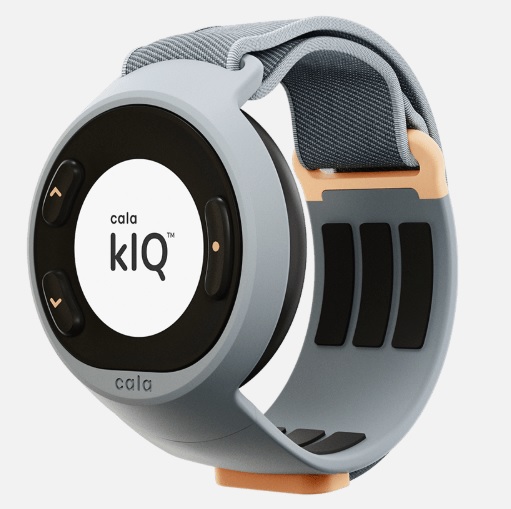
Wearable neuromodulator developer Cala Health gained $50 million in an unlettered raise. Unusually, it had a sole funder, Trinity Capital. Cala has developed the only FDA-cleared 510(k) wearable for action hand tremor in people with essential tremor and Parkinson’s disease. The funding will be used to scale commercial distribution and product development. The kIQ device uses transcutaneous afferent patterned stimulation (TAPS), which reduces hand tremors by measuring a patient’s tremor pattern and delivering individualized nerve stimulation. Prior rounds were in 2024 ($50 million), $77 million in 2021, and a $55 million Series B in 2019. Trinity Capital release, Mobihealthnews

Joyful Health, a financial operating system for providers, raised a $17 million Series A for a total of $22 million. It is designed as a claims denial intelligence and recovery infrastructure to work within an existing revenue cycle management system and connect claims data. The round was led by CRV with participation from seed investors XYZ Venture Capital, Designer Fund, Inflect Capital (the healthcare investment arm of Vituity, the largest physician-owned partnership in the United States), and Go Global Ventures (led by Commure founder Diede van Lamoen). Providers lose over $125 billion annually in lost revenue from unpaid or denied claims.  Joyful Health blog, Yahoo Finance

Back in the popular stomping grounds of telemental health, Tava Health raised a $40 million Series C. Tava, based in Salt Lake City, markets a  behavioral health platform to providers, employers, and health plans. It also announced three new products: Symphony for providers, TavaCare for the employer market, and Tava Guide for health plans, health systems, and care coordinators. Approximately 5,000 mental health providers are a part of the Tava Health network. Investors were led by Centana Growth Partners with participation from Catalyst Investors, Blue Heron Ventures, Peterson Ventures, and Springtide Ventures. Tava has raised $73 million since 2020 with its last raise in 2024. Yahoo Finance (release), Behavioral Health Business, Mobihealthnews

And an interesting partnership

Popular actor Jeremy Renner is partnering with public safety and first responder platform RapidSOS NYC (!)-based RapidSOS originally specialized in the technical aspects of public 911 systems and then developed integrations to link data from over 350 million connected devices, apps, and sensors directly to 911 centers and first responders. Increasingly, these integrations are AI-powered and even incorporate drones. Mr. Renner relates very well to first responders, having his own near-death experience on New Year’s Day 2023 where his snowcat machine rolled over and crushed him, breaking 38 bones along with blunt chest trauma. He is the focus of a 30-second documentary leading up to next Wednesday’s (29 April) premiere of Behind the Emergency. He is not only helping to tell their development story from his experience, but also as a partner plus investor. Mobihealthnews 

Even famous doctors have their identity stolen: Dr. Eric Topol “authors” an apparently fake, AI-generated paper

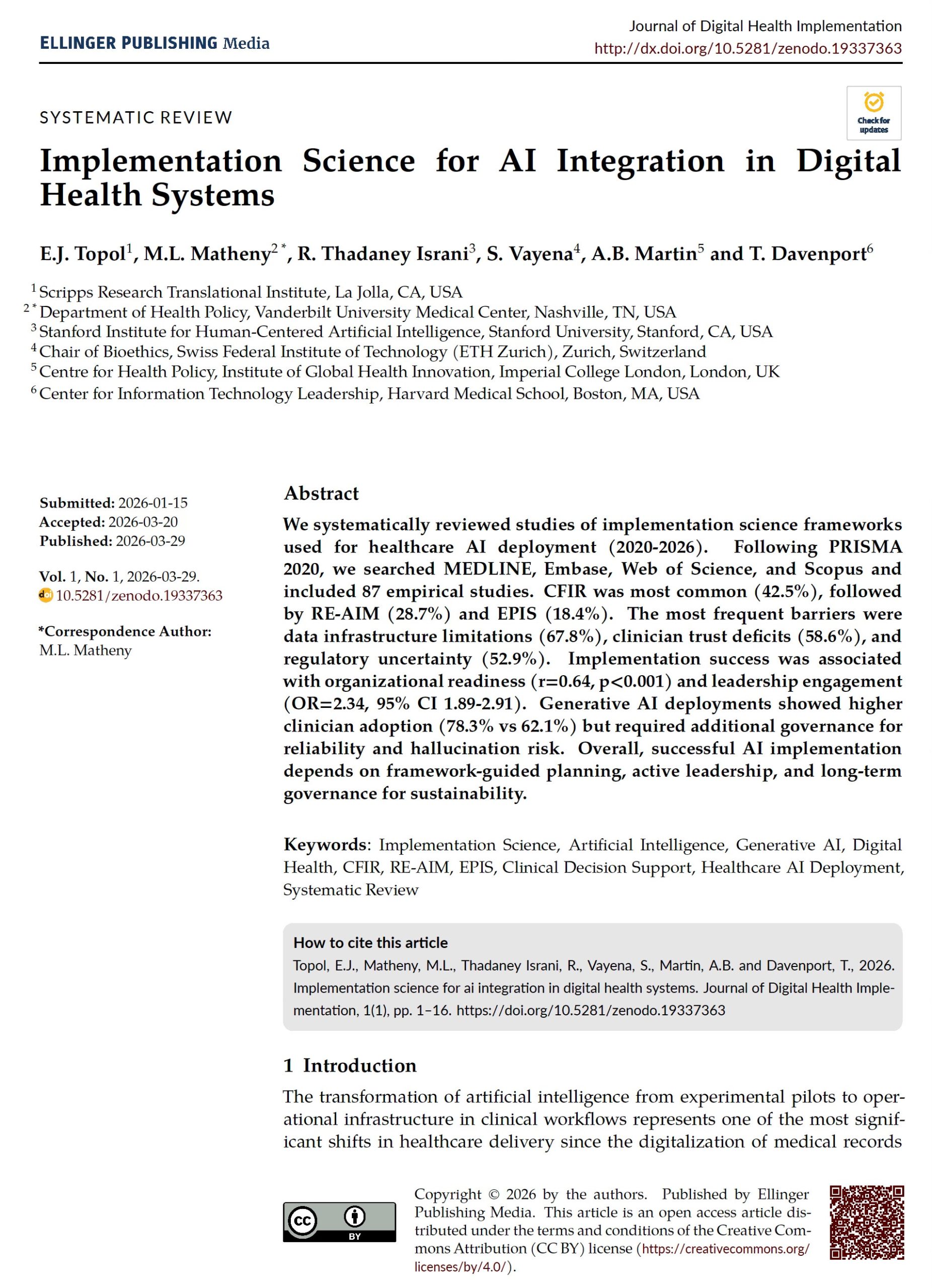
And now, it’s author names on research papers being spoofed. Eric Topol, MD, the noted physician, cardiologist, health tech maven, and director/founder of the Scripps Research Translational Institute, just experienced Grand Theft Auto on his identity. He was listed as the lead author of a paper entitled “Implementation Science for AI Integration in Digital Health Systems”, along with five other author/contributors. It was published in the “Journal of Digital Health Implementation” by Ellinger Publishing Media on 29 March.

Except, as Dr. Topol wrote in a post on his Substack blog, Ground Truths“, he never wrote it.

From his post along with a screenshot of the ‘paper’ and a link:

“This is a FRAUDULENT paper, AI-generated. My name was used as an author and I had nothing to do with it, never saw it until today

The “Editors” Angelo Rossi Mori, David Mensah, and Zarnie Khadjesari and this “Journal” should be reported.”

Substack readers are often commenters, and your Editor is no exception. So she did some digging and commented on Dr. Topol’s post [Editor’s further notes in brackets]:

Dr. Topol, the link on your post [he provided a link to the publication] is not only going nowhere (to blank screen/’this site can’t be reached”), but also trying to reach the e-PubMed.co.uk site by entering it directly goes to the same screen. When I searched under Ellinger Publishing in Google and the same URL came to the top under them [see screenshot right below], the link equally does not work. The UK E-PubMed Central is now Europe PMC concentrating on UK/EU research and partners with the US NIH PubMed site on certain papers, from what I have read online.

Gemini came up with this about Ellinger: “Ellinger Publishing Media: An independent academic publisher specializing in open-access journals, specifically focusing on artificial intelligence, medicine, social sciences, and interdisciplinary research.” Again, links in the AI summary to e-pubmed.co.uk do not work. My conclusion is that this is a total spoof/hack using a URL similar to the former UK E-PubMed and this Ellinger Publishing is a fraud. I don’t know how you picked it up but it’s no longer reachable.

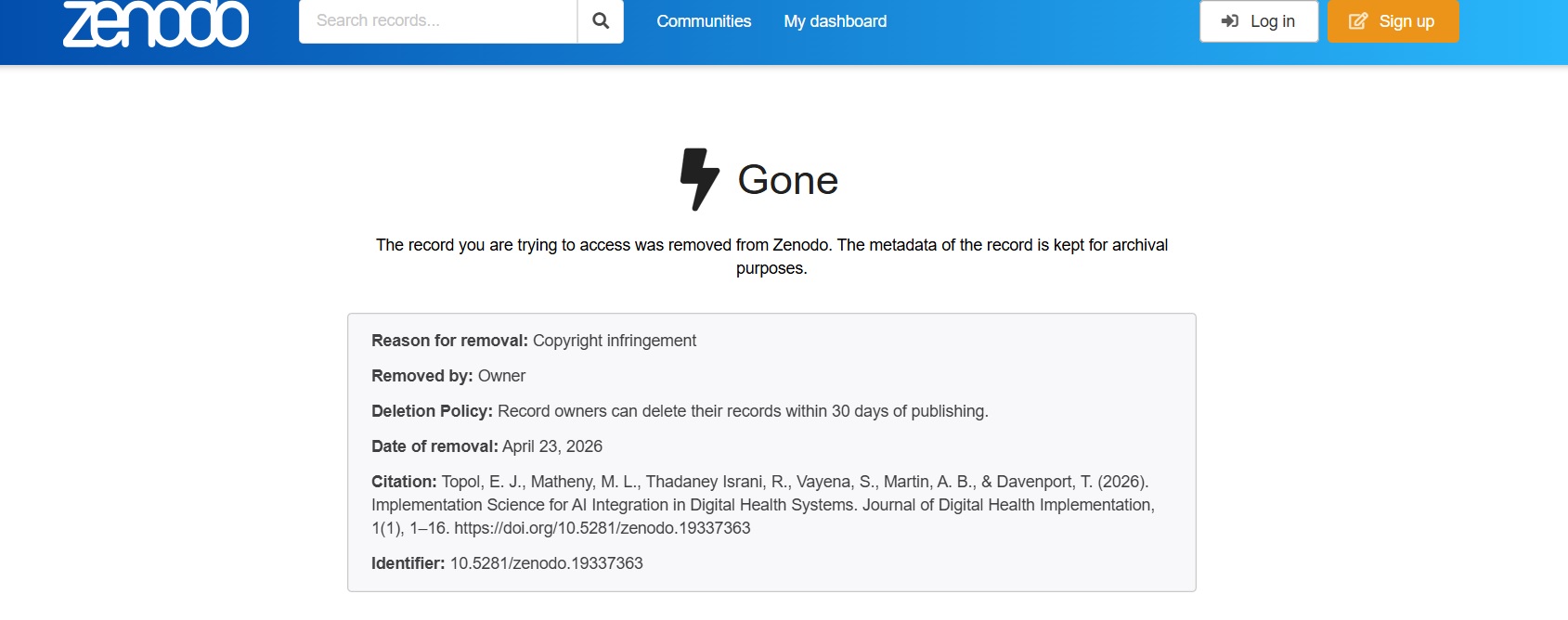
But, as they say on direct response TV…there’s more. I replied to my own comment,The paper has a link [that goes to another website], Zenodo. It says clearly that it has been withdrawn from there too. Reason for removal—copyright infringement.”

https://zenodo.org/records/19337363

So what happened? Its withdrawal is as mysterious as its appearance.

At this point, we can draw only certain conclusions.

When research papers, apparently AI-generated, are being fraudulently posted with names as prominent as Dr. Eric Topol’s plus five other authors (who may or may not be real–have not checked), for content that is clearly academic-appearing (apparently a meta-analysis), anyone who publishes or has a public persona is in trouble. Big trouble. And with little defense against this happening.

But even worse, unless the Ellinger Publishing Media site itself has been hacked, this may well be a fraudulent publisher claiming open access journal status.

  • My prompt on Gemini, FWIW, indicates that Ellinger Publishing is a ‘vanity press’ for books, not a journal publisher; read for yourself here. So Gemini contradicted itself when asked the prompt differently.
  • The journal is fake as well. A search on Google on the name gives you a link to a website called Conference.Researchbib.com, but when you click on the link for the journal, it goes to the same E-PubMed UK ‘this site can’t be reached’ URL as above.

Open access journals per se are controversial enough since they exist to publish non-peer reviewed materials. For studies in progress, this is valid as a platform for further discussion and research. But it doesn’t and cannot carry the weight, the rigor of peer review. We all know that less than rigorous studies used by less than scrupulous companies have leveraged open access journals for sales/survival proof purposes.

Fraudulent open access journals on mysterious websites that spoof the names of once-authentic journal websites just take it one step further. One wonders how long has this been going on.

This Editor invites Readers to give their perspective on this matter.

Teleprescriber Zealthy–and CEO Kyle Robertson–accused of asset fraud; DOJ moves to freeze assets and put company in receivership

A two-year+ story about teleprescriber illegalities that isn’t getting near enough attention. The Cerebral saga is far from over. Telehealth prescriber Zealthy, founded by former Cerebral CEO Kyle Robertson, is in deepening ‘hot water’ with the Department of Justice. The DOJ filed a motion last week in Federal Court seeking an immediate asset freeze and receivership for Zealthy. This is to stop what the DOJ called a “runaway campaign of lawbreaking” by both Robertson and Zealthy, “which is actively deceiving telehealth patients, endangering their safety, and raiding their bank accounts.” The asset freeze and receivership is being requested by DOJ because Zealthy’s liquidity is marginal at best.

Zealthy sells weight loss, birth control, ED, hair loss, mental health, and other prescription medications online. The DOJ is citing them for using the names and licenses of doctors who didn’t work there to fill thousands of prescriptions without the physicians’ knowledge or clinical supervision. The amended DOJ complaint states that both Zealthy and Kyle Robertson engaged in “systemic improper and dangerous telemedical practices,” including “the routine ordering of prescriptions by foreign call-center contractors and other non-clinicians with no medical license and the systemic misuse of the name and National Provider Identifier (NPI) number of doctors to order many thousands of prescriptions for patients they did not actually treat or order a prescription for, and without their knowledge or clinical supervision—and even when they have not even been employed by Zealthy.” Reportedly, the stolen identity of one doctor was used to write 8,000 prescriptions.

Zealthy lost its medical merchant certification from credentialing organization LegitScript in 2025 after it failed to disclose the DOJ litigation. Ad platforms and payment processors dropped Zealthy, which then created shell companies to get around this. Company executives also used credit cards to buy their own subscriptions, diluting the rate of consumer credit card chargebacks to improve their transaction dispute rates, a move to make them look better for their bankers and lenders.

This is part of the ongoing Federal lawsuit that started in June 2024 around deceptive practices that violated distribution of controlled substances, the FTC Act and Restore Online Shoppers’ Confidence Act (ROSCA). It mainly covered activities during the pandemic. Companies named in the original complaint were Cerebral, Zealthy (renamed Gronk Inc), Bruno Health PA, and also named executives Kyle Robertson, former Cerebral executive Alex Martelli, and executive German Echeverry. The DOJ settled the controlled substances distribution charges against Cerebral in late 2024 [TTA 8 Nov 2024] but not the charges against Mr. Robertson, who departed Cerebral in May 2022 at the start of the company’s DOJ and DEA problems. The amended complaint called out Kyle Robertson specifically: “Robertson’s lawbreaking is only becoming more brazen, and dangerous.” One wonders if Mr. Robertson is considering residences in low extradition countries. Sherwood News, FierceHealthcare, HealthExec, HIStalk

Chutes & Ladders: Vendor protest filed against VA-OIT, Teladoc stock touted as ‘best buy’, Treehub ‘founder residency’ launches, AcuityMD raises $80M to near-$1B valuation

This one’s a puzzlement. This Editor was ‘tipped off’ to a bid protest filed against the Department of Veterans Affairs (VA), specifically against the Office of Information Technology (OIT) Industry Day that took place on 27 March. It was found on the Government Accountability Office (GAO) website, filed on 17 April by The Gilchrist Law Firm, PA on behalf of an undisclosed vendor, under the solicitation number for the OIT Industry Day. The update from the source, Orange Slices, a government contract (GovCon) news site, stated that “the vendor” (whoever enters the info into GAO) “made a mistake in their entry to GAO and it has nothing to do with the industry day…” It has still not been fixed on the GAO website on the bid protest page.

Run out and buy TDOC stock! That’s the advice from “Insider Monkey” publishing on Yahoo Finance. In fact the Monkey rates Teladoc “among the best medical AI stocks to buy now”. The article is an overview of the Pineal Capital Management call for $200 million in share buybacks, breaking up the Integrated Care and BetterHelp businesses, and other shareholder friendly cash-generating ‘reforms’ [TTA 3 April]. Teladoc’s 2026 revenue forecast under CEO Chuck DaVita is essentially flat–$2.47 to $2.59 billion versus 2025’s $2.53 billion. This Editor noted a small rise in the stock price in the past month of about 70 cents. There may be some drama around the Q1 earnings report which will be issued next Wednesday (29 April). 

The interestingly named Treehub launches out of Stanford University. It’s designed to bridge the gap between the extreme early stage of a developing healthcare idea or technology, usually out of an academic lab, to where the formed company is fundable. It seems to be a combination of a healthcare tech scout, a venture studio with hands-on support, and an incubator community, with the capital of a venture fund. The Los Altos-based residency program is funded via the AI Health Fund and has some heavyweight names attached to it: Mary Minno, herself a former venture-backed founder now at Google, a brace of Stanford professors, Derek Minno of Point Capital, and two Wojcickis: Anne Wojcicki, founder of 23andMe, as Operating Partner and her mother, Esther Wojcicki, as a Founding Advisor. One wonders how Anne Wojcicki is faring in rebuilding 23andMe’s business and the 23andMe Research Institute; certainly they haven’t been shy about new products such as add-ins of African genetic groups, reconstructing ancestors’ DNA, and genetic predictors for GLP-1 effectiveness (press release list). Treehub release, Mobihealthnews interview with Ms. Minno and Esther Wojcicki, ‘the godmother of Silicon Valley’.

Raises this week so far have been slim. Medical commercial intelligence platform AcuityMD announced a raise of $80 million in a Series C led by existing investor StepStone Group, with additional participation from Benchmark, Redpoint Ventures, ICONIQ, and Atreides Management. Previous investment was $76 million. The company’s valuation is nearing the $1 billion mark at $955 million. AcuityMD’s platform helps medtech companies towards commercial insights that are typically scattered across claims databases, FDA filings, government records, and market signals. The fresh funding will be used to accelerate platform capabilities via AI. The company claims as customers 16 of the top 20 medtech companies and helping to identify $34 billion in pipeline. Release, Mobihealthnews

29th ISfTeH International Conference announced for 11-13 November in Germany–submit your proposal now!

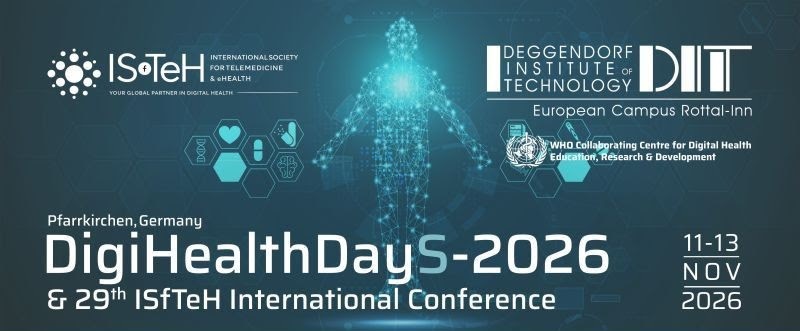
Save the dates, be a speaker, and book the tickets! One of the oldest international organizations in digital health, ISfTeH (the International Society for Telemedicine & eHealth) is meeting again for the 29th year. This year’s host will be member organization Deggendorf Institute of Technology (DIT) at their European Campus Rottal-Inn (ECRI). The ISfTeH meeting will be in conjunction with DIT’s annual DigiHealthDay (DHD) conference in Pfarrkirchen, Germany, 11-13 November.

The DHD Conference is a global forum for education, research, innovation, and networking in digital health, presented under the theme “Global Digital Health – today, tomorrow, and beyond.” The annual DHD conference is a culmination of DIT’s series of onsite and online events throughout the year, all centered on the question “How are digital technologies transforming health and care around the world?” 

The ISfTeH track at the event invites proposal submissions from members. If you are interested in presenting your work on current research or practical experience, submit it at https://forms.gle/hMH9NtjHUgDhK68S6 by Monday 4 May 2026. Questions? Email info@isfteh.org.

Perspectives: What Healthcare Can Learn from Formula One About AI

TTA has an open invitation to industry leaders to contribute to our Perspectives non-promotional opinion and thought leadership area. We welcome back Iris Telehealth for today’s topic on how telehealth and clinical dashboards should be like modern Formula 1 race cars’–displaying the relevant information for that patient visit and increasing clinician presence versus being overwhelmed by data and documentation load. The author, David Bartley, is Iris Telehealth’s Chief Solutions Officer, with over 20 years of experience leading healthcare product strategy across payers, providers, and population health organizations including MedeAnalytics, Cotivi (formerly Verisk Health), eviCore, Healthways and Humana.

Behavioral health organizations are already absorbing a level of administrative pressure that has nothing to do with clinical care. I’ve spoken with CEOs of rural mental health clinics who are deciding between keeping a clinician on staff and sustaining the administrative infrastructure required to stay compliant.

One told me he had seven people on staff doing nothing but collecting state reporting data — compliance work that consumed payroll he would rather put toward clinical capacity. That tradeoff is exactly what funding pressure forces, and it is where AI can do something genuinely useful: absorbing the administrative work so that the next available dollar goes toward a clinician, not a spreadsheet.

What’s keeping organizations from achieving this reality with AI? Well, most of the industry is measuring AI’s value primarily through operational metrics, like how many more patients a provider can see, how fast documentation gets processed, or how lean an operation can run. Those are important operational metrics — but on their own, they don’t tell us whether care actually improved.

The organizations that figure out how to use AI to deepen the quality of each encounter, rather than multiply the number of them, will move care forward.

Leading health systems are already building toward it. At Mayo Clinic, for example, investments in integrated, AI-enabled platforms are helping bring together multimodal clinical data and advanced analytics in ways that surface the most relevant insights at the moment of care. It’s a signal that the industry is moving beyond AI as an efficiency tool and toward AI as a clinical intelligence layer.

Surfacing what matters, exactly when it matters

When I think about what AI should look like inside a clinical encounter, I keep coming back to Formula One. A driver at race speed does not receive every data point the car is generating. They get tire temps, oil pressure, wind shear — the six or seven variables that matter most in that exact moment, surfaced at eye level in what is known as a heads-up display, so they can keep their focus on the track.

A telehealth dashboard should work the same way. Data like relevant patient history, active risk factors and behavioral signals worth exploring, all fixed at the top of the screen. Something buried in a clinical note from two years ago that has not been relevant for months could resurface the moment the conversation makes it useful again.  The goal of AI in behavioral health should not be to simply accelerate care delivery but to increase the signal-to-noise ratio inside each clinical moment.

The provider never has to look away from the patient to find it, and the patient never loses the sense that the person on the other side of the screen is fully present. In behavioral health especially, where the therapeutic relationship is the mechanism of care, the quality of that connection often determines whether treatment actually works.

The value of presence

A JAMA Network study published in October 2025, with data collected in 2024, on ambient AI scribes found that documentation load directly erodes the attention providers can bring to each encounter. Clearing that load only to fill the time with more appointments trades one problem for another.

Providers need time between encounters to process what they heard, notice what did not get said and carry genuine context into the next conversation. That kind of reflection is where clinical judgment actually develops and is exactly what gets squeezed out when efficiency becomes the primary design constraint.

Patients who feel that a provider is fully present are more likely to disclose accurately, follow through on treatment, and stay engaged over time. AI designed around that outcome becomes a powerful tool that actually earns its place in the workflow.

Formula One teams do not build heads-up displays to increase the number of races a driver competes in. They build them to make each race winnable. The industry would do well to borrow that distinction.

TTA’s Spring Fever: VA resumes Oracle EHR rollout, Click clicks on $50M, 27% layoff, IKS Health may buy TruBridge, and TELCOR’s tuck-in of Sample.


17 April 2026

The last couple of weeks must have exhausted everyone, because this week is downright sleepy. As scheduled, VA finally resumed its Oracle Health EHR rollout with four health systems in Michigan–the first since 2022. Nine more to come if these go well. For companies, spring fever deals were absent. Digital schizophrenia adjunct treatment Click Therapeutics raised both $50 million to move to commercialization, then pink slipped 27% of current staff. TELCOR tucked in Sample to bolster AI  in the RCM area. Pending in RCM, IKS Health may be making a $600 million offer for TruBridge–but that hasn’t been finalized. Yet.

Please feel free to comment on the articles and pass along this Alert. Let me know if this is worth it to you!

Chutes & Ladders: Click Therapeutics raises $50M, lays off 27%; India’s IKS Health in talks to buy TruBridge for over $600M; TELCOR buys Sample for RCM expansion

VA’s Oracle EHR resumes go-lives at four Michigan systems–finally

Last week, though, was fairly stupendous, including an indictment…

Two weekend ‘must reads’: the New Yorker’s Sam Altman/OpenAI exposé–and comments; a further deep dive into Carbon Health’s implosion

Perspectives: Exploring the Telehealth Extension: Building Infrastructures for Better Access

Funding/deal roundup: WHOOP’s $575M Giant raise, Anthropic buys med AI startup for $400M, early stage fundings for Jimini, Insight Health; Noom buys compounder; Mount Sinai NY to embed OpenEvidence

NY Times’ highly questionable but glowing–and viral–portrait of AI-created GLP-1 e-prescriber and marketer Medvi

Former VA EHRM executive director Federally charged with accepting vendor cash and gifts, making false statements

 * * *
Advertise on Telehealth and Telecare Aware
Support not only a publication but also a well-informed international community.

Contact Editor Donna for more information.

Help Spread the News

Please tell your colleagues about this free news service and, if you have relevant information to share with the rest of the world, please let me know!

Donna Cusano, Editor In Chief
donna.cusano@telecareaware.com

Telehealth & Telecare Aware – covering news on latest developments in telecare, telehealth and eHealth, worldwide.

Chutes & Ladders: Click Therapeutics raises $50M, lays off 27%; India’s IKS Health in talks to buy TruBridge for over $600M; TELCOR buys Sample for RCM expansion

So far, not a lot of ups and downs this week….

What’s both a Ladder and a Chute?

Click Therapeutics put together a healthy Series D of $50 million to commercialize its digital therapeutic for the treatment of the experiential negative symptoms of schizophrenia. That’s a cheerful earful, except for the reported 27% of their employees who just got chuted with a pink slip. In the reported range of 100-250 employees, that means 27 to 67 employees being told ‘no work for you’ after bringing the company to the commercialization point. That is a deep cut.

Boehringer Ingelheim and Click jointly developed the digital technology, which received Breakthrough Device Designation by the FDA in 2024 as an investigational technology. It provides an an adjunct to standard antipsychotic therapy through interactive psychosocial intervention techniques.

With the $50 million funding, Boehringer turned over commercialization to Click. What is odd here is that companies with investigational tech and large partners usually keep the staff lean. Commercialization and funding then means that hires change from researchers to marketers, sales, and compliance, for a net gain. The next question is…when?

Austin Speier, chief strategy officer, commented to Behavioral Health Business: “While we are incredibly excited about the potential of CT-155, that shift means making hard changes to our team to match our new commercial mission. These were not decisions we made lightly, and we are deeply grateful to everyone who helped us reach this stage.” CT-155, as it is formally known, does not yet have FDA clearance. It has a Phase III study, CONVOKE (NCT05838625), a Phase III, multicenter, randomized, double-blind, 16-week study evaluating the efficacy and safety of CT-155 versus a digital control app. Neither the BHB and FierceBiotech articles nor Click’s release reveal a timeline for FDA clearance and marketing. Which means that final FDA approval may be more distant than the funding and turnover make it appear.

Indian RCM provider IKS Health seeks to add TruBridge’s RCM for $675 million. Talks are reportedly in an advanced stage with an all-cash offer funded by a $675 million debt facility from banks like Citi, Deutsche Bank, and JP Morgan. It covers both purchase price and refinances TruBridge’s existing debt. No formal offer has been tendered to TruBridge’s board or shareholders. Surprisingly, this has gained little notice in the US healthcare press.

TruBridge provides HIT, an EHR, and RCM for health systems and practices. It is both established from the late 1990s, when RCM was new, and fairly large–it serves 1,500 healthcare organizations and employs 3,500 people with revenue of $347 million. It IPO’d in 2002 as CPSI on Nasdaq, converting to TruBridge in 2024. IKS Health is HQ’d in Mumbai but has a US HQ in Texas. It has 13,350 employees and a global base of 600 clients. It’s public on the National Stock Exchange of India Limited (NSE) and BSE Limited (BSE). In addition to RCM, it offers care coordination, risk and optimization, and utilization management tools for value-based care. Digital Health News (India)

Also in RCM, TELCOR is buying Sample Healthcare. Amount and transitions are undisclosed. Like TruBridge, TELCOR started in the late 1990s. It serves both hospital and independent labs’ RCM for billing plus point-of-care and laboratory data. It has a 57% market share in the US for point-of-care solutions and serves over 2,700 hospitals and laboratories. Sample will add an AI-driven workflow engine that will be marketed as a separate product. It received seed funding out of Y Combinator in 2024. It’s easy to determine that Sample is a tuck-in acquisition for TELCOR.  TELCOR release.

VA’s Oracle EHR resumes go-lives at four Michigan systems–finally

On schedule, the VA’s EHR Modernization resumes after a three-year-plus hiatus. The four VA Medical Centers (VAMCs) announcing their go-lives over this past weekend are all in Michigan’s VISN 10: Ann Arbor, Battle Creek, Detroit and Saginaw. Four more are planned for June, also in VISN 10 (a VISN is a VA region): Dayton Ohio, Chillicothe Ohio, Cincinnati, and Cincinnati-Fort Thomas Kentucky, then three more in August and two more in October. Based on the schedule, calendar 2026 will have a total of 13 system rollouts, all in VISN 10 except for the last in October, which will include VISN 20’s Anchorage, Alaska VA Health System. [TTA 8 Feb]

The only exception to the hiatus was a joint Military Health System/VA implementation at Lovell in Chicago, which has had its own bumps after its start in March 2024. VA previously had five disastrous implementations, VA Mann-Grandstaff (VISN 20) in October 2020 and four more in 2022. After many actions to fix them, the VA halted implementations in April 2023. Even in 2025, in its agency report, the VA’s Office of Inspector General in their March 2025 report, and their January 2026 report on VA’s Management and Performance Challenges for FY 2025 found a distinct lack of VA staff confidence in the EHRM and its performance to date [TTA 8 Feb].

Strategically, confining the rollouts to one VISN and a small group at a time is smart because of the geographical adjacency and not scattering efforts all over the US. After these 13 however, there are 157 more. VA has pegged a full completion by 2031.

In its press release announcing the April go-lives, the VA identified four factors that got the EHRM off the dime. FTR: 

  • Fixing hundreds of problems related to the initial rollout of the EHR system at the six original VA sites. Some of these related to efforts by local VA facilities to customize the system, which only complicated the process.
  • Eliminating the bureaucracy that was holding the project back. VA replaced that unwieldy system with a single council that answers to top VA leaders, increasing accountability and making it easier to find and implement common sense decisions.
  • Getting local facilities more involved. As VA’s lead official on the EHR rollout, VA Deputy Secretary Paul Lawrence has visited all 13 deployment sites this year and has engaged directly with facility leaders at each location to answer questions and make sure these sites are ready to go.
  • Hiring more people to ensure the rollout goes smoothly. VA has already hired dozens of staff to help with the rollout in Michigan and other locations and is in the process of hiring a total of 400 people.

Last year, VA terminated contracts for at least six independent contractors supporting the EHRM as part of a mass cleanup of department contracts. FNN

Federal News Network, Healthcare Dive

There is nothing in the release, of course, about Oracle Health’s manpower cuts, rumored to be 30%, nor the persistent talk that the EHR unit will be sold or spun off. Or the effects that the recent indictment of a former EHRM head will have in Congress. In this Editor’s view, Oracle’s corporate redirection to and big bet on AI datacenters strongly suggests that Oracle will not be engaged with this deployment by the time 2031 rolls around.

Two weekend ‘must reads’: the New Yorker’s Sam Altman/OpenAI exposé–and comments; a further deep dive into Carbon Health’s implosion

Too long to summarize or opine on this week–but a must for your weekend reading. Grab the cuppa for the talk of AI World–a New Yorker dissection of Sam Altman, the CEO of OpenAI (link below). To say it is an exposé worthy, at first glance, of the Old School (ain’t no school like the Old School–Ed.) on probably the most important company of AD 2026 is to undersell it. It’s a long article and you’ll need at least one break.

OpenAI, founded as a non-profit with integrity at its core to “prioritize the safety of humanity over the company’s success, or even its survival”, recapitalized last year as a for-profit corporation with 26% of the shares owned by the OpenAI Foundation. It is now a trillion-dollar company that had no trouble raising a paltry $122 billion last week [TTA 2 April] though arguments are made that at least some of that money are IOUs or contingent. ChatGPT has become almost generic for AI, like Kleenex has become for tissues. The battles over control and direction of the company are now totally controlled by Sam Altman, whom former colleagues are not shy about pointing out his difficulty with the truth and a pattern of deceit, for instance to his board, to employees, and Microsoft. Yet everyone continues to do business with him. The FOMO Factor is very strong.

Mr. Altman makes extremely broad statements on the future of work (most traditional managerial, healthcare, and IT jobs will be taken over by AI, thus most of us will be unemployed), has easy access to President Donald Trump, as well as other world executives, and may, as the headline barks, control our future. Thus, he is a person of consequence.

My read so far of this is that within OpenAI, there is no one to counterbalance Mr. Altman’s immense ambition, his desire to dominate and win, not only with AI but also over all business and everyday life. These are character issues that also show up in aspects of his personal life, detailed in the article. If past results are predictive of the future, this flaw usually curdles into the desire to control countries and a complete disrespect for the rest of us leading our lives. 

Sam Altman May Control Our Future–Can He Be Trusted?

I will offer two LinkedIn comment posts on this article from an AI person I respect, the head of Curiouser.ai, Stephen Klein. Many of his posts on LinkedIn deal with what AI can and cannot do in business. He writes that he is “committed to designing technology that augments people, creates jobs, and elevates humanity. It’s time we all got back to thinking for ourselves.” 7 April, 8 April 

Our second Must Read is from Sergei Polevikov’s AI Health Uncut, a long analysis on the failure of Carbon Health and what it tells us in “this business we have chosen”. “What The Hell Went Wrong?” and its implications need answers–because it’s being repeated again and again. Today’s article (9 April) is Part 1 of 2, sets the stage about the mistakes made (insiders talk) and, with full credit, springboards off Stuart Miller’s (Haverin Consulting) original analysis made at the time of the Chapter 11 reorg. What we called the ‘Ominous Parallels’ was a Must Read here on 12 February.  TTA (as Telecare Aware, our original name) and this article are also mentioned twice (thanks!).

Those who have yet to subscribe for Mr. Polevikov’s analytic, erudite, and revealing (Emperor’s New Clothes!) POVs can read part of this article for free–but seriously, if you’re in this business, the subscription is worth your money. He also podcasts (links are on his Substack, link at lower right sidebar).

An early and scandalous publisher (before he utterly lost it), Matt Drudge, used to say that he ‘went where the stink is’. Mr. Polevikov does the same. The stink is of our broken primary care reimbursement system, the Covid steroids that pumped up the company, flailing management running through money like drugs, and good ideas for patient care buried under incompetence.