Holiday weekend roundup: VA asks for ‘cyberspeed’ 25% EHR budget bump, update on EHRM fraud indictment; Commure raises $70M; Innovaccer buys Caduceus, lays off staff; Doximity, OpenEvidence slugfest gets hot

A slower news week preceding the Memorial Day holiday in the US and the UK late May bank holiday.

Federal budgets for 2027 are in the Congressional washing machine, and the cycle is on ‘agitate’. VA Secretary Doug Collins has tagged a 25% increase in the EHR Modernization budget for FY 2027 over what is currently in the 2027 Military Construction and Veterans Affairs Appropriations bill –$4.2 billion versus $3.4 billion, an increase of $840 million. He testified on Wednesday 20 May to the Senate Veterans’ Affairs Committee and Thursday 21 May to the House Appropriations Subcommittee on Military Construction, Veterans Affairs and Related. Apparently, the biggest problem VA has with the much-repaired and now standardized Oracle EHR is that every VA executive director wants it now, not later. An additionally funded EHRM would speed up the cutover for VA facilities to go from ‘dial-up’ to ‘cyberspeed’ internally, in communicating with other VA hospitals, community care, and in record sharing with the military system and civilian health facilities.

Difficulties reported to date (April for four sites in Michigan, VISN 10) are around transferring health records between VA and Department of War facilities. DoW healthcare also uses Oracle, but a different version suited for their needs that has been fully implemented. 

While the House has already passed the bill at the lower budget number and sent it to the Senate, the subcommittee chair John Carter (R-Texas) during the hearing said they’re “not through with the possibility of getting you some more money”. 

VA’s implementation timeline is 19 before the end of this year (13 new and the 2020-24 six), 26 new sites in 2027 and 28 VA Medical Centers in 2028. Even sped up, there are still 90 more to go and the deployment is not expected to be complete till 2031. FedScoop 21 May, 30 April

Update on the fraud indictment of the former EHRM director, John Windom. Surprisingly, there has been little to no mainstream media coverage of the Federal charges against John Windom, who was indicted on 25 March in the Federal District Court for the District of Columbia. The three counts related to accepting cash and gifts from vendors plus failure to report them could bring a maximum of 35 years. This article on conservative news website PJ Media is the most recent (re)telling of the tale and links to nearly all the same sources this Editor included in our 3 April article. It is more colorful than our reporting but brings up an important point I overlooked: where, oh where, are the indictments of some of the vendors who doled out cash, gifts, and maybe more, and in return got prime and sub-contracts. He knew, they knew to keep quiet–‘loose lips sink ships’. Because any Federal contractor–I worked for two, Viterion Digital Health and Collaborative Health Systems, then part of WellCare Health Plans–receives compliance training on working with their Federal agency counterparts. 

Perhaps there are investigations and indictments to come, as I’ve seen in Federal Medicare fraud cases that peel like an endless onion over years. According to the VA inspector general, Mike Missal, who served from 2016 until January 2025, evidence was being gathered internally back during the Biden administration. This fits the timeline of the US Attorney requesting a grand jury be summoned then sworn in on 30 October 2025. Mr. Missal was fired along with 16 other inspectors general by the incoming Trump administration.

Since Mr. Windom was deeply engaged in the choice of Cerner for the VA EHR in 2017-2018, and in the disastrous implementation of VA Mann-Grandstaff (VISN 20) in October 2020 and four more in 2022, resulting in the rollout’s termination in 2023, Oracle would be unwise to not prepare for a few questions about Cerner’s relationship with Mr. Windom, as I wrote at the time. 

The PJ Media article also references the comprehensive article in the 27 March Spokane Spokesman-Review, which has been on the Cerner/Oracle implementation story since the implementation failure in the region’s Mann-Grandstaff VA facility. Their check of the OEHRM website as of that date confirmed that Mr. Windom was still listed as the deputy director of the Federal Electronic Health Management Office, the joint VA-DOD initiative in the role he assumed in January 2022 after the Mann-Grandstaff problems detonated and the then-Secretary reorganized the department. (Heads did not roll, but they rarely do with SES members). FTA: “The Federal Electronic Health Record Modernization Office did not respond on Thursday (26 March) when asked if Windom remains employed there.” The article by Orion Donovan Smith is a recommended read.

In the funding/M&A department

Healthcare software integrator Commure received a $70 million funding from current investors. Commure’s lead investor is General Catalyst. Commure now has $750 million raised and a $7 billion post-money valuation for its AI infrastructure development. Its subsidiary, Athelas, provides AI-based revenue cycle management and clinical workflow tools. The General Catalyst funding of $200 million plus is an interesting scheme, in that GC fronts the cost of sales and marketing and, in return, receives a share of the revenue from new customers generated by that investment, up to a fixed cap. The new funding will be used for scaling its RCM and practice management platforms, advancing the ‘shared intelligence layer’ beneath Commure’s workflows, and expanding their AI infrastructure into global healthcare markets. Release, Mobihealthnews

Innovaccer acquires CaduceusHealth, a revenue cycle management (RCM) and management services (MSO) provider. Neither transaction cost nor management transitions were disclosed. Well-funded Innovaccer ($675 million through a Series F) has been growing in AI-centric healthcare IT services mainly through acquisition. CaduceusHealth is the fifth in their creating a “comprehensive agentic stack” for health systems and provider groups in their Flow suite. Innovaccer claims to serve over 200 health systems and payers, 95% of community pharmacies, and 80 million patient lives across the US. Release Unfortunately, their growth has been matched by a reduction in staff, with 340 layoffs in the US and India. It is their third layoff in four years as it applies its own AI to automate its own processes. (We are seeing a lot of this across the board, allegedly.) FierceHealthcare

We close with a major Must Read with the OpenEvidence-Doximity battle.

OpenEvidence and Doximity are slugging it out for the same market funding–and a third competitor has just sneaked into the ring. OpenEvidence is the upstart, founded four years ago, and the best valued ($12 billion) yet private healthcare AI company on the planet Earth and is generally thought of as the up-and-coming platform for physician information. Doximity is the mature company, public with a $3.6 billion market cap, proven revenue of $645 million, and (be still my heart) profitable with an EBIDTA margin of 55% and a stunning 49% free cash flow margin. It’s been dubbed ‘LinkedIn for doctors’ but is actually much more with tools for secure telehealth, news, reputation management, and free CME.

They are mutually litigious. Both OpenEvidence (OE) and Doximity tag-team each other in product offerings, use defamation tactics and key staff poaching, and in product development, copycat each other, with Doximity generally leading development and OE following shortly thereafter. Coming up is Doximity’s new product, an in-workflow e-prescribing, prosaically called Doximity Prescribe. Based on the pattern, how long will it be before OE develops a similar product?

Where they make their money is only indirectly from users. Both are supported by a fixed source–pharmaceutical advertising. They both slug it out for physician attention. While doctors love (or hate) both, if they become too similar, the balance will tip. Into this bout steps OpenAI with a new professional product, ChatGPT for Clinicians [TTA 30 April]. Lurking near the ropes is the AI-powered iteration of Wolters Kluwer’s UpToDate peer-reviewed medical content, integrated with Microsoft and Abridge, already in 70% of the largest enterprise health systems because it’s been around forever. OE’s vulnerability may be overpromising in claiming ‘no hallucinations’ of their AI-generated medical content–a claim that is structurally impossible, and results in deficits in completeness, communication quality, and systems-based safety reasoning.

Digging through all of this is the intrepid Sergei Polevikov on his Substack AI Health Uncut. Grab a cuppa and sandwich for this one. For most of the article (Part 1 of 2!), a subscription is required. Consider it money well spent for access to some of the best investigative reporting around with plenty of backup. OpenEvidence Prescribe Coming to Your Doctor’s Office This Month?

TTA’s Royal Visit Week: OpenEvidence goes dark in UK & EU, UK Biobank and Medtronic hacked, RapidSOS’s well-done docu-video, ‘fetching’ fundings, more!


Friday, 1 May 2026

This week saw King Charles III and Queen Camilla on our shores, from Washington to NYC to Virginia, before flying off to (hopefully) warmer Bermuda. Perhaps the pomp made for a quieter healthcare week. Perhaps the three most important stories were almost lost in the circumstance. “IT” clinical info app OpenEvidence stumbled over compliance with the EU AI Act–and chose to go dark in UK and EU. 500K UK Biobank records were hacked–by trusted Chinese researchers. Medtronic had what they depicted as a not-terribly-consequential breach of their corporate IT systems–we’ll see. A well-done docu-video on what happens when you call 911–and emergency services. Some fundings that ‘fetch’. And more!

Please feel free to comment on the articles and pass along this Alert. Let me know if this is worth it to you!

A quickie news roundup: ChatGPT for Clinicians unveiled, UHG to invest $1.5B in AI, Aidoc raises $150M, TriFetch raises $1.9M pre-seed, Boehringer Ingelheim & Eko Health partner on canine heart murmur detection

Breaking: OpenEvidence app access terminated in the UK and EU

(Updated) Medtronic reports corporate IT systems cyberattacked. 500K UK Biobank records breached in inside job. Are med device and research organizations the new hacker happy hunting ground?

‘Behind the Emergency’–a well-done presentation about and approach to a specialized healthcare market

Last Week

Weekend Must Read: The 10 point pattern of failure of healthcare tech companies

News roundup: (breaking) IKS Health finalizes TruBridge buy, Hims shares rise on independent Rx fills, Cala Health scores $50M, Joyful Health $22M, Tava Health $40M, actor Jeremy Renner partners with RapidSOS

Even famous doctors have their identity stolen: Dr. Eric Topol “authors” an apparently fake, AI-generated paper (This Editor’s investigation)

Teleprescriber Zealthy–and CEO Kyle Robertson–accused of asset fraud; DOJ moves to freeze assets and put company in receivership

Chutes & Ladders: Vendor protest filed against VA-OIT, Teladoc stock touted as ‘best buy’, Treehub ‘founder residency’ launches, AcuityMD raises $80M to near-$1B valuation

29th ISfTeH International Conference announced for 11-13 November in Germany–submit your proposal now!

Perspectives: What Healthcare Can Learn from Formula One About AI

 * * *
Advertise on Telehealth and Telecare Aware
Support not only a publication but also a well-informed international community.

Contact Editor Donna for more information.

Help Spread the News

Please tell your colleagues about this free news service and, if you have relevant information to share with the rest of the world, please let me know!

Donna Cusano, Editor In Chief
donna.cusano@telecareaware.com

Telehealth & Telecare Aware – covering news on latest developments in telecare, telehealth and eHealth, worldwide.

Breaking: OpenEvidence app access terminated in the UK and EU

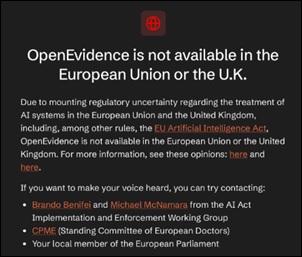
The hottest doctor reference source withdrew its medical evidence and decision support app from the UK and European markets. The news, reported in HIStalk on 28 April, is shocking–but not surprising. EU sources have predicted that this would be an outcome of the EU Artificial Intelligence Act. While the UK is not technically subject to EU regulation, the regulatory guidance to date has been along the EU Act’s lines; clearly a decision has been made not to enter the UK market accordingly.

The screen at left (courtesy of HIStalk) cites the ‘regulatory uncertainty regarding the treatment of AI systems’ and invites potential users to ‘make their voice heard’.

OpenEvidence is perceived by most to be the ‘up and coming’ platform for physician information. Its momentum was solidified with deals such as with Mount Sinai NY to integrate it within Epic [TTA 9 Apr], a $250 million Series D funding, and a monster valuation of $12 billion, making it the most valuable healthcare AI company in this solar system. It couples a free search engine trained on journals and clinical medical data only with an AI chatbot agent, making it easy to use for doctors. OpenEvidence partners with prestigious sources such as the New England Journal of Medicine and the American Medical Association.  It claims a daily average usage by 40% of US doctors in 10,000 hospitals and medical centers, achieving 18 million clinical consults in December alone. It recently added clinical trial matching to its capabilities, filtering trials by study design, enrollment status, and geographic proximity. To the US industry, OpenEvidence fills a gap in clinical intelligence that competitors Doximity (public), Epocrates (athenahealth), and Medscape (WebMD) have not to date, which certainly hurts the latter as tight pharma ad dollars reroute to OpenEvidence, as TTA has previously noted. 

The EU and UK constraint will likely not hurt OpenEvidence’s growth, but will hurt physicians in those countries by blocking a reliable source of information. It hits the NHS where it hurts, in its desires for technology advancement and integrating AI in practices. DistilledPost has a more UK-specific discussion of the consequences. Meanwhile, this Editor doubts that OpenEvidence will let this sit, and will eventually find a way towards compliance while growing outside of those markets, such as the Middle East and Asia. They have the resources, the name, and the growth. Hat tip to HIStalk. Letsdatascience

Chutes and Ladders w/o 9 Feb: Biofourmis’ ex-CEO faces 7 major Singapore fraud charges (updated), Doximity’s 17% drop; Devoted Health’s big $366M raise, Garner Health garners $118M, Synthpop’s $15M Series A

Chutes go first…

The worst kind of Chute to go down is one that lands in a coal-scuttle full of fraud and criminal charges–in a country known for its punishments. Biofourmis’ former CEO is facing seven counts in Singapore. Rajput Kuldeep Singh, one of the founders and former CEO, has been charged in Singapore with three counts of abetting the falsification of accounts, three charges of fraud by false representation or abetment thereof, and one charge of forgery for the purpose of cheating. These are connected to the Singaporean company, Biofourmis Holdings Pte Ltd., between 2021 and 2022. Headquarters moved to Boston after its Series B in 2019.

Mr. Rajput (surname is first) is accused of falsely invoicing US$16.5 million to Singapore’s Ministry of Health (MOH), and later false representations such as inflated revenue figures, falsified financial statements, a misrepresentation on payment by the MOH, and subsequently a forged employee stock option plan offer letter. This was purportedly intended to deceive DBS Bank into transferring funds from the bank.

The penalties are high in a country that canes offenders for spitting on the sidewalk. The Singapore Police Force announced the charges in a 3 Feb release. Each fraud charge against Mr. Rajput carries a maximum 20 years plus a fine. Falsifying accounts and forgery max out at 10 years plus a fine. Even if convicted of one charge, Mr. Rajput is looking at perhaps a decade of time in a Singapore prison–on multiple charges, perhaps the rest of his adult life. Mr. Rajput is a 34-year-old Indian national. Presently, he is out on bail of S$600,000 (US$475,000) and through his legal representation Eugene Thuraisingam Asia, indicated in court on Feb 4 that he intends to claim trial. Singaporean law moves fast–the pre-trial scheduled to start on 1 April. The Online Citizen (Singapore) Here’s the original article in the Straits Times.

Update on extradition: Should Mr. Rajput remove himself to the US and try to evade extradition, his attorneys will tell him that it may be futile, but will string out things. Extradition is covered by a foundational 1931 bilateral treaty that originated with the UK (as Singapore was a colony then) and has been honored since with modifications and expansions (e.g. the Extradition Act of 1968 and Amendments 2022). The mechanism is straightforward. A request has to be made by the Singapore ministry for law and subsequently heard in a US Federal court. The charges must be valid under existing bilateral laws and meet the requirement that the charges carry a sentence of 2 years+. The extradition back to Singapore must then be approved by the Secretary of State. Fraud, embezzlement, and the taking of money under false pretenses are all covered. Singapore is also an active cooperator with the US whereas many countries with treaties are not. Another complicating factor is that Mr. Rajput is an Indian national and may hold multiple passports.

What about Biofourmis? It merged in October 2024 with CopilotIQ, a smaller RPM/nursing company in home health that took over Biofourmis’ business in in-home delivery of complex care for health systems, payers, and pharmaceutical companies. It was announced by CopilotIQ. This oddity didn’t square with other financial reporting indicating that Biofourmis was the acquiring party, yet was reasonable considering that CopilotIQ’s CEO and his management were running the combined company. Yet Biofourmis was a much larger company, a unicorn with over $400 million acquired in 10 rounds of financing.  Another oddity: Mr. Rajput transferred his 96.6 million shares (!!) in Biofourmis to 19 existing investors immediately prior to the merger, according to filings with ACRA, Singapore’s Accounting and Corporate Regulatory Authority. Today, the single company runs as two separate brands. In 2024, Mr. Rajput returned to Singapore (and Boston) to found a new company, OutcomesAI, an AI-enabled nurse assistant and voice agent which raised $10 million last October. To be continued….

Doximity, a/k/a LinkedIn for doctors plus virtual visit capability, took a 17% crack on Friday after a wild overnight ride. This is despite the company clocking a decent Q4 2025 beating analysts’ revenue expectations. Sales were up 9.8% versus Q4 2024 to $185.1 million. EBITDA guidance for 2025 is in line at $356 million at the midpoint. What was the problem? Q1 2026. The company guidance is $143.5 million at midpoint, which is below analyst estimates of $151.3 million. It doesn’t seem like much, but the volatility indicates that Doximity has growing competition for the 80% of US doctors who are members. Epocrates and Medscape have for years been the main competition for partner dollars, but the new kid on the block, OpenEvidence, which just clocked a healthy Series D for its medical info search engine, is putting all three in the shade. The pie is also shrinking. Pharma companies are overall spending less and Doximity is spending more on a suite of new tools: DocsGPT, Doximity Dialer, and Doximity Scribe. Share price has stayed flat since Friday. Considering it once traded over $80…. Yahoo Finance, TIKR

Now for the Ladders…climbing them with a ‘barbell’…

Devoted Health raked in $366 million of Series F and post-F funding. This insurtech survivor, a combination of Medicare Advantage (MA) plans with in-house telehealth and in-home care, raised a split Series F: $48 million in November 2025 and at the end of January a Series F-Prime of $317 million. These very late rounds are rare in this constrained funding market. Both were led by long time investor The Space Between (TSB) [TTA 3 Jan 2024], in partnership with Centricus, a London-based global investment firm. This Editor counted 18 additional investors, which is a tell–even when you’re “redefining how healthcare is experienced and delivered” and they are 466,000 members strong, up 121 percent and across 29 states, with 98% of members in 4+ Star plans, they had to knock on a lot of doors for the raise. This raise is also about half of what it would have been in the 2020-22 Silly Money days. One wonders if an IPO is next. Devoted Health release

Garner Health’s latest raise is a $118 million Series D today (Tuesday). The employer-focused provider of health data analytics incentives to guide employees to the best-performing doctors in the employer’s existing health plans now has a total raise of $200 million and a valuation topping $1.3 million. The round was led by Kleiner Perkins with participation from Redpoint, Maverick, Kaiser Permanente Ventures, Mercy, Plus Capital, and other existing investors. Garner is claiming revenue increasing over 130% versus their prior year. Release

On the other end of the barbell, Cambridge MA-based Synthpop (not a music genre) had an early raise of $15 million that closed last week. The new Series A brought their total funding to $23 million. It was led by Ansa Capital, with Defy.vc and Peterson Ventures participating in the round with Storm Ventures and strategic investor Bruce Broussard. Marco DeMeireles, co‑founder and managing partner at Ansa Capital will be joining Synthpop’s board. Synthpop uses AI processes to coordinate document intelligence, payer-aware reasoning, and conversational voice agents to automate up to 80% of healthcare business processes, integrating directly with EHR, billing, and e-prescribe platforms. It was founded in 2023 by CEO Elad Ferber and CTO Jan Jannink, PhD, who have considerable previous founder experience. Release

Mid-week short takes: Amwell lowers 2023 outlook, DocGo goes up, Imprivata + PFH win Ireland HSE contract, Oracle Health’s Nashville move, layoffs at 23andMe, Doximity

Amwell missed Wall Street earnings analyst estimates and lowered its 2023 outlook. Q2 revenue of $62.4 million was a 3% drop versus prior year. Net loss was $93.5 million, added to a nearly $400 million net loss in Q1. Both quarters included goodwill impairment charges totaling nearly $400 million to reflect losses in stock value and market capitalization. Amwell is projecting downgraded revenue between $257 and $263 million compared with earlier guidance of $275 million to $285 million. Their adjusted EBITDA range for the year was also downgraded to lose $160-165 million from $150-160 million. Much of this is due to payer and provider migrations to their new platform, Converge, which will consolidate its offerings plus third-party tools, in a process that is losing providers and reducing visits. Release, Healthcare Dive

DocGo, a telehealth and medical transportation provider, upped its outlooks. First, they reported a tidy bump in Q2 revenue of $125.5 million, up from $109.5 million in prior year. Once known for mass Covid testing which has largely disappeared, which was $28 million in Q2 2022, non-testing revenue grew 53% versus prior year. Revenue is split between transportation ($45 million) and mobile health ($80 million). Adjusted EBITDA was $9.1 million for Q2, rising from $5.6 million in Q1. With $325 million in contracts not fully rolled out and wins with the NYC Department of Housing, their full-year 2023 revenue guidance is now projected to increase from $500-$510 million to $540-$550 million and monitoring over 50,000 patients. Release, Mobihealthnews

Ireland’s Health Service Executive (HSE) awarded a national framework contract to Imprivata and regional partner PFH Technology Group. Imprivata OneSign is a single sign-on (SSO) enterprise access solution for clinicians logging into various systems which eliminates repeated username/password entries. Logins will be via entering their password once per shift and reauthenticating with a tap of their ID badge, potentially saving 50 minutes per shift. Initial rollout will be to the following: Tallaght University, Beaumont, Rotunda, Galway University, Cork University Maternity, National Forensic Mental Health Service, and National Rehabilitation Hospitals. Imprivata release

Oracle Health on the move. Apparently Oracle Health, largely the former Cerner, will be moving to Nashville, Tennessee. This is a commitment that Oracle made in 2021 before purchasing Cerner. Oracle is building a $1.35 billion facility at a riverfront site, planning to locate 8,500 jobs in Nashville by 2031. Nashville has become a southeastern hub of healthcare companies and development. Oracle Health chair David Feinberg, MD and Seema Verma, a SVP there, were at a healthcare meet and greet there last week.  This adds to the de-Kansas City-ing of Oracle and perhaps more attrition among long-time employees. Becker’s

Two healthcare companies reported layoffs and revenue rethinks this week:

  • Genetic tester and data merchandiser 23andMe announced layoffs of 11%. This affects 71 employees primarily in their therapeutics segment, a cut of 47% in that segment and 11% of the company’s workforce. The staff downsizing reflected the end of a five-year partnership in therapeutics development with GSK and adds to April cuts of 75 jobs. The new cuts will be in Q2 of their 2024 fiscal year ending 31 March 2024 which will be by September this year. Revenues also fell in the quarter ending 30 June (their Q1) 6% to $60.9 million from $64.5 million in prior year, with a net loss of $104.6 million. Interestingly, 70% of their revenue is from direct-to-consumer services in genetic testing, subscriptions, and telehealth.  StreetInsider, GenomeWeb
  • Doximity also is laying off 10% of staff, or about 100 people. A digital platform for medical professionals with online networking tools, scheduling, CMEs, secure messaging and telehealth for consults, it is facing slowing growth and renewals among paying customers that include hospitals, health systems, pharmaceutical companies, and medical recruiting firms that purchase subscriptions for services on Doximity. The company adjusted its FY2024 (March end) financials downward to $452 to $468 million and $468 million from $500-$506 million, with adjusted EBITDA for the year to $193-$209 million from $216-$222 million. Release, FierceHealthcare