


The latest word is that the Rt Hon Matt Hancock MP, Secretary of State for Health and Social Care, will be giving the keynote address on the second day (23 May) of The King’s Fund’s annual Digital Health and Care Congress. If you are UK-based or do business there, and you haven’t signed up…what are you waiting for? This link here or on the right sidebar will take you straight to the program site. When you’re there to register, don’t forget to use the code Telehealth_10 to get an exclusive 10 percent discount for our Readers. TTA is pleased to be again an official supporter of the Digital Health and Care Congress.
About time: digital health grows a set of ethical guidelines
Is there a sense of embarrassment in the background? Fortune reports that the Stanford University Libraries are taking the lead in organizing an academic/industry group to establish ethical guidelines to govern digital health. These grew out of two meetings in July and November last year with the participation of over 30 representatives from health care, pharmaceutical, and nonprofit organizations. Proteus Digital Health, the developer of a formerly creepy sensor pill system, is prominently mentioned, but attending were representatives of Aetna CVS, Otsuka Pharmaceuticals (which works with Proteus), Kaiser Permanente, Intermountain Health, Tencent, and HSBC Holdings.
Here are the 10 Guiding Principles, which concentrate on data governance and sharing, as well as the use of the products themselves. They are expanded upon in this summary PDF:
- The products of digital health companies should always work in patients’ interests.
- Sharing digital health information should always be to improve a patient’s outcomes and those of others.
- “Do no harm” should apply to the use and sharing of all digital health information.
- Patients should never be forced to use digital health products against their wishes.
- Patients should be able to decide whether their information is shared, and to know how a digital health company uses information to generate revenues.
- Digital health information should be accurate.
- Digital health information should be protected with strong security tools.
- Security violations should be reported promptly along with what is being done to fix them.
- Digital health products should allow patients to be more connected to their care givers.
- Patients should be actively engaged in the community that is shaping digital health products.
 We’ve already observed that best practices in design are putting some of these principals into action. Your Editors have long advocated, to the point of tiresomeness, that data security is not notional from the smallest device to the largest health system. Our photo at left may be vintage, but if anything the threat has both grown and expanded. 2018’s ten largest breaches affected almost 7 million US patients and disrupted their organizations’ operations. Social media is also vulnerable. Parts of the US government–Congress and the FTC through a complaint filing–are also coming down hard on Facebook for sharing personal health information with advertisers. This is PHI belonging to members of closed Facebook groups meant to support those with health and mental health conditions. (HIPAA Journal).
But here is where Stanford and the conference participants get all mushy. From their press release:
“We want this first set of ten statements to spur conversations in board rooms, classrooms and community centers around the country and ultimately be refined and adopted widely.” –Michael A. Keller, Stanford’s university librarian and vice provost for teaching and learning
So everyone gets to feel good and take home a trophy? Nowhere are there next steps, corporate statements of adoption, and so on.
Let’s keep in mind that Stanford University was the nexus of the Fraud That Was Theranos, which is discreetly not mentioned. If not a shadow hovering in the background, it should be. Perhaps there is some mea culpa, mea maxima culpa here, but this Editor will wait for more concrete signs of Action.
A short but canny look at consumer behavior as a driver of health technology
Whether the global ‘smart home healthcare’ market actually totals $30bn by 2023, as a Research and Markets study trumpets, is debatable, but one thing that this Editor agrees with is that successful home health devices need to take a chapter from Steve Jobs’ Apple and famed industrial designer Raymond Loewy’s playbooks (search our Loewy references here) and design for how the consumer lives and would use their product. It isn’t flashy design awards, but how that technology can not only fit into a person’s life but also be an asset that they’d miss if someone took it away–a point often forgotten in the rush of initial design, testing, and funding.
Writer Scott Thielman of Product Creation Studio, a Seattle-based industrial design and engineering firm, outlines four health tech products/services that represent technology that is intuitive, easy-to-use, accessible, and, I would add, have a little something extra that makes them indispensable.
- Athelas, a next-generation immune monitoring device that resembles an Amazon Alexa in being a 3D black cylinder. Instead of playing music, it measures neutrophils, lymphocytes, platelets, white blood cells, morphology, and cell activation all within minutes from a test strip inserted in the cylinder. (Investigational device awaiting FDA review)
- Rochester Institute of Technology (RIT)’s smart toilet seat (which Editor Charles punningly referred to here) was tested with heart failure patients. It measured nine clinically relevant features, including weight, single-lead ECG, systolic/diastolic blood pressure, blood oxygenation and localized pulse timing, and a ballistocardiogram (BCG) for measuring the mechanical forces associated with the cardiac cycle. Normally, the patient would have to use several devices for these measurements rather than taking a seat. Speaking of the seat, it is standard white and replaces the one in the bathroom. Results were published in JMIR mHealth and uHealth.
- ResMed’s connection of its continuous positive air pressure (CPAP) sleep apnea treatment devices to the cloud before the patient uses them, plus their patient smartphone app helps them to claim that 84 percent of new users reach the necessary usage threshold for Medicare adherence in the first 90 days of treatment.
- Clarify Medical’s build-in of user feedback for its home vitiligo and psoriasis treatment that goes direct to their in-house customer service also registers patient usage, needed fixes, and outreach to those who need additional coaching and training.
- Livongo’s acquisition of myStrength’s behavioral health app [TTA 31 Jan] also points to the importance of consumer behavior in a somewhat different aspect–the 20 percent and more who are struggling with behavioral health issues along with one or more chronic conditions managed by Livongo for employers and health plans.
How to design home healthcare devices that people will use (Medical Design & Outsourcing)
News roundup: of logos and HIMSS roundups, Rock Health’s Digital Health Consumer Adoption survey, and the millennial/Gen Z walkaway from primary care
 HIMSS19 was last week. Onsite reports to this Editor declared it ‘overwhelming’, ‘the place to be’, ‘more of the same’, and ‘stale’. With a range of comments like these, everyone’s HIMSS is different, but HIMSS is well, a place that for most of us in digital health, have to be (or their companies have to be). It is still a major commitment, and if you are small, a place where you might be better off with no display and simply networking your way through.
HIMSS must be conscious of a certain dowdiness, because HIMSS is ‘reforming’ with a preview of a new logo and graphics here that changes out their Big ’80s curvy lettering and muted colors to hard edges in typefaces and equally hard blues.
Mobihealthnews (a HIMSS company) delves into blockchain (Boehringer Ingelheim and IBM Canada) and Uber Health’s continuing foray into non-emergency medical transport. Dimensional Insight’s blog takes some of the sessions from the data governance and healthcare business intelligence perspective, including the opioid crisis, AI to detect cancer (the link between falling hemoglobin rates and a cancer diagnosis), and pediatric disease registries. And there is the always incisive HISTalk with last Monday Morning’s Update, their 2/14/19 roundup, and Dr Jayne’s Curbside Consult on John Halamka’s world travels, including nascent care coordination in China and interoperability in Australia.
Rock Health’s survey of consumer attitudes towards digital health adoption leads with these insights:
- Wearable use is shifting away from fitness toward managing health conditions
- There was a 10% increase in use of wearables to manage health, corresponding to a 10% decline in physical activity tracking
- Telemedicine adoption is climbing, with urban consumers more than twice as likely to use live video telemedicine than rural consumers
- Paradoxical but true, in terms of adoption of at least one form, it was 67 percent for rural residents and 80 percent for urban residents.
- Highly trusted entities like physicians and health plans lost credibility in 2018—consumers were less willing to share data with them than they were in 2017. There’s an increasing distrust of ‘big tech’ and confidence in their ability to keep private data private–a wise takeaway given the Cambridge Analytica and Facebook scandals.
More acceptance of healthcare tools, less intermediation–and not trusting that data is secure spells trouble down the road unless these issues are addressed. Rock Health surveyed 4,000 respondents of US adults age 18 and over.
They’re not trad, dad. Accenture’s survey (released at HIMSS) also tracks the rejection of intermediation and gatekeepers when it comes to millennials and Gen Z in choosing non-traditional modes of healthcare, such as retail clinics, virtual and digital services. They are two to three times more likely than boomers to dislike in-person care; over half use mobile apps to manage health and use virtual nurses to monitor health and vital signs. Over 40 percent prefer providers with strong digital capabilities. Also Mobihealthnews
The Theranos Story, ch. 58: with HBO and ABC, let the mythmaking and psychiatric profiling begin! (updated)
This Editor thought that her next articles about Theranos would be trial coverage. There are court dates pending for Elizabeth Holmes and Not-So-Sunny Balwani–with the DOJ for 11 counts of wire fraud [TTA 16 June] and, for Mr. Balwani, with the SEC on (civil) securities fraud [TTA 15 March].
Instead, Theranos hits the headlines again. On 18 March, there’s the debut of an HBO documentary on Theranos. Titled The Inventor: Out For Blood In Silicon Valley (YouTube preview), we can treat ourselves once again to the SteveJobs-esque presence of Ms. Holmes, down to the unnaturally deep voice, blondined hair, and wide blue eyes, unpacking the deception and fraud that was part of the company from early days. But that’s not all! There’s a six-part ABC Radio ‘Nightline’ docu-podcast that started on 23 Jan and airs in six parts through February, which includes audio of depositions taken of board members, whistleblower Tyler Shultz, and patients affected by bad test results. (This Editor will give a listen on this alone.) Episode 5 and links to 1-4 are here via Yahoo.
On websites, we’re regaled with rehashes. The articles range from Teasing the Doc to Where The Ex (Balwani) Is Now (they don’t know) to What Is Her Net Worth (not $4.6 bn). There’s even a flurry of sensational podcasts and videos on YouTube–just Google them.
Fascinating Fraud. There’s fascination in The Long Con perpetrated by the principals, and less examined, our tendency to Want To Believe. Many of us like legal procedurals and the drama inherent in them (the eternal appeal of the long-running Law & Order in several countries.) Let’s face it, there’s a substantial dollop of schadenfreude mixed in.
What we are witnessing is the building of a myth, increasingly divorced from the real world where it happened, and not improbably or with superpowers.
Where it goes a little off the cliff. There is a curious article in Forbes that is written by a contributor who writes and teaches courses on stocks and entrepreneurship. He interviewed a former neighbor of Ms. Holmes, Richard Fuisz, MD. It turns out this psychiatrist, inventor, and former CIA asset knew her in childhood. The families were friends and Dr. Fuisz helped out her father when he hit a bad patch. There’s some sketchy profiling in this article, but it does make a fair attempt to get to the heart of the forces that put the gap in Elizabeth Holmes’ ethical makeup, including the Big Steal of Ian Gibbons’ IP. His position is somewhat complicated by a patent dispute (settled) between Dr. Fuisz & Son and Theranos. He’s still hammering on at it on Twitter (@rfuisz).
What’s missing? Much credit to the estimable John Carreyrou, who broke the story in the Wall Street Journal and got his livelihood (and perhaps a few other things) threatened a few times by Tough Guy Lawyer David Boies.
(Updated) At least it is here in a Vanity Fair article on the Last Days of Theranos, where they had to move to downscale Newark (California) and Ms. Holmes’ dog pooped where he wanted to poop. Her ‘persecution’ doesn’t seem to faze her from living in SF, frequenting cafes with said dog, and her new romance with a ‘younger hospitality heir’–a far cry from her former employees who wear the months or years of their lives at Theranos like a Scarlet Letter as they look for work and loose cash in the sofa.
We’ve gotten to the point where the hard business analysis ends and the looser parts of psychologizing begins, as we attempt to understand why. Beyond a certain point, does why matter when damage to real patients has been done? Collateral damage persists in funding of startups and for entrepreneurial women in health tech.
For this Editor, she looks forward to the warmer weather, when it’s expected when the Legal Action–and reality–resumes.
Roy Lilley’s tart-to-the-max view of The Topol Review on the digital future of the NHS
Well, it’s a blockbuster–at least in length. Over 100 pages long, and in the PDF form double-paged, which will be a tough slog for laptop and tablet readers. It’s Eric Topol’s view of the digital future of the NHS and it’s…expansive. In fact, you may not recognize it as the healthcare world you deal with every day.
Our UK readers may not be so familiar with Dr. Topol, but here you can get a good strong dose of his vision for the NHS’ future as delivered (electronic thunk) to Secretary Hancock. I haven’t read this, but Roy Lilley has. You should read his 12 February e-letter if you haven’t already.
Here is a choice quote: It’s a mixture of science faction, future-now-ism and away-with-the fairies.
Here’s some background. The Vision’s been around for awhile. Dr. Topol thinks and talks Big Picture, in Meta and MegaTrends. His view is patient-driven, self-managed, with their genomic sequenced and at their fingertips, with the doctor empowered by their records, his/her own digital tools for physical examination, with AI to scan the records and empower a partnership model of decision-making.
Topol In Person is quite compelling. This Editor’s in-person take from the 2014 NY eHealth Collaborative meeting is a review of vintage Topol. His expansive, hopeful view was in contrast to the almost totalitarian view (and it is fully meant) of Ezekiel Emanuel, with his vision of the perfectly compliant, low choice patient, and squeezed like a lemon medical system. At that time, I concluded:
One must be wary of presenters and ‘big thinkers’–and these doctors define the latter, especially Dr Emanuel who looks in the mirror and sees an iconoclast staring back. Fitting evidence selectively into a Weltanschauung is an occupational hazard and we in the field are often taken with ‘big pictures’ at the expense of what can and needs to be done now. Both Drs Topol and Emanuel, in this Editor’s view, have gaps in vision.
A year later, I reviewed his article The Future of Medicine Is in Your Smartphone which came out at the time of ‘The Patient Is In.’ which was quite the succès d’estime among us health tech types. “The article is at once optimistic–yes, we love the picture–yet somewhat unreal.” It seemed to fly in the face of the 2015 reality of accelerating government control of medicine (Obamacare), of payments, outcomes-based medicine which is gated and can be formulaic, and in the Editor’s view, a complete miss on the complexities of mental health and psychiatry.
Back to Roy Lilley:
There is an etherial quality to this report, spiritual, dainty. The advisory panel is 70 strong.
Studies and citations galore, from the world’s top research organizations. The advisory board–I believe well over 70–there’s not a soul down in the trenches running a hospital. Government, academics, and a few vendors (Babylon Health, natch). A lot of emphasis on AI, genomics, and training for ‘collective intelligence’. After reading but a few dizzying, dense pages, I admire the vision as before, but wonder again how we get from here to there.
Roy’s essay is a must read to bring you back to reality.
Robots’ largely positive, somewhat equivocal role in therapy for children with autism and cerebral palsy (HIMSS)
 A Georgia Tech study presented at this week’s HIMSS19 conference presented findings of an eight-week study of children with specific neurological conditions who were assisted by robotics in specific therapies for movement and cognition. The study began with the simple attraction of children to robots. Robots also don’t have the negative connotations of therapists, and in fact, based on the studies cited, robots are more trusted than humans by both adults and children.
For a child, robots ‘repetitive and predictable interactions’ can be reassuring (like Pepper in a Belgium hospital two years ago) , along with ‘gamified’ therapies and child-robot direct interaction as well as therapist-guided. The study’s approaches took several forms:
- Virtual reality therapy games
- Guided physiotherapy in movement–gross and fine motor skills
- Cognitive therapy to improve attention span
- ‘Gamified’ therapy
- Robot therapy coaching
- Tablet-based games
At the start of the study, physical and cognitive baselines were taken and retested at four weeks. By eight weeks the difference in movement parameters between normally developing children and those with cerebral palsy had largely equalized. In a second study, when the robots were withdrawn, their improvement decreased, but not back to baseline. The researchers’ concern was of course, dependency on the robots for therapy on a long term basis. HIMSS presentation by Ayanna Howard, professor of robotics at Georgia Tech is currently online–view quickly as usually they are withdrawn shortly after HIMSS is over. Mobihealthnews
The wind may be even stronger at the back of telehealth this year–but not without a bit of chill
Late last year, this Editor noted that ‘the wind may finally be at the back of telehealth distribution and payment’. The expansion of telehealth access for privately issued Medicare Advantage (MA) plans, state-run Medicaid and CHIP (Children’s Health Insurance Plan) plan members, and this year’s Medicare Physician Fee Schedule, along with a limited expansion of telemedicine in the Value-Based Insurance Design (VBID) model for MA announced earlier this year by CMS, is a leading indicator that government is encouraging private insurers to pay doctors for these services, who in term will pay vendors for providing them.
The Veterans Health Administration (VA) has historically been the largest user in the US of telehealth services (home telehealth, clinical video telehealth, store-and-forward). They are also a closed and relatively inflexible system (disclosure–this Editor worked for Viterion, a former RPM supplier to the VA). In 2017, under then Secretary David Shulkin (who left under a cloud, and not an IT one), there were hopes raised through the Anywhere to Anywhere VA Health Care Initiative. So the news released at the start of HIMSS’ annual meeting that veterans will be able to access their health data through Apple’s Health Records app on the iPhone, perhaps as early as this summer, was certainly an encouraging development. According to mHealth Intelligence, the key in enabling this integration and with other apps in the future is the Veterans Health Application Programming Interface (API), unveiled last year.
Anywhere to Anywhere is also making headway in veteran telemedicine usage. Of their 2.3 million telehealth episodes in their FY 2018, over 1 million were video telehealth visits with veterans, up 19 percent from 2017. 105,000 of those video visits were through VA Video Connect to veterans’ personal devices. The remainder were real-time interactive video conferences at a VA clinic. The other half were assessment of data between VA facilities or data sent from home (the underused Home Telehealth). Health Data Management
Virginia also moved to make remote patient monitoring part of covered telehealth services for commercial health plans and the state Medicaid program. The combined bills HB 1970 and SB 1221 will be sent for signature to Governor Ralph Northam, to whom the adjective ‘beleaguered’ certainly applies. National Law Review
But service providers face compliance hurdles when dealing with governmental entities, and they’re complex. There are Federal fraud, waste, and abuse statutes such as on referrals (Anti-Kickback, Stark Law on self-referral), state Corporate Practice of Medicine Doctrine statutes, and medical licensure requirements for telehealth practices. Telehealth: The Beginner’s Guide to Legal Pitfalls is a short essay on what can face a medical practice in telehealth.
News roundup: Current Health’s Class II, Healthware Italy’s €10 million boost, the low state of Latin America telemedicine, weekend reading on digital health in health systems
 Scottish startup gains FDA Class II clearance, pilots with Mount Sinai Brooklyn. Edinburgh’s Current Health has received FDA Class II clearance for its AI-enabled remote patient monitoring wearable monitors. The single arm-worn wearable sends data every two seconds on oxygen saturation, respiration rate, pulse rate, temperature, activity, and posture. Algorithms analyze the data and alert clinicians to patient status and deterioration. The Mount Sinai pilot follows on Dartford and Gravesham NHS Trust for a post-discharge monitoring program, with a 22 percent reduction in home visits plus fewer hospital readmissions and emergency department visits. Current Health is the renamed snap40. Mobihealthnews, BusinessWire release
Healthware, a Salerno, Italy-based consultancy group primarily concentrated in marketing and sales, has received a €10 million investment from Fondo Italiano d’Investimento SGR (FII Tech Growth). The investment will be used over the next two years has received to expand Healthware’s business transformation for life sciences companies and product development and services for digital health start-ups which improve health outcomes through new technologies. Release. Hat tip to Healthware’s Antonietta Pannella
Telemedicine adoption in hospitals ranges from 65 to below 30 percent in Latin America. A study published this week in Health Affairs Global Health Policy (paywalled) looks at the different rates of hospital-based telemedicine adoption in nine Latin America countries. Leading is Chile with the aforementioned 65 percent; Argentina, Costa Rica, Mexico and Peru with less than a 30 percent. In the middle: Panama (35 percent), Uruguay and Guatemala in the 40 percent range. Despite supportive official policies in many of these countries, “Efforts to implement telemedicine are isolated and scattered, often left to the public sector or taking the form of insulated projects that are not sustained” or scaled up nationally and regionally. Mobihealthnews
For weekend reading. Intersecting with the Latin America story above is this. This Editor missed the October issue of Global Health: Science and Practice published out of Johns Hopkins, but here it is. The focus of the six articles is digital health integration into health systems in the US and internationally. Hat tip to Alain B. Labrique via Twitter
Digital health versus eHealth: ‘here we go again’ with the confusion and the differences. Plus Women in eHealth (JISfTeH)
Editor Donna (and Editor Steve before her) always likes a good dust-up about terminology. One of the former’s pet peeves is the imprecise usage of telemedicine (virtual visits) versus telehealth (remote patient monitoring of vital signs); she will concede that the differences have been so trampled on that telemedicine has nearly faded from use.
The Journal of the International Society for Telemedicine and eHealth (JISfTeH) makes a grand attempt to parse the differing definitions of digital health and eHealth in their opening editorial of this month’s (24 Jan) issue. eHealth has fallen so far from use that the few times one does see it is in associations such as ISfTeH and the New York eHealth Collaborative. Even the World Health Organization, which has always been a fair arbiter for the industry, defined eHealth back in the salad days of 2005 as “the use of Information and Communication Technologies (ICT) for health”–broad, but workable. After a witty aside in defining digital health as “an area of healthcare focused entirely on fingers and toes” (plus), and examining the overly broad definitions of Eric Topol and Paul Sonnier, the authors Richard E. Scott and Maurice Mars seem to settle on this: that while digital health is given a much broader but nebulous definition (to the point of linguistic absurdity cited in Mesko et al.), and may incorporate related technologies like genomics (another poorly defined term) and ‘big data’, it would not work without that ICT. And that at least there’s a settled definition for eHealth, as stated above, for which this Editor assumes we should be happy. In the author’s closing, “Will we be sufficiently motivated to rise to such a challenge-globally agreed universal definitions? If not ……here we go again …..”
This month’s journal theme is also Women in eHealth, with articles on Brazilian eHealth distance education, digital technology in midwifery practice, and how online social networks can work for drug abuse treatment referral. There’s also a change in format, with article links opening to full PDFs of each article.
The telehealth ‘entrepreneur’ whose $5 million funding bought stays at the Ritz and portfolios at Bottega Veneta
This curious and cautionary tale should be better known. A young entrepreneur named Keisha L. Williams from Ashburn, Virginia had an attractive proposition. She needed immediate funding to bring to the US an Austrian telehealth system described as “software that would allow doctors to remotely examine and talk with patients.” Ms. Williams had degrees in both law and electrical engineering, so credibility. She also had a story. The software was in ‘escrow’ in Austria. There were taxes and fees that had to be paid immediately. And she had family situations, financial and medical emergencies. In other words, she had a ‘great line of ‘stuff’ on the technology, urgency, and personally, a few tugs on the heartstrings.
Ms. Williams told this story enough times over four years, and to enough people who believed her–more than 50, who invested over $5.4 million.
What happened? 95% of the money was spent on over the top vacations to Bora Bora, Italy, the Bahamas, and Jamaica, plus the occasional yacht with ‘hand and foot services’ and shopping at top-end retail such as Bottega Veneta and Vuitton. $500,000 alone was spent on her girlfriend. About $300,000 was spent on the software.
The rest of the story involves 14 Federal fraud charges, four accomplices, and unwitting, likely vulnerable people who were talked into giving over their savings. Late in January, she was sentenced to 15.5 years in Federal prison.
Many of our Readers have started companies or worked with entrepreneurs who have a great story and need money. The stories touch our hearts–and sometimes our checkbooks. Apparently, Ms. Williams raised the money without exposing herself to anyone in the industry or private investors who would ask remotely leading questions. To us, this technology sounds hardly sexy–it’s telemedicine virtual visit software with maybe some remote patient monitoring thrown in. Yet to 50 people, who are now poorer or who were involved with the fraudulent scheme — it sounded really special. (The name is also common–there are quite a few people on LinkedIn with the same name, which may make life difficult for them.)
With the rising tide of telehealth, if your cousin or uncle has heard of a great way to visit your doctor over the phone and asks you if you’ve heard about it, you might want to ask Uncle to pass the pie as you switch the conversation to being on guard for fraudulent schemes. Washington Post (read the comments), Daily Mail, Seattle Post-Intelligencer, press releases 17 Oct and 18 Jan from the US Attorney’s office, Eastern District of Virginia
Short takes: Livongo buys myStrength, Apple Watch cozies with insurers, Lively hears telehealth and $16 million
Livongo gets behaviorally stronger with myStrength. Extending from their base in diabetes and chronic disease management into behavioral health, Livongo made a logical extension with early-stage behavioral health company myStrength. A large percentage of those with chronic conditions are also struggling with a behavioral health issue–Livongo cites 20 percent but in this Editor’s opinion, the estimate is low. Both Livongo and myStrength have been very successful in the payment game, with both companies achieving payment and reimbursement by employers, insurers, health systems, and state/Federal payers. The other factor is that employers and payers want single, integrated platforms for wellness and disease management. Livongo last year bought Retrofit for its weight management program. Competitor Omada Health recently acquired the behavioral health technology of defunct Lantern. MedCityNews, Fortune, Livongo release

Apple Watch wastes no time in partnering with insurers. Or vice versa! Confirming that Apple Watch’s growth strategy hinges heavily on health via its new features are fresh agreements with Aetna/CVS Health and a rumored reach into three Medicare Advantage plans. The Aetna partnership is with an app called Attain, which blends Apple Watch activity tracking data with users’ health history to create personalized programs. The program is limited to about 250,000 slots plus additional slots for employer plans, and will debut this spring. Late last year, United HealthCare announced Apple Watches would be added to existing wellness program called Motion and their Rally platform. Both Aetna and United have tiered payment programs for the watches, with United adding a HSA reward. For Medicare Advantage plans, Apple is rumored that they will subsidize the watch for use as a health tracker and coach. FierceMobileHealthcare 30 Jan (Aetna), 14 Nov 18 (UHC), and 29 Jan (Medicare Advantage).
Lively adds telehealth to hearing assistance. Lively’s mobile-connected, direct to consumer hearing aids are adding more telehealth features such as remote tuning, virtual video consults with an audiologist, and an online hearing assessment/uploading audiogram for assessment. The NYC-based company also announced closing on a $16 million seed/Series A fundraising round led by Declaration Capital with participation from Tiger Management. There are an estimated 35 million Americans with hearing loss in a $10bn annual market. Hearing aids are rapidly adding digital and DTC features–others in the field are Eargo and ReSound. Lively release, AlleyWatch, Mobihealthnews. (Lively is not to be confused with Lively!, acquired by GreatCall two years ago)
Tunstall Americas sold to Connect America
 Connect America, a PERS and telehealth/remote patient monitoring company based in suburban Philadelphia, Pennsylvania, has acquired Tunstall Americas, the US division of Tunstall Healthcare Group. Financial terms were not disclosed.
The Tunstall brand name will ‘sunset’ and transition to Connect America, according to the 29 January release. Tunstall employees and offices will, at least for now, be operating from their current locations. The combined company will have 1,000 employees, more than 300,000 shared subscribers, and over 1,000 healthcare network partners.
Connect America is a private company, founded in 1977, and is estimated to have between 250 and 500 employees (Crunchbase); both companies are roughly equal in size. Their website states that they are the largest independent provider of PERS in the US. They market traditional and mobile PERS under the brands Medical Alert, Alert 911, Alert365, AlertMax365 for Men, and Caregiver365. The RPM devices are marketed under ConnectVitals. Richard Brooks, the president of the healthcare sales division, was formerly the president of Health Watch, which was the second largest PERS company in the US at the time of its sale to Philips.
Oscar Meyer, the president of Tunstall Americas, is quoted in the 24-7 Press Release headlined on the Tunstall Americas website, but it is not stated what position he will have in the merged company.
Tunstall Healthcare Group and its main investor, Charterhouse Capital Partners, have been quietly shopping the company for some years. In early 2017, Charterhouse and other shareholders were forced to relinquish nearly half the equity in the company to senior lenders and management amid a stunning £1.7bn debt burden at the end of September 2016 [TTA 7 Aug 2017]. The overall picture has improved somewhat, but is uneven especially in the home markets of UK and Ireland. A report in healthcare market intel company LaingBuisson News on 15 May 2018 reported on Tunstall’s financials for the FY closing 30 Sept 2017. While global revenue improved by 9.1 percent to £240.6m, UK and Ireland revenue fell 11 percent to £82.7m. A welcome sign was that losses narrowed to £46m to £391m, not breakeven but a substantial positive change. Reports on Companies House are not available yet for the 2018 closing.
Despite acquiring AMAC, the third-largest PERS company in the US back in 2011, Tunstall Americas never made much of a dent in the well-established US PERS market nor the difficult telehealth/RPM market, and had gone through many management changes in the past decade. A sale of the US operation, in this context, makes complete sense. Cision-PR Newswire Release. (Interestingly, the US sale release is not on the Tunstall corporate website as of today.)
Where’s the evidence? Healthcare unicorns lack the proof and credibility of peer-reviewed studies.
 Another sign that too many healthcare unicorns are decoupled from the rock-solid fundamental reality–that they work. Healthcare unicorns–those startups valued over $1 bn–are unicorns because they have patents, processes, or a line of business that has immense potential to be profitable. The standard in healthcare, unlike other tech, is the peer-reviewed study. Is this process or device effective based upon the study? Does this drug looks like it will work? Is this study validating, encouraging? Peer-reviewed research takes place before a drug or device goes into clinical trials — a precursor. It ensures a certain level of disclosure, validation, and transparency at an early stage.
Instead, these unicorns largely rely on ‘stealth research’–a term coined by Dr. John P.A. Ioannidis, the co-director of the Meta-Research Innovation Center at Stanford University (METRICS). He summed it up in his latest peer-reviewed paper, “Stealth research: lack of peer-reviewed evidence from healthcare unicorns” (co-authored with Ioana A. Cristea and Eli M. Cahan), published in the European Journal of Clinical Investigation 28 Jan:
In 2014, one of us (JPAI) wrote a viewpoint article coining the term “stealth research” for touted biomedical innovation happening outside the peer-reviewed literature in a confusing mix of “possibly brilliant ideas, aggressive corporate announcements, and mass media hype.”
The term ‘stealth research’ was prompted to the author by the practices of Theranos–ironically, a company that started and was funded in the Stanford nexus. By the time Dr. Ioannidis’ viewpoint paper was published in JAMA in Feb 2015, Theranos had ballooned to a $9 bn valuation. His paper was the first to question Theranos’ science–and Theranos aggressively pushed back against Dr. Ioannidis, including their general counsel attempting to convince the author to recant his own writing. Three years later, we know the outcome.
This latest study concludes that there is a real dearth of peer-reviewed research among healthcare unicorns–and that it’s detrimental. It measured whether these unicorns published peer-reviewed articles and whether they publish highly-cited (in other publications) articles; compared them against companies with lower valuations; and whether founders or board members themselves impacted the scientific literature through their own citations.
The meta-study looked at 18 current and 29 exited healthcare unicorns. Highlights:
- Two companies–23andMe and Adaptive Biotechnologies published almost half of all unicorn papers–196 combined
- Three unicorns (Outcome Health, GuaHao and Oscar Health) had no published papers, and two more (Clover Health, Zocdoc) had published just one
- Seven of the exited unicorns had zero to one papers
- In fact, ‘there was a negative, non-statistically significant association between company valuation and number of published or highly-cited papers’
As our Readers know, Outcome Health had a little problem around artificially inflated advertising placement wrapped in health ed and placed in doctors’ offices [TTA 29 Jan 18]. Oscar and Clover Health are insurers. Zocdoc…well, we know their business model is to get as many doctors to sign up in their scheduling app and pay as much as possible. But it’s the drug and device companies that are especially worrisome in a stealth research model. The paper points out among other examples StemCentrx, bought for $10.2 bn in 2016 by AbbVie for its Rova T targeted antibody drug for cancer treatment, was halted at Phase III because it was not effective. Acerta Pharma, also focused on cancer treatments, was bought by AstraZeneca for $7.3 bn; two years ago, AstraZeneca had to withdraw the Acerta data and admit that Acerta falsified preclinical data for its drug.
The conclusions are that healthcare unicorns contribute minimally to relevant, high-impact published research, and that greater scrutiny by the scientific community through peer-reviewed research is needed to ensure credibility for the underlying work by these startups. “There is no need for numerous papers. Discrete pivotal, high-impact articles would suffice.”
This Editor returns to #5 on Rock Health’s Bubble Meter: high valuations decoupled from fundamentals. Based on this, the lack of publishing represents risk–to investors and to patients who would benefit from better vetted treatments. To these companies, however, the risk is in having their technology or researched poached–as well as the investment in time and money research represents.
The study authors point out several ways to minimize the risk, including collaborating with academic centers in research, validation without disclosing all technical details, secure patents, and contributing their technology to other research. A higher-risk way is to “withhold significant publications until successful validation from agencies such as the Food and Drug Administration (FDA) or the European Medicines Agency (EMA)” but usually investors won’t wait that long. ‘Stealth Research’ paper, TechCrunch review Hat tip to David Albert, MD, of AliveCor via Twitter
News roundup: Virginia includes RPM in telehealth, Chichester Careline changes, Sensyne AI allies with Oxford, Tunstall partners in Scotland, teledermatology in São Paolo
Virginia closes in on including remote patient monitoring in telehealth law. Two bills in the Virginia legislature, House Bill 1970 and Senate Bill 1221, include remote patient monitoring (RPM) within their present telehealth and telemedicine guidelines and payment in state commercial insurance and the commonwealth’s Medicaid program. It is currently moving forward in House and Senate committees with amendments and. RPM is defined as “the delivery of home health services using telecommunications technology to enhance the delivery of home health care, including monitoring of clinical patient data….” Both were filed on 9 January. Virginia was an early adopter of parity payment of telemedicine with in-person visits. The University of Virginia has been a pioneer in telehealth research and is the home for the Mid-Atlantic Telehealth Resource Center. mHealth Intelligence
Chichester Careline switches to PPP Taking Care. Chichester Careline is currently a 24/7 care line services provided by Chichester District Council. Starting 1 March, PPP Taking Care, part of AXA PPP Healthcare, will manage the service. According to the Chichester release, costs will remain the same, technology will be upgraded, and telecare services will be added. Over the past 35 years, Chichester Careline has assisted over 1 million people across Britain.
Sensyne collaborates with University of Oxford’s Big Data Institute (BDI) on chronic disease. The three-year program will use Sensyne’s artificial intelligence for research on chronic kidney disease and cardiovascular disease. Sensyne analyzes large databases of anonymized patient data in collaboration with NHS Trusts. BDI’s expertise is in population health, clinical informatics and machine learning. Their joint research will concentrate on two major elements within long-term chronic disease to derive new datasets: automating physician notes into a structure which can be analyzed by AI and integrating it into remote patient monitoring. Release.
Tunstall partners with Digital Health & Care Institute Scotland. The partnership is in the Next Generation Solutions for Healthy Ageing cluster. Digital Health & Care supports the Scottish Government’s TEC Programme and the Digital Telecare Workstream. The program’s goals are to help Scots live longer, healthier lives and also create jobs. Building Better Healthcare UK
Teledermatology powered by machine learning helps to solve a specialist shortage in São Paolo. Brazil has nationalized healthcare which has nowhere near enough specialists. São is a city with 20 million inhabitants, so large and spread out that when the aircraft crew announces that they are on approach to the airport, it takes two hours to touch the runway. The dermatology waitlist was up to 60,000 patients, each waiting 18 months to see a doctor. The solution: call every patient and instruct them to go to a doctor or nurse to take a picture of the skin condition. The photo is then analyzed and prioritized by an algorithm, with a check by dermatologists, to determine level of treatment. Thirty percent needed to see a dermatologist, only 3 percent needed a biopsy. Accuracy level is about 80 percent, and plans are in progress to scale it to the rest of Brazil. Mobihealthnews.
The King’s Fund ‘Digital Health and Care Explained’ 27 March
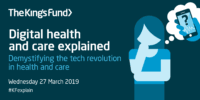 As briefly mentioned earlier this month, The King’s Fund in London will be previewing digital health with ‘Digital Health and Care Explained: demystifying the tech revolution in health and care”, a full day meeting on Wednesday 27 March at The King’s Fund. The ‘demystification’ will include policy challenges, operational innovations, research breakthroughs–and the practical aspects of making a ‘radical transformation’ real. Registration and session information is at the link above and here. Follow the event on Twitter at #KFexplain
And put on your calendar the Digital Health and Care Congress Wednesday-Thursday 22-23 May in London. Our Readers are eligible for a 10% discount using the link above or in the sidebar, plus the code Telehealth_10.


Most Recent Comments