Rock Health’s first half funding roundup adjusts the bath temperature to tepid, the bubbles to flat

The ‘new normal’ continues, as the bubbles vanish and the poor duck’s feathers are getting soggy and cold. Rock Health’s roundup of digital health funding (US only) continues the chilly flat-to-downward trend to funding. What money and fewer funders are out there which persist in their dedication to healthcare are betting cautiously, minimizing their risk on the table in lower unlabeled funding rounds and pre-vetted concepts. 

  • First half 2023 (H1) funding closed at $6.1 billion across 244 deals. Average deal size was $24.8 million, the lowest since 2019.
  • Breaking down by quarter, Q2 2023 funding hit a new low– $2.5 billion in funding across 113 deals, lower than Q4 2022’s ‘hole’ of $2.7 billion. By comparison, Q1 2023 funding totaled $3.5 billion over 131 deals, adjusted from the earlier report of 132 deals [TTA 5 Apr]. The collapse of three banks, most notably Silicon Valley Bank in March, clearly affected Q2.
  • Given the trend, Rock Health projects that 2023 funding will fall well below 2022, between 2019’s $8.1 billion and 2020’s $14.3 billion

Delving into the numbers:

  • Those ‘generalists’ who jumped into the digital health pool in 2021-22 jumped out. H1’s 555 investors had a 71% repeat rate, meaning that those who knew the water saw some opportunity or put on their wet suits. The overall total dropped from 775 in H1 2022 and 832 in H1 2021.
  • Unlabeled raises were suddenly the way to go. 101 of 244 deals–41%–had no series or round attached. This unprecedented move avoids the spectre of down rounds for companies needing to raise funds–down rounds affect valuation. Interestingly, 67% of these companies’ prior raises were in 2021 and 2022. 37 of them were Series B or lower. 
  • Mega deals inhabit a different territory. H1 had 12 mega deals, 37% of total funding dollars, and was at the 2021 norm of $185 million. Half were at Series D and growth/PE. They clustered in value-based care, non-clinical workflow, and that former mouse in the pumpkin coach, in-home and senior care. This level of funding also gravitated to the pre-vetted: incubated by VCs included Paradigm (clinical trials) and Monogram Health (kidney care).  Recently funded Author Health, long in stealth, will operate in a narrow slice of mental health funded by Medicare plans.
  • Zero IPOs, but acquisitions and shutdowns/selloffs continue. Acquisitions continued on a track of about a dozen per month, down from 2022’s average of 15. On the gloomier side, quite a few companies simply ran out of runway after raising a little or a lot of funding. These hit the lights at the end resulting in hull loss: Pear Therapeutics, SimpleHealth, The Pill Club, Hurdle, and Quil Health. If they were lucky, they had intellectual property worth something to someone–Pear to four buyers including a former founder, 98point6’s AI platform business to Transcarent–or subscriber bases worth acquiring, such as Pill Club to Nurx, SimpleHealth to TwentyEight Health. This does not count Amazon shuttering Halo and leaving subscribers in the lurch. (Nor Amazon’s dodgy approach to privacy getting Federal and private scrutiny, which this Editor explores here and here.)

To this Editor, 2023 will be a ‘grind it out and survive’ year for most health tech and digital health companies. Survivors will carefully tend their spend, their customers (who will be doing their own cutbacks), and watch their banks. The signature phrase this year was written in 1950, another uncertain time, by Joseph L. Mankiewicz and uttered with flair by Bette Davis in a classic film about the theatre, ‘All About Eve‘: “Fasten your seatbelts; it’s going to be a bumpy night.”   Rock Health Insights

Rounding up the week-end: Oracle Cerner layoffs hit 500+ in VA, DoD groups (updated); AWS cash cow stumbles; Transcarent-ViewFi team on virtual MSK; Veradigm delays annual, quarterly reports again; Olive AI sells BI to BurstIQ

Oracle, which already laid off 3,000 since its Cerner acquisition and dumped its real estate, is proceeding with more layoffs in Cerner groups serving the Federal government, specifically DoD and VA. According to the Reddit group r/cernercorporation on this thread, the layoffs hit broadly within the Federal teams: VA and DoD professional services, Federal care delivery, Federal change management, support service owners, and consulting. The number is at least 500 but may be more. The severance package is four weeks plus an additional week for every year of service plus unused vacation with the layoff date 30 June. Offers made to start for new hires have been rescinded. This has fueled speculation that Oracle Cerner may start to wash its hands of the just-renewed VA EHR implementation by outsourcing most of it. There is precedent for this: Cerner partnered with Leidos for the DoD implementation from the start and Oracle Cerner brought in Accenture for training in February. Of course, the all-heart Mr. Market liked the layoff news coupled with Oracle’s Q4 ending 31 May results of net income of $3.32 billion, a rise of 7% versus last year. CNBC  Oracle is now at a $342 billion valuation, a new high. HIStalk 16 June    

Updated 16 June: details remain sketchy but confirmation that layoffs are in the ‘hundreds’ Reuters, Becker’s, KC Business Journal (paywalled); the last posits from CEO Katz’s statement that this is only the first of many to come.   Further details on the Reddit group is that consultants were onsite at clients working on projects and go-lives when they received their layoffs, that 80% of departments were affected, and that the layoff may go over 1,000. 

Amazon Web Services’ business continues to slow, with the AWS cash cow’s growth slowing to half versus last year’s, with further decline expected this quarter. This Editor noted that market analysts at Seeking Alpha called it back in February when we looked at Amazon’s ability to spend cash so freely in healthcare, for example on OneMedical. Google and Microsoft have been tough competitors and while their growth is off too, they are starting with smaller pie slices. Companies are using more than one cloud provider in a ‘belt and suspenders’ approach; Gartner predicts that by 2026, more than 90% of businesses will use multiple providers, from 76% in 2020. AWS’ plans continue to build outside of the US, with a $12 billion investment in cloud infrastructure in India by 2030 as well as five data centers in Oregon due to a controversial $1 billion tax break. Google and Microsoft have also led in generative AI, while AWS has not. AP

Enterprise health navigator Transcarent has made another bid in the virtual health area. It’s a partnership with ViewFi, which helps MSK providers to diagnose and treat MSK injuries in real time. ViewFi providers are affiliated with the NYC-based Hospital for Special Surgery. The idea for ViewFi came from retired tennis champion Andy Roddick who, with his orthopedist Josh Dines, MD turned their bad experiences during the pandemic using FaceTime for virtual consults into a new platform. ViewFi’s platform now takes patients through an intro screener that records physical and mental health, through diagnosis and a recovery care plan with personalized diagnostic tests and exercises with real-time support from their health guides. For Transcarent-contracted companies, a ViewFi initial appointment can be set in as little as two days as opposed to the usual average of 17 days. Transcarent bought the virtual care platform developed by 98point6 in March. FierceHealthcare

We noted back in March and last month that Veradigm (the former Allscripts) had serious problems with their Q4 and FY 2022 reporting due to a software flaw (!) that affected its revenue reporting going back to 2021. Nasdaq has extended for the second time–from 14 June to 18 September–their 2022 annual 10-K filing and their 10-Q for the quarter ending 31 March 2023. Not filing the reports will mean delisting. Seeking Alpha

Olive AI’s reorganization continues [TTA 23 Feb], with data solutions company BurstIQ buying its business intelligence platform.  LifeGraph Intelligence uses AI tools such as natural language processing and machine learning to extract insights from clinical notes and EMR fields. The platform presents cost and clinical data in a meaningful way through cohort comparisons. According to an example on their website, it contributed to $90 million in savings for one health system. Acquisition cost and management transitions were not disclosed. BurstIQ release  Hat tip to HIStalk 16 June

Short takes: Amazon dims to black Halo wearable line, eVisit acquires Bluestream Health, Moving Health Home launches to lobby Congress, government

Amazon shuttering Halo health and fitness product line and services. On Wednesday, Amazon emailed Halo users that the line (View, Band, and brand new Rise sleep tracker) and services, including apps, will be switched off on 31 July. Users will be able to download or delete health and other data. Subscriptions will be refunded as well as all purchases made in the last 12 months. Remaining staff in the Halo unit will be laid off. This was not unanticipated given that Amazon cut jobs at Halo back in February as part of their mass layoff of 18,000 then and another 9,000 last month. Amazon is being quite ruthless in reacting to its 2022 loss and changing up its bets in healthcare to buying F2F care, like One Medical–as the Federal Trade Commission cleans its sights to hunt big game [TTA 23 Feb, 23 March] and the Department of Justice lurks in the wings, despite the sale closing. Engadget, Amazon notice, The Verge, Becker’s

Virtual care platform eVisit acquires virtual care platform Bluestream Health. Bluestream adds ‘white labeled’ telehealth as a customized “front door” for health systems along with virtual care workflow and LanguageLine translation to eVisit’s capabilities in automating patient care management for large health systems. eVisit picks up Bluestream’s 50,000 providers and 500 health systems to add to its 100 healthcare delivery organizations, 2,000 sites of care, and access by over 275,000 clinicians.  Acquisition cost and leadership/workforce transition are not disclosed. eVisit is based in Phoenix while Bluestream is HQ’d in NYC. This Editor first met with founder Brian Yarnell about 2015 or possibly earlier, when the company was operating out of two offices in shared workspace. Release, eVisit Bluestream acquisition page. FierceHealthcare

A new industry organization launches to lobby Congress and government for home health. Moving Health Home announced in March that it was forming to unify healthcare organizations to advocate for home health and to make the home a reimbursable site of care from insurers and Medicare. This spans prevention such as fall risk assessment and nutrition as well as direct care in the home including hospital at home. Members include Amazon, Hackensack Meridian Health, DaVita, Signify Health, Dispatch Health, and many others from the clinical, vendor, and provider areas. It’s headed by Krista Drobac, who has been for some time an activist in the connected health and health policy areas. Earlier this month, they announced that there will be a House bill, Expanding Care in the Home Act (ECHA) which is similar to prior bills both in the House and Senate.

DOJ drops appeal to block UHG-Change; more hints that FTC will be hunting big game with Amazon

DOJ has walked away from trying to stop the already-closed UHG-Change Healthcare merger. The US Department of Justice, which had appealed in November the District Court of DC approval in late September of UnitedHealth Group’s acquisition of Change Healthcare, on antitrust grounds, decided ‘enough egg on face’ and dropped its appeals court filings on 21 March. DOJ did not respond to Reuters’ report. Change is being integrated into OptumInsight and will be kept separate from the health plans. The DC District Court ruling found that DOJ did not conclusively prove its allegations of antitrust and loss of competition in services to hospitals and other providers. Statements from UHG’s competitors such as Cigna, Aetna, and Elevance (Anthem) that the acquisition would not lead them to ‘stifle innovation’ also weakened the DOJ’s case. Had the appeal been successful, it would have forced separation of Change Healthcare’s businesses, which are being quickly integrated into OptumInsight.  Healthcare Dive, Becker’s. Also TTA 4 Oct and 22 Nov 22.

Elsewhere in DC, it’s hunting season for the FTC, and its sights are fixed on Big Game called Amazon. POLITICO confirmed the speculation (or gave advance notice) [TTA 3 Mar], that FTC was building a multi-layered case beyond the Amazon-One Medical buy and warnings about failing to maintain consumer privacy [TTA 3 Mar] to include multiple practices. The POLITICO report indicates that there are at least six ongoing investigations by the FTC’s competition and consumer protection teams, with three apparently near the boiling point of action:

  • Blocking the acquisition of iRobot, famous for its Roomba robot vacuums. Amazon’s $1.7 billion acquisition has stalled with FTC rumoring action and Amazon apparently shutting down any further information. It does not have UK or EU approvals, which gives the FTC some more time to build a case. iRobot is the largest maker of robot vacuums. An acquisition would be expected to shut out competitive manufacturers marketing on Amazon such as Samsung. Their report indicates that FTC’s staff attorneys are leaning toward suing to stop the deal. Court action is expected in the next few months or sooner. 
  • Privacy investigations involving data security from their Ring camera/security system business and the Alexa voice assistant. The Alexa investigation also involves potential violations of the Children’s Online Privacy Protection Act. iRobot, Ring, and Alexa also tie into another FTC concern that Amazon is cornering the market on connected home devices.
  • Retail operations. These possibly could be around bundling services through the Prime subscription business and how competitor data is used on the Amazon platform to ‘outmuscle’ them. There is also a deceptive advertising probe around the use of the “Amazon Choice” label for certain products, including pay-to-play practices.

There is also scrutiny of how Prime and other Amazon services entice customers in with offers for expensive subscriptions, then make it extremely difficult or opaque to unsubscribe. This deceptive practice is called a “dark pattern”. Stay tuned.

FTC takes off the gloves: $7.8M fine for Teladoc’s BetterHelp, warns Amazon (and everyone else) on One Medical patient privacy

The Federal Trade Commission (FTC) goes to ‘bare knucks’. BetterHelp, Teladoc’s promising telemental business, settled a complaint brought by the FTC in a 4-0 vote over ad trackers and sharing consumer health data with third parties. The ad trackers shared data with  Facebook, Criteo, Pinterest, and Snapchat for ad retargeting to these customers, knowing their situation. While the $7.8 million fine has to be approved by a Federal judge (as does GoodRx’s), the $7.8 million will be returned to consumers whose data was shared. How this will be done is a question mark to this Editor, but the tracking was done from 2013 (prior to Teladoc’s buy in 2015) to 2021, so quite a few will be eligible. According to the complaint, BetterHelp made false and deceptive statements to users about the disclosure of their information and formally “disseminated, or caused to be disseminated, misleading and deceptive representations regarding its compliance with federal health privacy laws.”

BetterHelp did not disclose to users that it was sharing personal information with third parties and never obtained consent. In fact, they assured users on intake that their information would be private, between them and their therapist. BetterHelp did not offer disclosure of information sharing and an opt-out form until October 2021. The information shared was extensive:

  • Intake questionnaire answers, such as whether the user was experiencing suicidal thoughts, and if they belonged to a group such as LGBTQ, teens, or Christians
  • Prescriptions
  • Prior therapy history if any
  • Email addresses and IP addresses
  • Financial status

The decisions on sharing information were delegated to a junior marketing analyst without training in PHI and protecting privacy from 2017. There was no formal compliance review or employee training in HIPAA practices. BetterHelp also displayed various logos, including HIPAA, to assure users that their information adhered to governmental standards and practices for health, when it clearly did not. (Editor’s note: as a marketer, both are shocking with Teladoc as a parent company well aware of these issues.)

Why this is important: Ad tracking is a form of revenue for companies, which now will be effectively shut off. This presents a decline in revenue hopes for Teladoc, which in January positioned BetterHelp as a bright spot of ‘balanced growth’. Expect that BetterHelp will be only the first of these companies in telemental health counseling to receive a working over from a newly-aggressive FTC–and with a return to in-person visits required for Schedule 2 meds, further depressing the entire category.  Complaint, Healthcare Dive, Mobihealthnews

FTC’s shot across the bow to Amazon and everyone in DTC digital health. With Amazon closing the buy of One Medical, the FTC issued a 1 1/2 page public statement warning both companies that because of privacy representations they have made prior to and after the acquisition, any failure to maintain consumer privacy will be in violation of Section 5 of the FTC Act. FTC will be looking at ‘false net impressions’ and “make clear not only how they will use protected health information as defined by HIPAA but also how the integrated entity will use any One Medical patient data for purposes beyond the provision of health care. ” And in closing, a broader warning:

The Commission has long taken the position that personal health information is sensitive data and has reaffirmed this position through recent enforcement actions. Further, companies that fail to have adequate safeguards or controls in place to protect sensitive data or fail to obtain consumers’ express affirmative consent for marketing based on sensitive data such as health data may be in violation of the law.

The law requires companies to treat sensitive data with great care. Accordingly, the parties and the market more broadly should be on notice that the Commission will continue to monitor this space and bring enforcement actions whenever the facts warrant.

Hat tip to HISTalk 3 March   TTA on FTC issues with Amazon post-closing 23 Feb

More gimlety views on CVS-Oak Street Health, Amazon-One Medical acquisitions

Perhaps this Editor is not that much of an Outlier in thinking that these deals don’t beat, say, sliced bread. Oak Street Health (OSH) disclosed its financials in an SEC 10-K filed on Tuesday. One must wonder what CVS is seeing in the company other than bulking up its primary care profile. Their loss grew to $510 million from 2021’s $415 million. While OSH grew impressively in 2022 with a 51% increase in revenue to $2.2 billion, driven by 40 new centers ending with a total of 169 facilities in 21 states, expenses grew exponentially for the new patients: medical claims expenses grew 48%, cost of care went up 49%, and sales and marketing up 38%. Scalable, so they claim; profitable, not till 2025 at earliest.

Other problems were revealed in the 10-K. OSH has substantial business from other payers, which may not be pleased that CVS owns a small payer called Aetna, though has pledged to keep OSH payer-neutral. OSH leases or licenses most of its care centers from Humana. That payer also accounted for 32% of its 2022 capitated revenue. Centene’s plans and HealthSpring made up an additional 23%. Other, more routine concerns are regulatory review, attrition of physicians and clinician staff, and last but not least, breakup fees ($500 million if CVS walks away, $300 million if it’s OSH). When you add these to other factors as outlined in our earlier article, such as the Medicare Advantage and high-need populations, CVS is cutting off a hefty slice of loaf, especially considering that the more complex Signify Health buy is due to close this quarter. Earlier opinions on the buy [TTA 16 Feb], Healthcare Dive

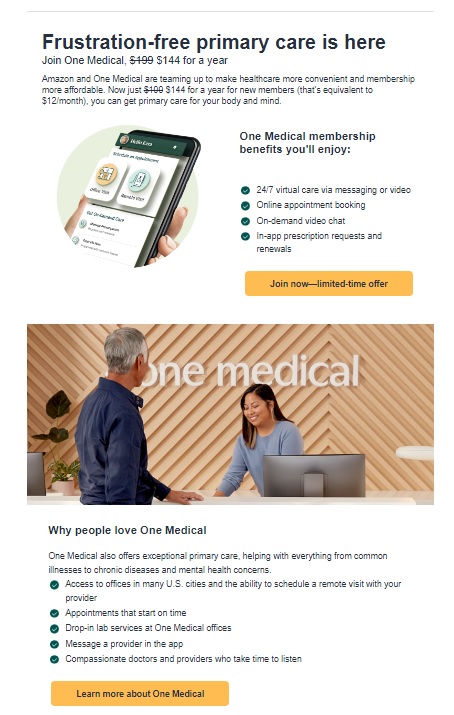
Now to Amazon and One Medical. This Editor received her invitation to buy a One Medical membership earlier this week (left). Countering this Editor’s analysis from last week, which maintains that Amazon is already under a broad antitrust microscope viewed by the Federal Trade Commission (FTC) and the Department of Justice (DOJ), Healthcare Dive counters, quite logically and in the view of their experts, that if either agency was going to object, they would have done so before the closing, and the grounds were likely too novel. The article concedes that the FTC could take action further down the road, for instance if Amazon violates HIPAA or consumer privacy with ad trackers. Instead, the focus is on objections by consumer groups, Amazon leveraging health data, privacy violations, and a general consumer unease around Amazon dealing with their health issues.

  • Consumer protection group Public Citizen urged regulators to block the deal in a letter to regulatory groups after it was announced last summer. For instance, it could bundle One Medical and Prime membership (a no-brainer). By tying the two together, Amazon could gain consent for using patient data from health records. Amazon could also serve ads for products related to medical conditions without that access (that old Pixel/ad tracker business again). These concerns are publicly shared by two FTC commissioners.
  • Analysts said that data acquisition was likely a big driving factor for the deal. After linking One Medical’s data with that from its other products and services, Amazon can analyze petabytes of healthcare data in the cloud and use the findings to better manage the health of One Medical’s Medicare population, build new products and pinpoint people with rare diseases to solicit participation in clinical trials, according to (market research firm) Forrester’s (Natalie) Schibell.” [Editor] That would, of course, require patient consent. 
  • Forrester noted that the consumer unease around Amazon in healthcare is substantial. 34% of surveyed adults weren’t at all comfortable with Amazon for healthcare needs with an additional 17% only somewhat more comfortable (tier 2). Trust levels are low, and it would take only one or two incidents, such as a security breach or HIPAA violations, to destroy it. This Editor would add that if One Medical practices were not managed impeccably, that would go viral among individual and corporate members, in a way that Amazon Care did not.

Breaking: Amazon closes One Medical $3.9B buy, despite loose ends–and is the Antitrust Bear being poked?

The Big Deal closes, but loose ends and larger issues remain. Today’s news of Amazon closing its purchase of the One Medical primary care group is being received in the press, especially the healthcare press, enthusiastically. This Editor cannot blame her counterparts, as since last year there’s not been much in the way of good news, compared to 2020-21’s bubble bath. Her bet as of a couple of weeks ago was that the deal would not go through due to Amazon’s financial losses in 2022 and/or that the FTC would further hold it up, both of which I was wrong, wrong, wrong on. (Cue the fresh egg on the face.)

Wiping off said egg, here is what Amazon is buying and their first marketing move. (Information on size and more from the 1 Life 2022 year end 10-K):

  • Amazon acquired 1Life Healthcare Inc. for $3.9 billion, or $18 per share in cash.
  • The practices are primarily branded as One Medical, closing out 2022 with 836,000 members and 220 medical offices in 27 markets
  • It is a value-based primary care model with direct consumer enrollment and third-party sponsorship across commercially insured and Medicare populations. Their Net Promoter Score (NPS) is an extremely high 90. (NPS is a proprietary research metric that indicates customer loyalty and satisfaction.)
  • They also have at-risk members from the $2.1 billion Iora Medical acquisition in seven states, in Medicare Advantage (MA) and Medicare shared savings value-based care (VBC) arrangements [TTA 27 July 22].
  • One Medical has contracts with over 9,000 companies, establishing Amazon at long last in the desirable corporate market.
  • One Medical also provides a 24/7 telehealth service exclusively to employees of enterprise customers where there are no clinics.
  • Amazon will be offering a discounted individual membership of $144 versus $199 for the first year, without an Amazon Prime subscription.

The Federal Trade Commission (FTC), which had additional questions about the buy as part of a Second Request in the Hart-Scott-Rodino Act reporting process, did not act in time to prevent the closing. Nor did the SEC or DOJ. This is CEO Andy Jassy’s first Big Deal at Amazon and certainly, the champagne and kvelling are flowing at HQ plus One Medical’s investors and shareholders for a successful exit. But should Amazon be looking over their shoulder? 

What are the open issues? Is a large, hungry Bear called Antitrust being poked, or lying in wait for its prey?

  • The FTC has the right to probe into the transaction despite the closing and a deadline passing for antitrust review. In FierceHealthcare and STAT, FTC spokesman Douglas Farrar is quoted as telling the WSJ (paywalled) in a statement that “The FTC’s investigation of Amazon’s acquisition of One Medical continues. The commission will continue to look at possible harms to competition created by this merger as well as possible harms to consumers that may result from Amazon’s control and use of sensitive consumer health information held by One Medical.”
  • As previously reported here, only in December did the FTC send out subpoenas to current and former One Medical current and former customers as part of its investigation. That’s late to stop a buy–unless FTC had something else larger in mind.
  • Early February reports in Bloomberg and the WSJ indicated that this may be part of a larger FTC action in developing a wide-ranging antitrust lawsuit against Amazon on multiple anticompetitive business practices. Their chair, Lina Khan, is highly critical of Amazon’s business practices. Amazon’s buy of iRobot, maker of Roomba, which at $1.7 billion was a comparative snack, is still not closed and has received a lot of negative attention for possible misuse of consumer information. 
  • Sidebar: This FTC is ‘feeling its oats’ on antitrust. GoodRx found itself making history as FTC’s first culprit of the 2009 Health Breach Notification Rule, used to prosecute companies for misuse of consumer health information. This was for their past use of Meta Pixel, discontinued 2019, to send information to third-party advertisers. One Medical is a HIPAA-covered entity which puts it at a far higher risk level. 
  • The Department of Justice (DOJ) has not publicly moved to approve or disapprove–yet. 
  • The change of ownership has not been reported as passing muster by regulators in multiple states. Example: Oregon approved it, but with multiple stipulations [TTA 6 Jan]–and there are only five One Medical clinics in Oregon. States like New York, Massachusetts, Connecticut, and California are not exactly pushovers for approval, with California alone having two approval entities.
  • Congress is increasingly feisty on data privacy–consumer health information and its misuse in telehealth [TTA 9 Feb]. 

Will this be ‘buy now, regret later’, a lá Teladoc’s expensive acquisition of Livongo, or Babylon Health going public with a SPAC? Is this a clever trap laid for Amazon?

  • Amazon is already under a Federal and state microscope on data privacy. Information crossing over from One Medical to their ecommerce operations such as Pharmacy and Prime will just add to the picture. 
  • Accepting Medicare/Medicare Advantage increases scrutiny on quality metrics and billing, to name only two areas. At-risk patients in Medicare and other VBC models, especially Medicare Shared Savings Program (MSSP) fall under CMS scrutiny. Amazon may take a look at that and spin-off/sell off the former Iora Health practices/patients.
  • Amazon has failed in healthcare previously, as a partner in the misbegotten Haven and in its own Amazon Care ‘home delivery’/telehealth model selling to companies, now closed. Its asynchronous virtual care service, Amazon Clinic, is too new to judge its success. 
  • Office-based, brick-and-mortar healthcare provided by doctors, nurses, and allied health professionals is an entirely new area for Amazon. Will they be satisfied with their new masters–and new metrics? It is also expensive. One Medical has never been profitable and did not project breakeven for years. (If one asks how this is different than CVS acquiring Oak Street Health, or Walgreens acquiring VillageMD and Summit Health, CVS and Walgreens have experience for decades in multiple aspects of providing healthcare–profitably and in compliance.)
  • One wonders how heavy of a hand Amazon will place on One Medical’s operations. How their management, doctors, and other professionals will feel after a year or two of Amazon ownership is anyone’s guess. This Editor doubts they will remain in place or silent if unhappy.
  • Selling to enterprises–and account retention–is a vastly different relationship-building process and buyer journey than 1:many consumer transactions. One Medical made a go of it with 9,000 companies and enrolling employees at about a 40% rate, so they did something right. By contrast, Amazon failed to sell Amazon Care well to companies. Humility and service, for starters, are required.
  • Last but certainly not least, is how Amazon will deal with regulation and compliance at multiple levels.

Expect that the FTC and DOJ will not be done with Amazon any time soon in what looks like a wider antitrust pursuit that may take some time, which they have. Amazon has tens of millions in government business (AWS) at stake and shareholders expecting a reversal of losses. Pro tip to Amazon: run One Medical as a separate operation with minimal integration and no information sharing until past this. And then some.  Healthcare Dive, Becker’s

Is CVS’ Oak Street Health deal genius? Or a waste of time and $10B?

A sample of the split opinion. In the buccaneering between CVS and Walgreens, plus Walmart and Amazon, to add primary care, CVS definitely buckled the swash with three deals: Signify Health (being questioned by DOJ and FTC) [TTA 21 Oct 22 latest], a $100 million investment in Carbon Health [TTA 11 Jan], and Oak Street Health [TTA 9 Feb]. These are in line with their strategy of acquiring companies to expand their capabilities in primary care, provider enablement, and home health. The wisdom of the first–primary care–is being questioned by a few in healthcare. 

The basic argument is that primary care is money-losing, ‘unless you have significant ancillary revenue and downstream referral income’ according to Randy Davis, vice president and CIO of CGH Medical Center, based in Sterling, Illinois. Oak Street’s Medicare Advantage business is also money-losing because of its dependence on increasing severity scores (risk adjustment) and is generally an ‘uphill battle’. This Editor will add that as previously noted–and lauded in CVS’ release–Oak Street is notable for serving underserved patient populations–50 percent of Oak Street Health’s patients have a housing, food, or isolation risk factor. That equates to greater expenses that may or may not be reimbursable. Oak Street certainly has proven the money-losing part, forecasting a loss of $200 million for 2023 and not projecting a profit until 2025. Mr. Davis was blunt, calling it a deal that made no sense and “CVS better have a plan they implement in 18 months or they’ll get slaughtered.”

Another rap on the deal is that it is not big enough. Given the size of Oak Street at about 169 offices and the national figure is quoted as 600,000 ambulatory sites, it’s tiny. However, what isn’t considered is Aetna’s existing relationships with primary care physicians through ACOs formed as joint arrangements, and if Signify Health goes through, the Signify/Caravan ACOs. In fact, this may be a factor in the DOJ/FTC consideration of antitrust.

Others see opportunity in integrating primary care into CVS’ retail locations (Carbon Health) and serving historically underserved communities–much the same tack that Walgreens is taking with VillageMD (acquiring Summit Health) and Walmart with Walmart Health clinics. Becker’s Hospital Review

And as to Amazon, this Editor’s prediction is that Amazon will strike its Jolly Roger and sail away from the One Medical buy.

Ad tracker action heats up: Congress questions DTC telehealth companies on sensitive patient health data sent to advertisers

It looks like telemental and addiction counseling telehealth sites are routinely sending patient information to media ad platforms–Google, Facebook (Meta), TikTok, Microsoft, Snapchat, Bing, Pinterest, and Twitter–to serve ads back to patients. Four Senators sent letters this week to three telehealth companies treating patients: Monument (alcohol addiction), Workit Health (opioid and alcohol), and Cerebral (ADHD and other mental health). The letters questioned the use of ad trackers (pixels) such as Meta Pixel that collect information from telehealth sites and then use the information to send users targeted ads based on that information. Except that this is not about curtains or shoes, but medical treatment. 

Kicking this off was The Markup/STAT study in December, examining 50 telehealth websites.

  • 49 of 50 websites shared user/patient tracking data to advertising platforms. This captured data as routine as URLs and IPs, and as extensive as name, email, phone, questionnaire answers, when users created accounts, and cart behavior, such as a prescription medication or treatment plan.
  • 35 were found by the study to have trackers sending individually identifying information to at least one media platform that included names, email addresses, and phone numbers
  • 25 had at least one tracker that indicated when users added prescription drugs and other items to their cart or when they checked out with a subscription for a treatment plan
  • 13 had at least one tracker that collected patients’ answers to medical questions

Ad trackers then send that information to platforms, which then serve targeted ads back to the telehealth companies’ users and patients. For the telehealth companies, the data is monetized. Because ads are served, there is a revenue stream back to the telehealth companies. 

From the senators’ letter: “This data is extremely personal, and it can be used to target advertisements for services that may be unnecessary or potentially harmful physically, psychologically, or emotionally.” Markup/STAT

Users may well assume that because the telehealth companies eventually connect them to a provider covered by HIPAA, or sends them a prescription from a provider, such as migraine treatment, that their data is protected along the entire journey. That assumption has now been demonstrated to be incorrect. This included major, heavily advertised DTC providers such as Lemonaid, Keeps, Hims & Hers, Talkspace, and Roman (Ro). Many of them are now examining their pixel policies.

The December article linked above has all 50 companies and what information they found was sent to ad platforms. The only website that did not was Amazon Clinic–brand new and of course not wanting to share their information outside of Amazon.

This follows on the FTC’s still to be approved by a Federal court, but apparently successful $1.5 million action against med discounter GoodRx using the never-used-before Health Breach Notification Rule, enacted in 2009 [TTA 3 Feb]. 

Why this is significant: first, the FTC action using an old rule, followed by the senators targeting three prominent (and in Cerebral’s case, beleaguered) telehealth companies, and the red meat documentation provided by The Markup/STAT study provide grounds for endless follow-up by not only Congress, but also private and public (DOJ) litigation. Stay tuned.

Amazon gets all tangled up on their $3.9B One Medical buy as FTC widens antitrust scrutiny

Amazon’s ride towards being the #1 threat to healthcare hits an oncoming train. A report in stock analysis newsletter Seeking Alpha, picked up from other sources (the subscription Dealreporter), states that the Federal Trade Commission (FTC) hired outside economists to scrutinize Amazon’s $3.9 billion purchase of provider network One Medical (1 Life Healthcare). In a little-noticed action in early December, FTC also sent out subpoenas to current and former One Medical current and former customers as part of its investigation.

Both the Wall Street Journal and Bloomberg (paywalled) are reporting that this appears to be part of a larger FTC action in developing a wide-ranging antitrust lawsuit against Amazon on multiple anticompetitive business practices. In a recent example, FTC held up Amazon’s acquisition of iRobot (Roomba) during the summer, and in September, requested information from 1 Life and Amazon above and beyond the usual required Hart-Scott-Rodino Act (HSR) reports reviewed by the FTC and DOJ [TTA 15 Sept 2022]. This examination has been going on for some years, across two administrations, but may come to fruition as early as this spring. The main investigation is around Amazon favoring its own products, how it treats outside sellers on its platform, and copycatting the products of outside sellers. It may also cover Amazon Prime bundling practices. Prime also plays into its healthcare strategy. FierceHealthcare

Another factor: the highly profitable growth of Amazon Web Services (AWS) has taken a nosedive along with the cloud market, killing Amazon’s growth and value, according to Seeking Alpha’s analysis (may be paywalled). Amazon is also closing or pausing already built-out food stores–Fresh supermarkets and Go convenience shops–ending a long-term commitment to developing them.

When all of these factors are combined with Amazon’s 18,000 layoffs and huge 2022 net loss of $2.7 billion, it’s hard to believe that Amazon now has enough blue sky fisc to make the huge investment and long-term commitment that a largely new and cash-intensive business, delivering healthcare through real live providers in offices, will require. Amazon’s current health business is either transactional virtual retail (Pharmacy and the new non-face-to-face Amazon Clinic for virtual medical referrals) or hardware+subscription (Halo)–areas that Amazon knows well. But managing an entirely new and complex area that provides expensive and regulated provider services?

This Editor will go out on a wintry limb and predict that Amazon, facing FTC and state anticompetitive actions plus plenty of shareholder profit pressure , will cancel the deal with One Medical–leaving One Medical on another limb.

CVS works their plan in Oak Street Health buy talks, Carbon Health $100M investment + clinic pilot; VillageMD-Summit finalizes (updated)

CVS, Walgreens, Amazon, Walmart all chasing the same type of companies to expand their service continuum. During their Q2 2022 earnings call, CVS Health announced that they were determined to enhance their services in three categories: primary care, provider enablement, and home health. And CVS’ CEO Karen Lynch was pretty blunt about it: “We can’t be in the primary care without M&A” (sic). So CVS’ latest moves should come as no surprise.

Oak Street Health: CVS is in talks with this value-based care primary care provider for primarily older adults in Medicare and Medicare Advantage plans. With 100 offices nationally, it’s not too small, not too large to combine with other operations. As a public company traded on the NYSE but puttering along in the $13-$22 per share range since the fall from a high of $30 in August, the news of CVS’ interest has boosted them above $28 and a market cap of just under $7 billion. Although Oak Street has previously maintained that they have no interest in a sale, it has never been profitable and is on track to lose $200 million this year. That is not a good look for CVS but they are working a strategy. Previously, CVS walked away from primary care group Cano Health [TTA 21 Oct 22]. Bloomberg News (paywalled) reported that CVS could pay $10 billion which would be over $40 a share. Healthcare Dive, Reuters

Carbon Health: CVS leads their Series D with a $100 million investment plus piloting Carbon Health operations in primary and urgent care clinics in their retail stores. However, the deal came at a price. Last week, prior to the investment announcement, Carbon announced that it would wind down lines of business in public health, remote patient monitoring, hardware, and chronic care programs, cutting 200 jobs in addition to a June cut of 250, at the time about 8% of their workforce. Carbon will now concentrate on their clinic core business. 100 are presently located across Arizona, Nevada, Colorado, Kansas, Florida, Massachusetts, and California (San Francisco, Bay Area, and San Jose).

In the last two years, Carbon raised $350 million and grew by acquiring four clinic chains. It diversified by buying Steady Health (chronic care management in diabetes) and Alertive Health (remote patient management)–both businesses they are departing. Reportedly last month they bought Inofab Health, an Istanbul-based digital health platform for patients with asthma, chronic obstructive pulmonary disorder, and cystic fibrosis. Crunchbase, FierceHealthcare, Mobihealthnews, SF BizJournal,

CVS is still working its Signify Health acquisition past the Department of Justice (DOJ) and the Federal Trade Commission (FTC). It went into a Second Request for information in late October under the Hart-Scott-Rodino Antitrust Improvements Act of 1976 (HSR), which adds 30 days to the review timetable after the Second Request has been complied with. There is some competitive overlap between CVS and Signify in home health management and accountable care organization (ACO) operations, and some divestitures may be necessary. A closing in Q1 as planned seems optimistic. Acquiring Oak Street may complicate matters since their clinics operate as a Direct Contracting Entity (DCE, now ACO REACH). This present administration is not friendly towards healthcare consolidation of any type, especially with entities participating in Federal programs. (See UHG’s acquisition of Change Healthcare, with court approval being appealed by DOJ.) Reaching (so to speak) deep into CMS programs could be a red flag.

Walgreens’ VillageMD finalized their Summit Health acquisition for $8.9 billion yesterday (9 Jan) (updated). Now with 680 provider locations in 26 markets and 20,000 employees, the group adds to VillageMD’s primary care practices specialty practices in neurology, chiropractic, cardiology, orthopedics, and dermatology plus 150 City MD urgent care locations. 200 VillageMD locations are already adjacent to Walgreens locations. Walgreens Boots Alliance (WBA) and Evernorth, the health services business of Cigna, were the two investors. WBA raised full-year sales guidance from $133.5 billion to $137.5 billion. The current chair and former chief executive officer of Summit Health, Jeffrey Le Benger, MD, will be the interim president until VillageMD finds a permanent president reporting to VillageMD CEO Tim Barry. Release, RevCycleIntelligence, Forbes  At this point, Walgreens hasn’t moved forward with the rumored acquisition of ACO management services organization Evolent Health [TTA 1 Oct 22], which would be far more complex. 

Amazon is still awaiting Federal approval for One Medical as well as in multiple states (Oregon only the first; expect scrutiny). It is also closing Amazon Care and opening asynchronous non-face-to-face telehealth service Amazon ClinicWalmart continues on an internal strategy of opening Walmart Health clinics in underserved areas. Earlier in 2022, they announced the opening of more health ‘superstores’ in Florida, having established 20 in Arkansas, Illinois, and Georgia starting in 2019. Walmart’s approach to retailing health services and products, since getting serious about it in 2018, has wavered with multiple changes of strategy and executive departures [TTA 22 Nov 22]


Amazon-One Medical gains conditional OK in Oregon–a preview of coming scrutiny?

Amazon has approval for the $3.9 billion One Medical acquisition from the Oregon Health Authority (OHA)–but with conditions.  OHA’s task is to review transactions such as these in how they affect patient cost, access, quality, and equity. OHA’s key comments were positive on cost and access, equivocal on quality, and expressed concern on equity (28 December PDF here):

Cost: “…the transaction will not meaningfully change Amazon and One Medical’s market share for primary care services in Oregon. Commercial insurance payment rates for One Medical are negotiated through the partnership with Providence [Health & Services].” In the Conclusions, they noted that “Amazon, with its advanced supply chain and purchasing power, may generate efficiencies and savings for One Medical, though any savings would not necessarily be passed to consumers.

Access: The few One Medical clinics were found to be in urban areas where there is good access to healthcare. “The entities have also stated that they plan to expand One Medical’s network of clinics, which may provide additional access to services.”

Quality: “OHA has limited insight into quality for One Medical locations, since its [five] Portland clinics opened in 2020 and 2021 and One Medical does not participate in some programs that require regular quality reporting.” However, they noted that “Amazon’s business model also has the potential to impact quality.”

Equity: concern on “One Medical siphoning off commercially insured patients with higher payment rates from clinics that serve more Medicaid and Medicare-covered patients.”

Conditions for approval are in reporting on these areas. Amazon is to report on the services it provides and the quality of care, plus any governance or organizational changes, every six months for five years after the acquisition closes. OHA then must perform follow-up analyses on the impact of the transaction on the commitments Amazon makes on cost, access, and quality of care. 

One Medical’s limited Oregon footprint proved to be helpful to Amazon in gaining OHA approval–but may be a Preview of Coming Difficulties. One Medical operates in 29 markets including NYC, Los Angeles, Boston, and Atlanta, with 815,000 members and 8,000 company clients. States like New York, Massachusetts, Connecticut, and California are not exactly pushovers for approval, with California alone having two approval entities. Then there are the Feds. Back in September, Amazon disclosed the Federal Trade Commission (FTC) was scrutinizing the acquisition, with no resolution announced yet. One Medical also owns Iora Health, which has a full-risk value-based care model for patients in Medicare Advantage (MA) and Medicare shared savings across seven states–HHS and CMS territory. Two more shoes yet to drop: the SEC and the Department of Justice (DOJ). DOJ of late casts a gimlet eye on any healthcare merger–just ask UnitedHealth Group and Change Healthcare, which they are still fighting.

This Editor will stand by last year’s prediction: Iora will be sold either before or immediately after closing. The higher cost/higher care needs Medicare market doesn’t fit with Amazon’s monetization model. It is less profitable and requires advanced risk management, a skill set that Amazon doesn’t have and likely doesn’t want. MA and MSSP (Medicare Shared Savings Program) routinely face regular Federal scrutiny, which Amazon doesn’t do well either. Amazon can use the cash; it is facing major league bad press with its planned layoff of 18,000 workers, about 6% of its 300,000-person corporate staff. One wonders if many of its shareholders (other than Jeff Bezos) approve of this massive investment in a relatively small provider organization.  Reuters 

Mobihealthnews, FierceHealthcare

Short takes: Will there be an Amazon Clinic?, Transcarent and Teladoc, perfect together?, Get Well partners with Palomar Health, expands with Veterans Health Administration

Did Amazon prematurely leak an initiative? Or was it an error? The Verge reports that a video was uploaded to Amazon’s YouTube page on Tuesday–then taken down–describing a new service that would offer assessment, diagnosis, and treatment of common conditions such as allergies. The Amazon Clinic video depicts a user taking an online questionnaire about their symptoms, After paying a fee, a clinician reviews it, diagnoses, and prescribes as needed, sending to the patient’s pharmacy. The disclaimer: “Telehealth services are offered by third-party healthcare provider groups.” The video directs to amazon.com/clinic which is not live. Another Amazon Mystery. Amazon Care is shuttering and the company is jumping through Federal hoops to get approval to close their buy on OneMedical. Hat tip to HISTalk today.

HISTalk also pointed to a Forbes article on health navigator companies such as Castlight and Firefly Health, with a bit of a ‘sting’ at the end. Transcarent, a health navigator that takes on risk integrating its services into employee benefits, is the latest enterprise founded by Glen Tullman, a serial entrepreneur who founded Livongo, investor group 7Wire Ventures, and built up Allscripts as CEO. The writer speculates that Tullman should buy Teladoc to give Transcarent a distribution system–a built-in network of physicians and health system relationships. Yes, this is the same Teladoc that Tullman sold Livongo to for a tidy $18.5 billion, then earlier this year wrote off $6.6 billion as an impairment. This one drips with irony. With its stock down nearly 90% from its January 2021 high, it’s never been cheaper!

Get Well, an RPM, patient care management, and workflow automation company, announced new and expanding partnerships. The new one is with Palomar Health, a health system in Escondido, California. This will implement Get Well services in four phases in five areas to improve patient experience: digital care management (GetWellLoop), inpatient experience (Get Well Navigator and a workflow automation for hospital staff), emergency department experience, care gap closure, and health equity through additional features. Becker’s  The second is an expansion with the Veterans Health Administration (VHA) into 70 Veterans Affairs Medical Centers (VAMC) and a fifth Veterans Integrated Service Network (VISN) with nine facilities. They also now have a FedRAMP “In Process” designation for cloud services which is enabling expansion of GetWellLoop care plans with a VAMC. Release (Business Wire)

VillageMD opens the Walgreens purse, set to buy Summit Health for $8.9B

Moving from rumor to deal in a New York Minute. Primary care provider VillageMD has moved to a definitive agreement to acquire specialty/urgent care provider Summit Medical in an $8.9 billion deal including debt. This was heavily rumored last week [TTA 1 Nov]

This will create a provider behemoth of 680 provider locations, 750 primary care providers, and 1,200 specialty care providers in 26 markets. The fun facts:

  • VillageMD has 342 total primary care clinics in 22 southern and northeastern markets covering 15 states, with 152 co-located with Walgreens; these will eventually increase to 200.
  • Summit Health has 370 locations in New York, New Jersey, Connecticut, Pennsylvania, and central Oregon. VillageMD and Summit do not overlap (except in NJ) on markets.  
  • VillageMD consists of primarily owned and affiliated primary care practices; Summit Health specialty practices (neurology, chiropractic, cardiology, orthopedics, dermatology) plus 150 CityMD urgent care locations.
  • VillageMD has successfully mastered value-based care models in Medicare and entered advanced Medicare ACO models early and vigorously (Editor’s information). Summit Health presently is primarily is fee-for-service with some participation in value-based programs.

The participation in this one is interesting: 

  • Walgreens Boots Alliance (WBA) will invest $3.5 billion through an even mix of debt and equity 
  • Cigna’s health services organization Evernorth will become a minority owner; the exact percentage is not disclosed at this point
  • It’s not disclosed at this time whether Summit Health’s current majority owner, Walburg Pincus, will retain an interest in the combined companies. 

WBA remains the largest and consolidating shareholder of VillageMD, but with this acquisition, reduces its ownership share from approximately 62-63% to 53%. WBA’s other US non-retail healthcare interests include specialty pharmacy company Shields Health Solutions and at-home care provider CareCentrix.

Based on their release, the acquisition is expected to close in January 2023, subject to the usual Hart-Scott-Rodino Act (HSR) premerger notification and report with the DOJ and the Federal Trade Commission (FTC) that initiates a 30-day waiting period.

Bet on VillageMD and Summit closing deeper into Q1–but closing. This Editor’s over/under is that this is overly optimistic given the current DOJ and FTC’s scrutiny and apparent dislike of healthcare acquisitions, even though the provider groups don’t overlap except in a minor way in NJ. But perhaps Amazon, with a healthcare footprint primarily in pharmacy and shuttering Amazon Care, thought OneMedical would move smartly. CVS thought the same with Signify Health, yet both are on information Second Requests that extend the waiting period. DOJ is after all smarting hard with a Federal District Court nixing their challenge of UHG’s Optum with Change Healthcare, but it’s hard to throw typical antitrust at this one.

Go big or go home, indeed.     Healthcare Dive, Becker’s

VillageMD considering $5-$10B merger with Summit Health provider group: reports

Two large provider groups, VillageMD and Summit Health, reportedly are considering a merger. VillageMD, which now is majority owned (62%) by Walgreens Boots Alliance, has 342 total primary care clinics in 22 southern and northeastern markets covering 15 states, with 152 co-located with Walgreens eventually increasing to 200. Summit Health has 370 locations in five states, including specialty practices and CityMD urgent care locations. Summit Health is majority owned by Walburg Pincus.

This reinforces a trend of cross-healthcare sector buys, consolidations, and control. VillageMD’s move from a co-location deal with Walgreens to majority ownership (but controlled by an independent board) was one step starting during the pandemic in July 2020 [TTA article series here].

  • Amazon agreed to acquire OneMedical (1Life) for $3.9 billion at the end of July, and abandon Amazon Care, though now running into FTC/DOJ review headwinds with a second request for information [TTA 15 Sep].
  • CVS Health has made no secret of its desire to acquire primary care, provider enablement, and home health companies (Signify Health, also under DOJ scrutiny), but apparently has abandoned or put on hold a deal with Cano Health [TTA 21 Oct].
  • Walmart continues to go direct by opening full-service clinics, announcing the expansion of 16 based in the Tampa, Jacksonville, and Orlando areas in 2023 (Healthcare Dive, Healthcare Finance News).

Valued at $12.9 billion and with Walgreens’ backing, VillageMD has the ‘go big or go home’ resources to execute Walgreens’ version of this strategy.

Why this very well may happen. The two do not overlap (except in NJ) on markets. VillageMD is primarily owned and affiliated primary care practices; Summit Health specialty practices (neurology, chiropractic, cardiology, orthopedics, dermatology) and CityMD urgent care. VillageMD has successfully mastered value-based care models in Medicare and entered advanced Medicare ACO models early and vigorously (Editor’s information); Summit Health primarily is fee-for-service with some participation in value-based programs. More to come. Bloomberg, Becker’s, and a very big hat tip to research from Jailendra Singh of Truist Securities  (paper here)

Breaking: CVS’ Signify Health buy under DOJ scrutiny in ‘second request’

Not unexpectedly, the US Department of Justice (DOJ) is taking a hard look at the Signify Health acquisition by CVS Health. The two companies were notified Wednesday on DOJ’s Second Request for information. This was disclosed on an SEC Form 8-K. The DOJ now has 30 additional days to investigate antitrust aspects of the merger, once that additional information is received. 

The timetable goes like this:

  • 19 Sept: CVS filed its premerger notification and report with the DOJ and the Federal Trade Commission (FTC) under the Hart-Scott-Rodino Antitrust Improvements Act of 1976 (HSR). This initiates a 30-day waiting period.
  • 19 Oct: At deadline, the request for additional information initiated by the DOJ was received by both CVS and Signify (Second Request)
  • The Second Request extends the waiting period under the HSR Act by 30 days after both CVS and Signify have substantially complied with the Second Request. The DOJ can terminate the waiting period earlier, or move it to an agreed-upon later date. 

CVS continues to affirm closing the deal by first half 2023 as planned, which is a fairly wide window.

The current government’s DOJ and FTC have made no secret of their policy-driven yen for using antitrust in the name of lowering healthcare costs (even favored pharma). The crashing failure of DOJ’s antitrust motions against UnitedHealthGroup and Change Healthcare [TTA 20 Sept] must have smarted. What this usually initiates is the search for a quick and easy win to put said embarrassment behind them. CVS Health is certainly a high-profile target, though Signify even at $8 billion, like Change, is not except in the industry. 

Signify’s competitive overlap with CVS/Aetna isn’t as large or obvious as UHG’s Optum with Change, but there is some: home health management and (in this Editor’s view), ACO management services with Signify’s Caravan, which participates in multiple Federal shared savings models where Aetna also is. One wonders if some divestment will be demanded by DOJ. Even before the auction, Signify started the complicated and long exit from the failing Bundled Payments for Care Improvement (BPCI) programs inherited from the Remedy Partners buy.

Could the DOJ action have played a role in CVS’ sudden cold feet in acquiring Medicare/Medicaid primary care provider Cano Health? [TTA 20 Oct] The timing is certainly close. 

DOJ is not working alone. The FTC also has a yen for Amazon in their 2 September second request for information on their acquisition of OneMedical, which also added 30 days to the Hart-Scott-Rodino (HSR) clock after compliance. Amazon is already going through this with their iRobot acquisition [TTA 15 Sept]. Reuters, FierceHealthcare, Home Health Care News