


The Washington Examiner estimates that there are 700 or more ‘cyber-squatters’–the dodgy websites that have URLs close to a well-known name–on the Obamacare Healthcare.gov and the 14 state (plus District of Columbia) sites. Identity theft moves to a new and obvious level when it’s no hacking required. All thieves need to is to put up a legitimate-appearing website with the appropriate language and forms that ask for your name, address, income, date of birth and Social Security number, which is apparently what Obama-care.us does. “[Obama-care.us] is so well deceptively designed that I had to research the owner to verify that it wasn’t a government site,” said a retired cybersecurity industry expert.” According to the article, 3,000 people have visited it. What is normal for major sites is to ‘buy around’ the name in multiple domains, alternate search terms and even misspellings and using them to redirect. This is another standard business practice that somehow they neglected to check off the list at HHS. Example: a long-established and legitimate site, Healthcare.com, is so close in name that it alone is capable of siphoning off 30 percent of normal traffic–and they never were approached to sell. Which considering that the real website doesn’t work…. Obamacare launch spawns 700+ cyber-squatters capitalizing on Healthcare.gov, state exchanges And more on the Lucky Men ‘laughing all the way to the bank’ behind Healthcare.com from VentureBeat. Previously in TTA: The sea of security ‘red flags’ that is Healthcare.gov
The Gimlet Eye’s fashion update
[grow_thumb image=”https://telecareaware.com/wp-content/uploads/2013/10/heartbeatdress-260×300.jpg” thumb_width=”200″ /]Enough of this talk of failing health insurance websites and dodgy taxes! Begone! The Babe Paley or Gloria Guinness that The Gimlet Eye aspires to be longs for a dress such as this. And accompanied with its built-in InflataCorset which will calm my excited heart and nervous system when reading the latest outrage, Eye am also assured of maintaining an unblinking countenance (though too much corseting may cause me to fall into a faint.) The Flutter dress is pretty enough to conceal its premise to assist the wearer with hearing loss to ‘feel’ loud sound and respond. And Dahea Sun’s color changing dress depending on the environment–perfection, though the microcontroller may scratch. Does it change to basic black? Rise of the Fashionable Machines (MedCityNews)
Telecare-assisted AL resident monitoring: study
Research on telecare in the US has been rare of late. Thus this qualitative analysis of focus groups with twelve housing managers from twelve different Evangelical Lutheran Good Samaritan Society (GSS) assisted living communities in the LivingWell@Home (LW@H) program should be looked at carefully for both benefits of and issues with sensor-based monitoring of residents’ significant activities of daily living (ADLs). On the ten most prevalent themes, the most positive were:
- Benefits: marketing in bridging home to AL and enhanced quality of care; validation of information helping with resident medical status and overall safety; proactive detection of health events
- Sleep patterns: quality of sleep was perceived as important, and disturbance as an advance indicator of a change in resident health
- Family member assurance: family members understand the value of technology-assisted care in advanced alerting to potential health problems. In fact using the system at home was possibly more attractive to them than in AL.
However, issues with the LW@H program ranged from perceptual ones (resident privacy) (more…)
‘Game changing’ healthcare robots
Healthcare service robots have definitely gone ‘mainstream’ if two are ‘Game Changer’ winners in the industry’s Robotics Business Review. The honors go to the Aethon TUG, a laser and infrared-guided robo-deliverer for medications, lab specimens, food, blood, linens–and remover of trash and waste; and the sumo-like Hstar Technologies RoNA – Robotic Nursing Assistant System to lift extremely heavy patients and minimize nurse/aide injury. Among the finalists were the iRobot Ava using the Cisco TelePresence EX telemedicine platform and (a new one on this Editor) a physician assistant for the delicate work of scalp hair transplantation, Restoration Robotics ARTAS Robotic System. But we could also see healthcare uses for Five Elements Robotics’ Budgee personal transport carrier to assist those who cannot carry heavy loads. RBR’s full list.
mHealth for Behaviour Change
4 December 2013, Holiday Inn Regent’s Park, Central London, UK
SMi’s masterclass hosted by David Doherty of 3G Doctor will cover the following:
• Introduction to how mobile is changing behaviour (positive & negative)
• Overview of available mHealth technologies
• Lessons from previous research efforts
• Ways Healthcare Providers are leveraging Mobile Technology to change behaviour
• Deep dive on world leading program that uses mHealth tech to manage Chronic Disease
• Insights into how to design for sustainable behaviour change
Wireless Health 2013 (US)
1-3 November 2013, Johns Hopkins University-Carey Business School, Baltimore, Maryland
Presented by the San Diego-based Wireless-Life Sciences Alliance (WLSA), the trans-disciplinary focus of the conference, crossing research, development and implementation lines, will bring together members of the medical and health research community, device manufacturers, clinical and health services providers, government leaders and policy makers. Peer-reviewed papers and abstracts, interactive workshops, emerging application demonstrations, and distinguished speakers will be featured. 1 November features pre-conference workshops. Keynoters include Dr. Michael Roizen, Chief Wellness Officer and Wellness Institute Chair at the Cleveland Clinic, Dr. Peter Tippet, Chief Medical Officer and Vice President of the Verizon Innovation Incubator, and computer/healthcare scientist Deborah Estrin of Cornell NYC Tech. Release. Information and registration here.
150 Health 2.0 presentations online
Last month’s Health 2.0 three-day conference in San Francisco appears to be almost totally on video, with presentations ranging from 5 minutes to over 1/2 hour. The 15 pages include demos, keynotes and interviews. Warning–don’t use the categories at the upper right hand corner or the sidebar to try to sort through them, because these group together multiple meetings by topic. Everything you wanted to know about Quantified Selfing, patient communities (PatientsLikeMe, Medivizor), HIT, EMRs, employer wellness programs (Keas), discussing end of life care (Blaine Warkentine’s Vimty) as well as other ‘unmentionables’ like vulnerability, caregiving, social support, death, sex, taxes. Quite a few on the US health insurance exchange which was going to lead Americans to The New Healthcare Jerusalem in a few days. Somehow GetInsured.com manages to calculate possible individual insurance savings in two-three screens, though you have to call about insurance. Tim Kelsey, the NHS National Director for Patients and Information, announces £1 billion in a technology fund here. Health 2.0 San Francisco 2013.
Turn up, tune in but don’t drop out with health monitoring earphones
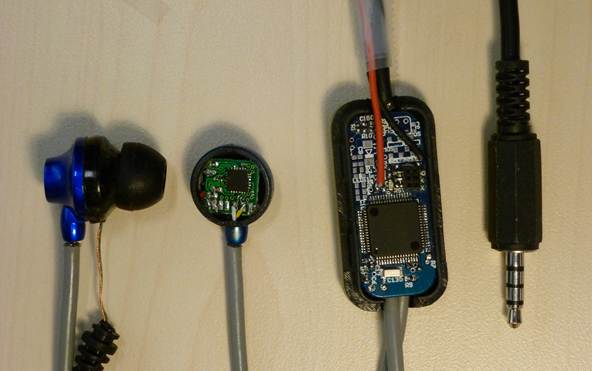 As part of a recent research project, Microsoft has incorporated health and fitness monitoring into a pair of earphones.
One application being developed for the hardware platform named Septimu, is a smartphone app called Musical Heart. The app enables Septimu to generate tunes based on a person’s mood or activity. So for example, fitness enthusiasts who want to keep the heart rate high can use Musical Heart to automatically up the tempo, helping them keep up the pace. Or for those feeling stressed or angry, Musical Heart could select something more soothing to help bring the heart rate and breathing down to a more relaxed level. Reported in PSFK.
A timely study published online last week in Proceedings of the National Academy of Sciences, demonstrated that ‘musical agency’ (i.e. music chosen by the study participants) greatly decreased perceived exertion during strenuous activity. (more…)
What the Blue Blazes and 3D printing apps
[grow_thumb image=”https://telecareaware.com/wp-content/uploads/2013/10/blue-blazes.jpg” thumb_width=”150″ /] 3D printing and apps are both very topical just now, so surely a 3D printing app has to be the height of popular appeal? Well perhaps not when MakerBot launched their Thingiverse iPhone App for the 3D Printing Community.
Unless I’m missing something critical, it just seems to be a smartphone photo album for keeping (2D) pictures of your favourite 3D printout on. Oh and you can “browse Thingiverse and check out featured, noteworthy, and popular designs, all on your phone”.
Telecare round up: the good, the bad and the future
Telehealth & Telecare Aware has largely moved on from individual reporting of incidents. However once in a while it is perhaps worth sitting back to review the recent past, and look to the future. In telecare, the world of environmental sensing has developed so fast recently that it takes an incident like that reported in Harlow last month where it appears as if (more…)
Practical use of big data in analysing the Mexican pandemic
Further to my write-up of the SIHI big data conference in Portsmouth, Wired has just published an excellent summary of Nuria Oliver’s presentation on how analysing anonymised mobile phone information made a significant contribution to understanding the dynamics of the recent H1N1 flu outbreak in Mexico in 2009.
Worth a read.
UK Comparative Healthcare Costs
OECD have recently updated their useful summary of comparative healthcare costs, with pointers to further detail if required.
It poses a bit of a puzzle by pointing out that the UK’s healthcare expenditure as a proportion of GDP is marginally higher than the OECD average, even though the number of physicians/unit of population is below the OECD average, the number of hospital beds on the same measure is significantly below the OECD average and MRI & CT scanners per million population are both less than half the OECD average. Although it’s not hard to guess the cause, no explanation is offered as to why costs are not therefore lower than the OECD average. (The number of nurses/unit of population is similar to the OECD average.)
Hat tip to Prof Mike Short.
Telehealth round-up: the good, the bad, and the future
Getting the bad news out of the way first, the seemingly-eternal researchers have thrown their grappling iron into the ancient store of data from the now-only-historically-relevant Whole System Demonstrator data pool and dragged out yet another unexploded bomb that they have then endeavoured to detonate, in the form of a short research article.
Thankfully the explosive has deteriorated with age so (more…)
Startup accelerators come to Germany
Hubraum, based in Berlin, announced the seven startups in its program including health technology, an online education startup, a digital identity provider and a service that lets users monetize their own personal data (perhaps Primal Shield will find a way to pay back those QS Obsessives, but alas it’s only from the social network). Three out of the seven are in health tech: Goderma (teledermatology), OPTretina (teleopthamology) and PocketAid (rewards for your wait time in hospital or doctor’s office room). Hubraum is backed by Deutsche Telekom, launched 2012 and recently collaborated with two accelerators in Tel Aviv to bring early-stage Israeli companies to Berlin and recently launched a programme in Krakow. Hubraum’s new accelerator batch…(Venture Village Berlin)
Humana, Healthrageous and some object lessons
The acquisition of the assets of Partners HealthCare spinoff Healthrageous by insurance and health service giant Humana is reverberating in the field in the US, particularly those in the buzziest digital health sectors. Some may look away, but a hard look provides some object lessons at the sheer unpredictability of the field for those who are innovating and attempting to shape consumer behavior and health. (Not behavioral health)
- Healthrageous had an impressive lineage and credibility. Developed over three years at Partners HealthCare, it was spun off in 2010, PHC members on the board, leadership from well-known/regarded figures such as Rick Lee and Mary Beth Chalk–and enjoyed abundant, rapid startup funding–$12.5 million in two rounds, the last exactly one year ago, from equally impressive investors, reportedly $15 million total. No raiding the credit cards here.
- It occupied what everyone for the past few years thought of as a sweet spot–personal health management targeted to employers/benefit managers along with health plans to lower costs that combined sensor-based telehealth data with individualized coaching and feedback–and data from a broad base of 10,000 users. (more…)
Oxitone Medical developing pulse O2 telehealth at wrist
Israel’s Oxitone Medical is one of the Lucky Thirteen participants in the GE/StartUp Health Academy Entrepreneurship Program [TTA 4 April]. By this profile in MedCityNews, it appears they are getting closer to being in market with their wrist-worn device. Current fingertip devices are uncomfortable and not wearable for long periods of time, a major advantage with a bracelet style (if not too clunky). The device is still in prototype, but the system will send out alerts to family, caregivers and a call center if saturation drops below a pre-set level, who can then attend or call for medical assistance. Their first markets are COPD and CHF patients. Device moves continuous oxygen saturation monitoring from the fingertip to the wrist



Most Recent Comments