Short takes: Athenahealth close to sold, Teladoc wants More of the Patient, CVS fewer store customers

Some thought starters for your weekend…

Reportedly, EHR and systems provider Athenahealth is thisclose to being sold. Via Becker’s Health IT, Seeking Alpha, a stock analysis site, connects the dots. In September, Bloomberg reported that private equity firms Veritas Capital and Elliot Investment Management (Evergreen Coast Capital) were considering selling Athenahealth for $20 billion or filing an initial public offering (IPO), two dramatic ways to exit. They entered in 2019 for $5.7 billion when it was already public, taking it private and combining it with a GE acquisition, Virence Health.

Timing is now Q1 2022. The most interested investors apparently are Hellman & Friedman, Bain Capital, KKR, Thoma Bravo, and Brookfield Asset Management. While no longer the powerhouse it once was in EHRs and related systems, it still can fetch a good return and provide a favorable exit for the two companies. Athenahealth had no comment for Becker’s. 

Teladoc and Big Telehealth wants More of the Patient, but will it be profitable? Our Readers are well aware of the War of the Roses (because it’s gone on so long) among the traditional telehealth players: Teladoc, Amwell, Included Health (Grand Rounds-Doctor on Demand), MD Live, with other smaller players jumping out of the juggernauts’ way and sticking to their knitting. With the addition of primary care (and, one can assume, the pandemic push), health systems and companies like Amazon Care and Babylon Health have jumped into the mix with ‘hit them where they ain’t’ offerings–Amazon offering house calls and services direct to employers, and Babylon 360 being offered to health plans and employers. Babylon and Teladoc’s Primary360 cover much the same ground, though, in connecting the patient users with an assigned doctor and primary care team for ongoing care.

As noted last month [TTA 7 Oct], the walls between payer and provider in primary care are collapsing in multiple ways in telehealth and payer models like insurtechs. Another model is Amwell’s reinforcing behavioral health capabilities (SilverCloud) and sliding into care management (Conversa and Amwell’s Converge platform).

Readers do not have to go far for confirmation that Teladoc aggressively wants most or all of the patient and isn’t going to settle for less. This is conveniently summarized by HISTalk from Teladoc’s Investor Day (with Editor’s emphasis)

image

Teladoc’s investor day presentation predicts that consumers will expect virtual-first encounters whose quality equals in-person ones and that offer them a variety of coordinated care services. The company says it has evolved from fee-for-service video visits and will become a partner with its customers in offering whole-person care at under value- and risk-based arrangements. It says it will be “the first place consumers turn to for all healthcare needs” for “whole-person care that is personalized, convenient, and connected.” TDOC shares dropped 8% on the day and have shed 25% in the past 12 months, with the company’s market value being $20 billion versus the $18.5 billion in cash it paid to acquire Livongo in late October 2020.

As we’ve previously noted, Teladoc has never made a profit. Many felt it overpaid for Livongo and cut loose too many in the leadership with truckloads of gold. Investors weren’t quite on board with the whole-person vision either, looking at the share price trends. 

CVS Aetna, on the other hand, wants fewer store customers, more patients. Their announcement this week is that they are closing 10% of their stores (900 of 9,900) to focus on urgent/chronic care HealthHUBs, expand those services, and cut down on the brick-and-mortar. This responds to Walgreens buying a majority interest in VillageMD/VillageHealth with adjacent full-service primary care practices and CareCentrix for home care [TTA 14 Oct]. Reuters

Say goodbye to the local, easily navigated ‘boulevard’ CVS, often furnishing food, writing tablets, wrapping paper, and paper towels along with prescriptions and shampoo, often patronized by an older age group, for a barn-like, coldly-lit superstore that you have to drive to. (And say goodbye to pharmacy head Neela Montgomery.) And why is every HealthHUB this Editor has seen unimpressive–strangely under-staffed or no-staffed, tatty waiting areas with a couple of plastic chairs, expanded with ugly outside trailers that cut down on parking spaces?

Cui bono? According to CNN Business, it’s Dollar General, which loves those local locations and has been planning to beef up its health-related OTC meds. They also now have a chief medical officer who is evaluating in-store eye exams, telemedicine, and partnerships with local pharmacies. Given inflation, more customers will be checking Dollar General out.

Short takes: Now J&J splits up, a Color(ful) $100M, Cue Health goes DTC, Amwell’s busy Q3, Teladoc’s Investor Day 19 Nov

Breaking up seems to be the thing this month. Now Johnson & Johnson is spinning off its consumer brands into a separately traded public company, retaining the pharmaceutical and medical device businesses. The consumer business includes such J&J global signature products such as Band-Aids, Neutrogena, Q-tips, Baby Powder and Shampoo, and the Listerine line of products. It’s expected to take 18 to 24 months. The pharma/med device business will retain the J&J brands, sub-brands like Janssen, and development in AI and robotics. The consumer products divisions will have to hunt around for a new one. Outgoing CEO Alex Gorsky must be heaving a sigh of relief and dreaming of a long vacation, as he won’t have to shepherd this one– incoming CEO Joaquin Duato starts in January. Pharma/med device is much larger, with $77 billion in revenue. Consumer accounts for $15 billion, with four products alone accounting for $1 billion each. The reason behind it, of course, are the talc lawsuits around Baby Powder and Shower to Shower which have been adroitly hived off, but continue. CNBC, Reuters

Population health and genomics is more Color(ful) than ever, with the company’s $100 million Series E topping off last year’s $167 million Series D for a total of $497 million since 2014 (Crunchbase). Valuation of the company is now at $4.6 billion. Color’s platform is targeted primarily to the public sector–health agencies, research institutions, employer organizations, health systems, and others for custom-built software that can integrate patient information and genomics with lab results and education.  It previously teamed up with the National Institutes of Health for the ‘All of Us’ project collecting research data from a broad scope of the US population. Mobihealthnews

San Diego-based Cue Health, which up to now was known for a molecular COVID-19 at-home test, is expanding its direct to consumer market with a virtual health platform featuring their COVID-19 test (on FDA EUA, CE marked) starting on 15 November. It’s expanding ‘on cue’ with a membership offering, Cue+, with 24/7 online medical consults, e-prescriptions, what they term CDC-compliant test results for travel through in-app video proctoring, and same-day delivery of their products. Membership starts at $49.99 per month for the lowest level plan, escalating to $89.99/month for supervised COVID-19 testing. To make this work requires a Cue Reader that costs $249 along with testing packs priced at $225 for three. Cue also has in development testing for other factors–where it started prior to the annus horriblis of 2020. Not for those on a tight budget, but if you need it…. Cue release, Mobihealthnews

Amwell’s busy Q3 in visits reflected the uptick in the ‘delta’ variant of COVID-19, but was disappointing on the earnings side as urgent care brings in less revenue than behavioral health or specialty care. Amwell’s year-to-year revenue was down less than 1% to $62.2 million, but the decrease is forcing a revision in 2021 full year forecasted revenue. The Converge platform [TTA 29 April] has reached 4,000 providers and 43 enterprise clients which was far more than forecasted. Newly acquired SilverCloud and Conversa Health [TTA 29 July] are integrated into Converge and already cross-selling. Amwell, however, remains in the red with a quarterly net loss of $50.9 million. Healthcare Dive  

The Telehealth Wars continue to see-saw, with Teladoc’s Investor Day on Thursday 19 Nov next week. According to Seeking Alpha, a stock analysis site, “Bank of America is cautious on TDOC ahead of the event, citing questions about the near-term margin trajectory and competition. Shares of Teladoc rose 22% in the three weeks following its last investor day.”

Short takes: Papa Health’s $150M Series D, Hinge Health’s $600M Series E, Teladoc’s revenue up 81% but continues in the red

Senior care provider Papa Health gains a Series D of $150 million, for a total of $240 million. Home care and older person support continues on its hot streak, after the blockbuster Honor-HomeInstead and Humana-Kindred at Home acquisitions plus smaller ones like ModivCare-VRI, Walgreens investment in CareCentrix, and Sharecare-CareLinx. The company’s valuation is now estimated at $1.4 billion. Papa’s technology connects older people with trained Papa ‘Pals’ for companionship and light home work through to Papa ‘Docs’ who serve to coordinate that person’s care. Their business model is to contract with payers such as Aetna and WellCare to offer its service as a benefit. They claim that they have added over 25 health plans as partners in the past seven months. This funding round was led by SoftBank Vision Fund 2 with participation from TCG, Tiger Global Management (which seems to have a bottomless bucket of funding), Canaan, Initialized Capital and Seven Seven Six. Mobihealthnews, Papa release

But Papa should envy Hinge Health, with its $600 million Series E for a total of $1 billion. In January, they had a $300 million Series D [TTA 14 Jan]. Their valuation is now boosted to an eye-blinking $6.2 billion, up from $3 billion. Tech and musculoskeletal seem to be a hot match, with Hinge’s virtual MSK Clinic for back and joint pain care and rehab including access to physical therapists, physicians, health coaches, and wearable sensors to guide exercise therapy. Existing investors Coatue and Tiger Global led the round, with new investors Alkeon and Whale Rock taking a $200 million stake.   FierceHealthcare 

Teladoc’s strong Q3 growth outstripped Wall Street’s forecast, but the competition is ever more fierce–and it continues in the red. Teladoc’s Q3 revenue grew 81%, to $522 million from $289 million prior year, beating a projection of $517 million by Zachs. Organic revenue growth (excluding acquisitions) was 32%. 2021 is now projected to be $2.02 billion, up 85% compared to 2020 revenue, and a 2022 projection of $2.6 billion. However, Teladoc continues to lose money, with an $84.3 million Q3 loss compared to $36 million in last year same quarter. Teladoc stated that it was primarily attributable to increased stock-based compensation and amortization of acquired intangibles, usually the case with acquisitions. Their stock value logically has taken a hit.

As previously reported, Teladoc has entered into the primary care sector with Primary360, now being pitched to health systems as a white-labeled “virtual front door” in addition to existing agreements with Aetna and Centene for 2022 exchange plans in four states. But as FierceHealthcare notes, the competition is equally hot, with care startups such as One Medical, Oak Street Health, Privia Health, and Forward. Accolade, which is a benefits platform, is acquiring PlushCare, and payers are setting up their own virtual-first primary care.

Amazon Care confirms five more cities, beefs up DC lobbying–but what’s the real game?

Amazon Care will be expanding in 2021, confirming five new locations–and maybe more. Kristen Helton, the director of Amazon Care, confirmed at HLTH21 that 2021 rollouts of the virtual + mobile care service would include Dallas, Chicago, Philadelphia, Boston, and Los Angeles, ‘to name a few’. Ms. Helton confirmed that Washington DC and Baltimore region are live. The website does not state active cities, only permitting a zip code search and confirmation. Pharmacy delivery is also available in select, but not stated, areas. Healthcare Dive

Amazon Care originated with Amazon employees as a telehealth service, with in-person available to employees in the Seattle area. By March, they opened the full service (Video and Mobile Care Medical) to other Washington state companies. At that time, they announced that Video Care will be available nationally to companies and all Amazon employees by the summer–and claimed that in-person services would be rolled out to multiple cities by the summer. That did not happen. 

In June, at a Wall Street Journal Tech Health event, while being coy about the rollout, Amazon Care VP Babak Parviz said that the service would look like:

  • Clinician chat/video connected within 60 seconds
  • If an in-person visit is required, a mobile clinician arrives within 60 minutes, who can perform some diagnostic tests, such as for strep throat, provide vaccinations and draw blood for lab work. For other diagnoses, that clinician is equipped with a kit with devices to monitor vital signs which are live-streamed to remote clinicians.
  • Medication delivery within 120 minutes

Basically, what is not being said is that Amazon has been slow walking Amazon Care, probably wisely. With telehealth visits, mobile care, and pharmacy, there are multiple and complex elements to mesh seamlessly, which is after all Amazon’s Promise. What’s not so seamless is paying for it. While for Amazon it is with immediate payment for service, it is not for the patient–obtaining reimbursement, if available, is left up to the patient–at least for now, as reports indicate they are negotiating with Aetna. Amazon Care is also its own closed network.

There’s also the blunt fact that Amazon is moving into territory well staked out by major players that integrate employers, insurance, primary care, and pharmacy: Teladoc, Amwell, Included Health (Grand Rounds + Doctor On Demand), MD Live. They are now joined by UnitedHealth Care’s announcement a few days ago of NavigateNOW, a new virtual-first commercial plan rolling out next month to employers in nine markets and 25 markets by end of 2022. It offers 24/7 primary care, urgent care, and behavioral health care services through Optum as well as UnitedHealthcare’s national provider network. Many services and medications will have $0 copayments. Healthcare Dive, FierceHealthcare

However, if the cost of Washington lobbying is any indicator, Amazon is blasting off in healthcare. According to a report in OpenSecrets.org, “Amazon, which is creating its own health care service, is the biggest corporate lobbying spender so far in 2021. The company has spent nearly $10.2 million on lobbying in the first six months of the year, and spent $18.7 million in 2020.” The (unfortunately paywalled) report in STAT confirms the hire of Claire Winiarek from PCMA to be their new director of health policy.

This Editor’s opinion remains as in June–that Amazon’s business plans for Care and Pharmacy, and generally in healthcare, are really about accumulating data, not user revenue, and are certainly not altruistic no matter what they say. Amazon will accumulate and own national healthcare data on Amazon Care and Pharmacy users far more valuable than whatever is spent on providing care and services. Amazon will not only use it internally for cross-selling, but can monetize the data to pharmaceutical companies, payers, developers, and other commercial third parties in and ex-US. That’s a very different game than traditional insurers and the telehealth giants.

What’s next for telehealth? Is it time for a correction?

crystal-ballThe boom may be over, between shrinking visit volume and a pileup of providers. Is a correction in the cards? The flood of funding that started in 2020 and has not abated was kicked off by the pandemic and a massive shift to telehealth visits in March/April 2020 from a barely-above-plant-life number in January/February.

Post-pandemic, the shift corrected.

  • The peak of 69% of visits tracked by Epic in April had tailed off to 21% as early as May 2020 [TTA 2 Sept 20].
  • National commercial claims data via FAIR Health was lower. They tracked its peak also in April 2020 at 13%, falling continuously monthly: May to 8.69%, 6.85% in June, 6% in August, and 5.61% in October [TTA 9 Jan].
  • By mid-year 2021, the claims numbers continued to lose altitude: June 4.5%, July 4.2% (FAIR Health monthly report).

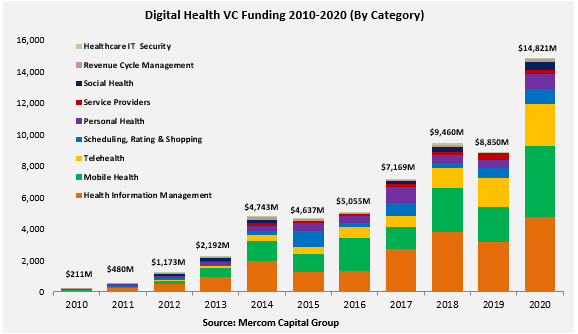
Despite the numbers, telehealth companies raised $4.2 billion of a total $15 billion in digital health funding in the first half of 2021, according to Mercom Capital Group, a global communications and research firm. So…what’s the problem with les bon temps rouler?

CB Insights notes the increased specialization of new entrants and, as this Editor has noted previously, the blending and crossing of business lines.

  • Companies like Heal, Dispatch Health, and Amazon Care will send a clinician to your house for a checkup–no running to your urgent care.
  • Kidney disease? Monogram Health. Musculoskeletal pain? Hinge Health. Child with an earache or fever? Tyto Care. Check symptoms first? Babylon Health.
  • Telemental health has gone from cocktail party repellent to the belle of the ball, concentrating on cognitive remote therapies. For the past year, it moved to more than half of all telehealth claims, with currently over 60% of procedure codes–and it’s consolidating. AbleTo was bought by Optum, Ginger bought by Headspace, SilverCloud by Amwell.

So for the Major League–Teladoc, Amwell, Doctor on Demand, Grand Rounds, and MDLive–what does this mean? If this interview with Teladoc’s CIO is an example, they plan to segue to a ‘hybrid’ model of virtual quick response plus integrating providers into a continuing care model with patients, creating a relationship with history and familiarity. A model that’s very much dependent on IT, analytics, and connecting with willing providers. But in this free-floating sea of verbiage, it didn’t come into misty focus till the very end, when he mentions Primary360 [TTA 7 Oct] and a virtual primary care team. (And let’s not forget Babylon360 along similar lines.) He finally sketches a view of all the connections to conditions coming together on a very far horizon. 

One can say it’s a cloudy crystal ball, indeed. FierceHealthcare, HealthcareITNews (Teladoc CIO interview)

Telehealth’s primary care wars heat up: Teladoc’s Primary360, Babylon 360

The new fronts in the Telehealth Wars continue to expand, with this week Teladoc announcing that their virtual primary care offering, Primary360, is now available for health plans, employers, and other payers. Babylon Health, in its push into the US market and their upcoming SPAC, also announced that their similar program, Babylon 360, is also being offered to health plans.

Both these services connect the patient users with an assigned doctor and primary care team for ongoing care. They emphasize building a relationship with a doctor and team, not just a random selection previously typical of telehealth. Both Teladoc and Babylon are fully virtual in exams and checkups, sending equipment where needed, ordering lab tests and prescriptions, and accepting your prior health records, plus have 24/7 coverage for urgent situations. Babylon’s service also offers a symptom checker and connection to social determinants of health (SDOH) community services.

It’s obvious that the payer-provider walls are coming down in all directions–telehealth is one more. Babylon, as we noted earlier, acquired two California-based practice groups. Payers like lower-cost, more convenient visits, and after a fractious start, have for some time. Many of the insurtechs either have close relationships with providers or have bought practices (Bright Health’s NeueHealth)–copying the Optums which have affiliations with or ownership of practices all over the US. It’s also another pressure on primary care practices around reimbursement. Often the answer is to either sell out or enter into value-based care arrangements.

For the patient/member, there’s the benefit of convenient care, and a relationship with a team, albeit not with an in-person option right now–if these services are consistent in their promise and steady in their physician/clinician groups. Mobihealthnews (Teladoc)

Is healthcare too much for Big Tech’s Google and Apple? Look at the track record. And David Feinberg’s $34M Cerner package.

With Google scattering Google Health to the four winds of the organization--the heck with what employees recruited for Health think of being reorg’d to, say, Maps or YouTube and falling through the corporate rabbit hole–more detail has leaked of Apple’s struggles. This time, on the scaleback list (a/k/a chopping block) is Health Habit. It’s an app in the Apple Store that connects users with AC Wellness, a doctor’s group in Cupertino, California. The ‘eligible participants’ are restricted to Apple employees. From the app site, they can check weight, nutrition, blood pressure, and schedule wellness checks. It seems to be the typical ‘skunk works’ project that’s not ready for prime time, but its public fate seems to be poorly timed and simultaneously, overblown because they are–well–Apple

Bottom line, is healthcare once again proving rather resistant to being leveraged by technological solutions? Those of us who go back to the Stone Age of health tech, or those of us who joined in the Iron and Bronze Ages, remember when you couldn’t get into a conference cocktail party without a “wellness” app. (You say you’re in behavioral and remote patient monitoring for older adults? Oh, look! A squirrel!)

Microsoft was going to dominate consumer health with their HealthVault for personal health records (PHRs). We know how that turned out–dead apps, Fitbit an also-ran bought, Pebble and Misfit going to the drawer of failed toys, Jawbone t-boning plus Intel and Basis written off in 2017, and HealthVault unlamentedly put out with the trash at the end of 2019. Oh yes, there was an earlier Google Health for PHRs, which died with a whimper back in 2012 or so.

The press releases crow about Big Tech’s mastery of complexity, yet going off on their own without partners–or even with partners–never seems to work. In the industry, it makes for a few good articles and the usual rocket launching at places like Forbes, but the pros tend to treat it with a shrug and pull out a competitive plan. Glen Tullman, founder of Livongo who will never have to worry about paying for chateaubriand for two for the next billion years or so, stated the obvious when he said that patients cared about the overall experience, not the tech.

Speaking of experience, Amazon Care promises the best for its employees and enterprise accounts–a one-minute telehealth connection, a mobile clinician if needed within the hour, and drugs at the door in two hours. All with direct pay. This has met with skepticism from telehealth giants like Teladoc and Amwell with established corporate bases. There’s also CVS Health and Walgreens. The Editor has opined that care isn’t Amazon’s game at all–it’s accumulating and owning national healthcare data on Amazon Care and Pharmacy users that is far more valuable than whatever is spent on providing care and services [TTA 16 June]. Will Amazon really be able to pull it off?

Paddy Padmanabhan, the author of Healthcare Digital Transformation, lists a few more reasons It’s Too Hard For Big Tech In Healthcare in his HealthcareITNews article here….

  • Healthcare is a part-time job for Big Tech
  • Big tech firms want to solve the healthcare problem by themselves
  • Selling technology is not the same as selling healthcare services

…but holds out some hope that the initial success of “digital-first and virtual-first providers of healthcare emerging as challengers” will point the way for them.

And speaking of Google Health and former employees, Cerner’s necessary SEC disclosure today of new CEO and president David Feinberg, MD’s compensation package was sure to create some talk in Googleville among his now-scattered team. $34.5 million over the next 15 months is structured as follows:

  • $900,000 base salary
  • a target cash bonus of $1.35 million
  • a one-time cash bonus of $375,000 stock
  • $13.5 million in Cerner’s restricted shares for 2022
  • $3.375 million in stock shares for the fourth quarter of 2021
  • a new hire award of $15 million in restricted stock shares to offset his equity loss with Google. 

Whew! Becker’s HealthIT

News roundup: update on UnitedHealth/Change Healthcare DOJ check, Tunstall adds new CTO, Amwell’s gloomy second half, Teladoc’s Aetna deal, Fitbit and LifeScan diabetes

Just the news, no deals. UnitedHealth Group’s $13 billion acquisition of diversified health IT/imaging/payments company Change Healthcare has hit another snag. Back in March, the US Department of Justice requested specific information as part of DOJ’s review of the merger under the Hart-Scott-Rodino Antitrust Act (HSR). Both UHG and Change have agreed with DOJ to not certify compliance with the request before 15 September, then wait an additional 120 days, based on a 7 August Securities & Exchange Commission (SEC) filing. This could be shorter if DOJ formally advises them that their investigation is closed. Announced in January as a giant addition to UHG’s Optum unit, this now looks like the sale will close sometime in December–if it is not derailed. Becker’s Health IT with a brief recap. This was not a good week for UHG as they had to pay $15.6 million to settle a US Department of Labor finding that they did not pay out-of-network mental health claims at parity, wrongfully denied others, and flagged still others for utilization reviews. FierceHealthcare

Tunstall Healthcare announces a new Group Chief Technology Officer. Gary Steen joins Tunstall from broadband provider TalkTalk where he was Group Managing Director for Technology. He will lead Tunstall’s innovation and development function globally including all solutions and products from Tunstall’s technology delivery centres in the UK, Sweden and Germany. Previously, he was with MDS Global, a software services business active in Europe, Australia, and the US. Tunstall release.  Hat tip to Jenny Marston at Lucky North.

Amwell projects that Covid-19 will depress second half telehealth results by 200,000 visits and $8 million. CEO Ido Schoenberg MD made this surprising projection on the second quarter investor call, but the projection may be sound. His rationale is that there will be not much of a cold and flu season, as the latest virus variants will have people masking up and social distancing (and presumably avoiding indoor crowds. As we’ve noted previously, the Brothers Schoenberg tend to be contrarians on various headline trends (e.g. looking askance at Amazon Care biting into the enterprise telehealth business and hospital-grade in home care). One would assume that if more stay away from in-person care, telehealth would increase beyond the current claims rate of 5% especially in mental health which is half of telehealth claims. But this could be some clever sandbagging for investors, as he went on to say in the call that if the impact of Covid isn’t as bad as we think, there’s always the flu! FierceHealthcare

Amwell’s frequent sparring partner in various courts, Teladoc, announced that they would be powering Aetna Virtual Primary Care for their Aetna members in national self-funded employers. This is a trifecta of Teladoc’s physician-led care team model, Aetna’s provider network, and CVS Health services at MinuteClinics and where available, CVS HealthHUBs. The virtual visits will have no co-pay for as well as select in-person CVS Health services. CVS Health release, FierceHealthcare

Fitbit is, believe it or not, still around. They announced a partnership with LifeScan diabetes monitoring to integrate its health tracking apps with the company’s glucose monitoring devices for diabetes management. The Fitbit tools that track activity such as daily activity, nutrition, and sleep will provide tracking of impact on blood glucose levels. FierceHealthcare

Telehealth Wars: Amwell’s raises game with buys of SilverCloud and Conversa Health (updated); Teladoc’s slow member, hospital growth lead to $133M Q2 loss

Updated. Amwell’s announcement today (28 July) of the twin acquisitions of SilverCloud Health and Conversa Health for the tidy total sum of $320 million in cash and stock was, if not quite a ‘see ya and raise ya’ move, a confirmation that Amwell was going to raise its game, at long last, versus Teladoc. SilverCloud provides digital telehealth programs for common behavioral health conditions. A spinoff of Trinity College Dublin, it counts as US clients Kaiser Permanente, Optum, and Providence Health, plus over 80 percent of NHS’ mental health service. Conversa is a StartUp Health portfolio company that developed a scalable care management triage system for at-risk patients that provides automated patient outreach and engagement tools that can move them to higher levels of care where needed. Clients include Northwell Health, UCSF Health, UNC Health, Merck, MedStar Health, and Prisma Health. 

For Amwell, this expands their capabilities in the hot behavioral health area and, with Conversa, into a care management platform targeted to providers, pharma, and payers. They see digital workflows, patient engagement, a longer-term relationship with their consumer base through the continuum of care, through these two companies’ hospital, health system, health plan, and employer clients.

The wrinkle? Neither company is all that far along–SilverCloud has total funding of only $26 million but is more established with 750,000 clients and 300 organizations. Conversa’s Series B was a tiny $8 million for total funding of $34 million. Amwell also paid a premium price. According to Healthy Skeptic, a blog written by long-time UnitedHealth Group senior healthcare executive Kevin Roche, their combined revenue was $15 million–more than a 20x multiple of the purchase price. The other challenge for Amwell? Making all the systems work together in a meaningful way–and to market what can be a confusing picture properly. Amwell press release, Mobihealthnews

Update 2 August. The Irish Times, undoubtedly working a local contact at Silver Cloud, ascertained that Silver Cloud was purchased by Amwell for a price in excess of $250 million. That means a tidy payday of €23 million ($27.3 million) for the company’s founders – Ken Cahill, James Bligh, Karen Tierney, Dr John Sharry, and Gavin Doherty. If that is so, Conversa was bought for $70 million or less. One wonders why a shell game tactic was used, as Conversa is known to be an early-stage company. Hat tip to HISTalk today.

For Teladoc, growing beyond urgent care, plus integrating the former Livongo and InTouch Health, presents difficulties. Telehealth usage continues to shrink as in-person visits rebound save for behavioral health, which is also bad news for the payers as utilization goes up. Teladoc now struggles to add new members after last year’s pace. Their hospital business that came with last year’s acquisition of InTouch Health is growing more slowly than expected [TTA 16 July]. The expected cross-sales traction with the former Livongo hasn’t caught fire yet, but that may change with myStrength Complete and the myStrength app going live with health plans or employers starting this month. The first enterprise customers are a major Blues plan (likely HCSC) and a Fortune 100 employer. [TTA 14 May]. Teladoc is also growing into other areas with more continuous user engagement, such as chronic care, weight management, and primary care. That program, Primary360, is in “very very late-stage” discussions with multiple payers. Teladoc, which has never been profitable, lost $133.8 million for Q2.   Healthcare Dive

The implications of Teladoc’s integration into Microsoft Teams

The Big News this week was the terse announcement by Microsoft and Teladoc that Teladoc’s Solo application for hospitals and health systems will be integrated into Microsoft Teams applications. The integration includes workflows and through Solo, integration into EHRs while remaining in Teams.

During the pandemic, many health systems resorted to Microsoft Teams to communicate internally and one-on-one with patients. Integration means that while on the Teams consult, a clinician can securely access clinical data included within the EHR and workflows via Teladoc Health Solo without leaving it. It can also connect care teams on the consult. The release also mentions the magic words artificial intelligence and machine learning, without giving examples. 

As of now, with telehealth receding to perhaps 5% of visits based on claims [TTA 9 July], it’s a strategic win for Teladoc to integrate with a part of the Microsoft suite widely used by providers. It also builds on an existing relationship between the companies, as Teladoc already uses Azure as one of its cloud providers. Health systems still have to license Teladoc Solo if they do not already, and engineering work is yet to be done. Teladoc has a substantial foothold in this market due to its July 2020 acquisition of InTouch Health. InTouch’s hospital-to-home telehealth is now Teladoc Solo, with a separate line of business into the specialty telehealth consult market through its portable wheeled telehealth carts for in-hospital use. It’s notable that the InTouch brand remains, albeit visibly transitioning to Teladoc.

According to Credit Suisse’s analysis (page 3), 46% of C-Level executives from hospitals and health systems (combined representing 563 hospitals) said that they currently work with Microsoft Teams as a telemedicine vendor. 11% said they already work with Teladoc/InTouch Health.

As for telehealth already used by providers, such as Zipnosis’ ‘white label’ triage/telehealth system (now owned by insurtech Bright Health) and Bluestream Health, can they compete? Also FierceHealthcare

Telehealth usage going flat, off by 1/3 and declining: Trilliant Health study

Trilliant Health, a healthcare data analytics and advisory shop based in Tennessee, has run some projections on the US healthcare market and telehealth, and they’re not as bright as many of us–and a lot of investors plus Mr. Market–have believed. It opens up on page 4 of the electronic document (also available in PDF) with this ‘downer’–that the largest sector of the largest global economy is overbuilt and unsustainable. Hospitals and health systems have operated for decades that basic economic factors–demand, supply, and yield–don’t apply, and there are more companies competing with them for the consumer healthcare dollar than they realize–with more proliferating every day. 

Sledding through their 160-page report, we turn to our sweet spot, telehealth, and Trilliant is not delivering cheerful news (pages 32-43). 

  • Unsurprisingly, demand for telehealth is tapering off. Based on claims data for face-to-face video visits, excluding Medicare fee-for-service (Original Medicare) and self-pay visits, they peaked above 12 million in April 2020 and, save for a bump up in December 2020-January 2021, steadily declined to about 9 million by March 2021.
  • Teladoc, the leading provider, is projecting that 2021 volume will only represent 4 percent of the US population–a lot more than before, but not growing as it did in 2020.
  • Telehealth’s growth was astronomical on both coasts–California, Massachusetts, Vermont, Oregon–and Hawaii–but relatively lower in middle and Southern America in places like Wyoming, North Dakota, Mississippi, and Iowa. Telehealth usage is declining sharply in that region as well but across the board in all states including California. In fact, Phoenix and Dallas had higher telehealth utilization pre-pandemic than during it.
  • Mental health drove telehealth growth during the pandemic, representing 35 percent of claims, almost four times the next group of categories at 8 percent. The largest group of diagnoses were for anxiety and depression among women 20-49. With the reopening of the US economy and children heading back to school, will this sustain or decline?
  • Women 30-39 are the largest users of telehealth–pre, during, and post-pandemic

Telehealth is not only proliferating, it is going up against now-open urgent care, retail clinics from Walgreens, Walmart, and CVS, plus tech-enabled providers that blend virtual care with home care, such as Amazon with a full rollout of Amazon Care and other employers. The cost of care is also a negative driver. FierceHealthcare analyzes other parts of the report impacting practices, health systems, and hospitals.


Disruption or giveaway: Amazon Care signs on employers, but who? Amazon Pharmacy’s 6 months of meds for $6. (updated)

Is this disruption, a giveaway, or blue smoke requiring IFR? An Amazon Care VP, Babak Parviz, said at the Wall Street Journal’s Tech Health virtual event that all is well with their rollout of virtual primary care (VPC). Washington state is first, with VPC now available nationally to all Amazon employees as well as companies. However, Mr. Parviz did not disclose the signed-up companies, nor a timetable for when in-person Amazon Care practices will be expanding to Washington, DC, Baltimore, and other cities in the coming months.

Mr. Parviz also provided some details of what Amazon Care would ultimately look like:

  • Clinician chat/video connected within 60 seconds
  • If an in-person visit is required, a mobile clinician arrives within 60 minutes, who can perform some diagnostic tests, such as for strep throat, provide vaccinations and draw blood for lab work. For other diagnoses, that clinician is equipped with a kit with devices to monitor vital signs which are live-streamed to remote clinicians.
  • Medication delivery within 120 minutes

FierceHealthcare

The timing of the Amazon Care rollout has not changed since our coverage of their announcement in March. This Editor noted in that article that Credit Suisse in their overview was underwhelmed by Amazon Care as well as other efforts in the complex and crowded healthcare space. Amazon Care also doesn’t integrate with payers. It’s payment upfront, then the patient files a claim with their insurer.

Existing players are already established in large chunks of what Amazon wants to own.

  • Both Amwell’s Ido Schoenberg [TTA 2 April] and Teladoc’s Jason Gorevic (FierceHealthcare 12 May) have opined that they are way ahead of Amazon both in corporate affiliations and comprehensive solutions. Examples: Amwell’s recently announced upgrade of their clinician platform and adding platforms for in-home hospital-grade care [TTA 29 Apr], Teladoc’s moves into mental health with myStrength [TTA 14 May].
  • Even Walmart is getting into telehealth with their purchase of a small player, MeMD [TTA 8 May].
  • CVS has their MinuteClinics affiliated with leading local health systems, and Walgreens is building out 500 free-standing VillageMD locations [TTA 4 Dec 20]. CVS and Walgreens are also fully integrated with payers and pharmacy benefit management plans (PBM).

Another loss leader is pharmacy. Amazon is also offering to Prime members a pharmacy prescription savings benefit: six-month supplies of select medications for $6. The conditions are that members must pay out-of-pocket (no insurance), they must have the six-month prescription from their provider, and the medication must be both available and eligible on Amazon Pharmacy. Medications included are for high blood pressure, diabetes, and more. The timing is interesting as Walmart also announced a few days earlier a similar program for Walmart+ members. Mobihealthnews.

crystal-ballThis Editor’s opinion is that Amazon’s business plans for both entities and in healthcare are really about accumulating data, not user revenue, and are certainly not altruistic no matter what they say. Amazon will accumulate and own national healthcare data on Amazon Care and Pharmacy users far more valuable than whatever is spent on providing care and services. Amazon will not only use it internally for cross-selling, but can monetize the data to pharmaceutical companies, payers, developers, and other commercial third parties in and ex-US. Shouldn’t privacy advocates be concerned, as this isn’t being disclosed? 

Teladoc integrates the myStrength cognitive mental health app with their telehealth network

Teladoc gets into the mental health app business, end to end. The myStrength cognitive health app, which was picked up as part of the Livongo acquisition, reappears as a Teladoc product called myStrength Complete. The front door is the myStrength app, which offers coaching, positive psychology, and cognitive behavioral therapy, which then connects with Teladoc’s therapists and psychiatrists to offer a comprehensive experience.  

Teladoc will offer this to consumers through their health plans or employers starting in July. The first enterprise customers, according to Teladoc, are a major Blues plan and a Fortune 100 employer. 

The company also provided the results of their proprietary third-party research, which indicated unsurprisingly that a majority who sought support (69 percent) indicated it would be difficult and/or overwhelming to use multiple websites, mobile apps, or virtual care platforms to address mental health needs. Nearly all of those surveyed who said they sought virtual mental health support – 92 percent – reported at least some improvement during the pandemic, with over one-third reporting significant improvement or a “breakthrough” during treatment.

An unintended consequence of Teladoc’s move? A cooling off of the mental health boomlet, now that the elephant has chosen where to sit. The stand-alone cognitive health apps such as AbleTo, Lyra Health, and Ginger, now need to seek partners, such as health plans (Vida Health) or telehealth providers. Unfortunately, the telehealth providers remaining have either some behavioral health capabilities–and that may be enough for their business–or find the price too high. Teladoc release, Mobihealthnews

News roundup: Buddi’s £500M LSE float, Accolade to buy PlushCare for $450M, Teladoc adds chief innovation officer, Tyto Care’s Italy expansion

Buddi going public later this year. Something we missed and found (quite by accident) was that the Buddi personal alert wearable will be floated on the London Stock Exchange later this year. According to the report in SkyNews, CEO and founder Sara Murray has appointed Zeus Capital to manage it. The value is rumored to be up to £500 million and will be a great reward for Ms. Murray and her other early investors. The bands, which connect to smartphones or a wireless-connected clip, then to pre-set connections or their 24/7 support, retail for up to £248. Buddi is reported to be used by more than 80 percent of local authorities in the UK, UK police forces for domestic violence cases and witness protection, lone worker situations, plus government customers internationally. Buddi also designs and assembles their Buddi units in the UK. Also City A.M. 

Accolade, a health benefits navigation provider, announced a definitive agreement to purchase one of the smaller telehealth players, PlushCare, for a plush price of $450 million, composed of $40 million in cash, $340 million in Accolade common stock, and up to (the usual) additional $70 million of value payable upon the achievement of defined revenue milestones following the closing, expected in June. Accolade, which itself went public on NASDAQ in July, raising $220 million, then in October floated additional shares to raise $221 million, has been on a telehealth acquisition tear of late. In March, they closed their acquisition of virtual second medical opinion provider 2nd.MD for $460 million. PlushCare will enable Accolade to directly offer primary and mental health care telehealth to its members. According to Steve Barnes, chief financial officer at Accolade, their addressable market will increase nearly five-fold to more than $200 billion. One wonders whether their existing relationships with Teladoc and Livongo will continue.  Release.  Also HealthcareDive and FierceHealthcare.

Teladoc adds a chief innovation officer. Claus Jensen, PhD comes from Memorial Sloan Kettering Cancer Center, where he served as chief digital officer and head of technology. His purview will include product innovation, information systems, health informatics, and data products. Previously, he was with Danske Bank, IBM, and chief technology officer of CVS Health-Aetna. Release, Becker’s Hospital Review

TytoCare advances further into Italy in a partnership with Multimed srl, a local medical device company. The partnership will develop the market there with local providers, hospitals, elder care facilities, independent physicians, and pharmacies, as well as at-home monitoring. Multimed is a multi-line distributor of surgical devices for robotic surgery, endoscopy, laparoscopy, orthopedics, sanitization/sterilization, and similar. Tyto earlier explored the Italian market in a partnership with the ASL of Vercelli hospital group, where physicians monitored and treated elderly and pediatric COVID-19 patients, performing pulmonary, cardiological, and dermatological telehealth visits. Release

Weekend reading: the strange reasons why Amwell doesn’t consider Amazon a competitor; ground rules for the uneasy marriage of healthcare and technology

Yahoo Finance interviewed co-CEO/founder of Amwell Ido Schoenburg, MD on the company’s 2020 results and forecast for 2021. It makes for interesting but convoluted reading on their growth last year in what is a consolidating field where Amwell was once one of the undisputed two leaders. They now compete against payers acquiring telehealth companies (MDLive going to Optum) and mergers like Doctor on Demand-Grand Rounds that are taking increasing market shares. Then there are specialty providers like SOC Telemed and white-labels like Bluestream Health. However, there are a couple of whoppers in the happy talk of growth for all. Dr. S pegs the current run rate of telehealth visits at 15-20 percent. The best research from Commonwealth Fund (October) and FAIR Health (August) tracked telehealth at 6 percent of in-office visits. Epic Health Research Network measured 21 percent at end of August. [TTA summary here

Then there’s the tap dance around Amazon Care. His view is that telehealth companies all need a connective platform but that each competitor brings ‘modular components’ of what they do best. What Amazon excels at is the consumer experience; in his view, that is their contribution to this ‘coalition’ because healthcare doesn’t do that well. There’s a statement at the end which this Editor will leave Readers to puzzle through:  

“And Amazon and others could bring a lot of value to those coalitions, they should not be seen as necessarily competing unless you’re trying to do exactly what they do. And there are some companies, including some telehealth companies, that that’s what they do. They focus on services. They try to sell you a very affordable visit with a short wait time and a good experience. They should be incredibly concerned when someone so sophisticated as Amazon is trying to compete in that turf.”

The last time this Editor looked, none of these companies were non-profit, though nearly all are not profitable.

Gimlet EyeLooking through her Gimlet Eye, Amazon Care is a win-win, even if the whole enterprise loses money. In this view, Amazon accumulates and owns national healthcare data far more valuable than the consumer service, then can do what they want with it, such as cross-analysis against PillPack and OTC medical shopping habits, even books, toys, home supplies, and clothing. Ka-ching!

A ‘bucket of cold water’ article, published in Becker’s Health IT last month, takes a Gimlety view of the shotgun marriage of healthcare and technology. Those of us laboring in those vineyards for the better part of two decades might disagree with the author in part, but we all remember how every new company was going to ‘revolutionize healthcare’. (The over-the-top blatherings of ZocDoc‘s former leadership provide a perfect example.) The post-Theranos/Outcome Health/uBiome world has demonstrated that the Silicon Valley modus operandi of ‘fake it till you make it’ and ‘failing fast and breaking things’, barely ethical in consumer businesses, are totally unethical in healthcare which deals in people’s lives. Then again, healthcare focused on ‘people as patients’ cannot stand either. Stephen K. Klasko, MD, President and CEO, Thomas Jefferson University and Jefferson Health in Pennsylvania, advocates for a change–far more concisely than Dr. Schoenburg. You may want to pass this along.

Two major moves and what they mean: Doctor on Demand, Grand Rounds to merge; Amazon Care will go national by summer (updated)

This week’s Digital Health Big Deal (as of Wednesday!) is the merger agreement between telehealth/virtual visit provider Doctor on Demand and employer health navigator Grand Rounds. Terms were not disclosed. It’s important because it extends Grand Rounds’ care coordination capabilities beyond provider network navigation and employee clinical/financial tools for six million employees into an extensive telehealth network with 98 million patients in commercial, Federal, and state health plans.

Both companies had big recent raises–$175 million for Grand Rounds in a September 2020 Series E (Crunchbase) and Doctor on Demand with a $75 million Series D last July (Crunchbase). The transaction is a stock swap with no cash involved (FierceHealthcare, CNBC), and the announcement states that the two companies will operate under their own brands for the time being. Owen Tripp, co-founder and CEO of Grand Rounds, will run the combined company, while Doctor on Demand CEO Hill Ferguson runs DOD and joins the board. The combined company is well into Double Unicorn status with over $2 bn in valuation. Also Mobihealthnews.

What it means. Smaller (than Teladoc and Amwell) telehealth companies have been running towards M&A, with the most recent MDLive joining Optum’s Evernorth [TTA 27 Feb] creating interstate juggernauts with major leverage. Doctor on Demand was looking at their options for expansion or acquisition and decided 1) the time and the $ were right and 2) with Grand Rounds, they could keep a modicum of independence as a separate line while enjoying integration with a larger company. The trend is profound enough to raise alarms in the august pages of Kaiser Health News, which decries interstate telehealth providers competing with small and often specialized in-state providers, and in general the loosening of telehealth requirements, including some providers still only taking virtual visits. Contra this, but not in the KHN article, this Editor has previously noted that white-labeled telehealth providers such as Zipnosis and Bluestream Health have found a niche in supplying large health systems and provider groups with customized telehealth and triage systems.

UPDATED. In the Shoe Dropping department, Amazon Care goes national with virtual primary care (VPC). To no one’s surprise after Haven’s demise, Amazon’s pilot among their employees providing telehealth plus in-person for those in the Seattle area [TTA 17 Dec 20] is rolling out nationally in stages. First, the website is now live and positions the company as a total care management service for both urgent and primary care. Starting Wednesday, Amazon opened the full service (Video and Mobile Care) to other Washington state companies. The in-person service will expand to Washington, DC, Baltimore, and other cities in the next few months. Video Care will be available nationally to companies and all Amazon employees by the summer.

Notably, and buried way down in the glowing articles, Amazon is not engaging with payers on filing reimbursements for patient care. Video Care and Care Medical services will be billed directly to the individual who must then send for reimbursement to their insurance provider. The convenience is compromised by additional work on the patient’s part, something that those of us on the rare PPO plans were accustomed to doing back in the Paper Age but not common now. It also tends to shut out over 65’s on Medicare and those on low-income plans through Medicaid. It is doubtful that Amazon really wants this group anyway. Not exactly inclusive healthcare.

TechCrunch, FierceHealthcare. Jailendra Singh’s Credit Suisse team has a POV here which opines that Amazon continues to have a weak case for disruption in VPC, along with their other healthcare efforts, and an uphill battle against the current telehealth players who have already allied themselves with employers and integrating with payers.