


A relatively quiet week woke up at the end.
Garner Health’s doctor finder app now has another $100 million to back it. The Series E was led by Index Ventures with participation from existing investors including Kleiner Perkins, Redpoint, Thrive, Sequoia, Founders Fund, and Kaiser Permanente Ventures. The round brings Garner’s valuation to $2.74 billion. It’s a far cry from the 5x Series E typical raises of a few years ago, but fairly healthy in the current slow recovery of lettered raises and more conservative fundings. Previous funding was $219 million through a 2024 Series D. Garner’s apps (Assistant and Research Agent) are targeted to employers and benefit managers as a service to connect employees with high-performing in-network physicians, based on clinical performance data and claims information, and to save on total healthcare spend. The company claims that they serve over 700 companies. The app is still available to individuals as a free download. Release
 Veradigm finally files its financial reports for 2023 and 2024, and they’re not cheering. This took the form of a ‘Super 10-K’, a comprehensive annual report that covers two fiscal years, as promised on Veradigm’s investor call last February.
2023 to 2024 results weren’t cheering for the shareholders, as revenue dropped 5% 2024 compared to 2023, continuing their multi-year decline. The company in 2024 swung to a net loss, a change of $341 million due to impairments and other costs. Adjusted EBITDA was affected by 29%.
- Revenue of $594 million in 2024 compared to revenue of $626 million in 2023, which includes $19 million of non-recurring revenue in 2023 from settlements.
- Net Loss in 2024 was $292 million compared to Net Income of $49 million in 2023. The net loss in 2024 reflects an impairment of goodwill and other assets as well as the impact from transaction and other costs.
- Adjusted EBITDA of $94 million in 2024 compared to Adjusted EBITDA of $132 million in 2023.
Veradigm has three main market segments: provider, payer, and life science. It is adjusting its software and implementations to incorporate AI, which was briefly discussed on their earnings summary call 26 May. The transcript and audio is on Seeking Alpha.
According to Veradigm’s release, they will file their 2025 Form 10-K before year-end 2026. Revenue is estimated to be in a range between $584 million and $589 million, flat from 2024. Nothing definite was stated about their 2026 filings with the SEC, which will be required before they can file for relisting on Nasdaq or on any exchange. From the release, “The Company remains focused on getting current and staying current with its SEC filing obligations and subsequently relisting its common stock on a national exchange. As of May 12, 2026, the Company had 109.0 million shares of common stock and 13.3 million of unvested restricted stock units outstanding.”
Veradigm also has a new CFO, Christian Greyenbuhl, replacing interim CFO Lee Westerfield, who came for six months and stayed for two years. He will remain in a ‘strategic advisory role’ until March 2027, a standard workout period. Mr. Greyenbuhl was formerly CFO of Ministry Brands, which provides over 90,000 faith-based organizations and private sector businesses, SaaS payments and background screening solutions. Previously, Christian was a longtime finance and operating executive at ADP.
It’s now the fourth year of make-up reporting since 2022. Veradigm’s their failure to provide audited reports due to financial software problems has been an embarrassment for a software and once-leading health IT company. In 2025, 15% of staff were cut, three facilities closed, and will exit at least two more as well as their present Chicago HQ by 2027. Our February article also provides a capsule of Veradigm’s recent troubled history and our back file as the situation for the former Allscripts developed.
And to wind up with something that could really help in hospitals in moving patients from point A to B…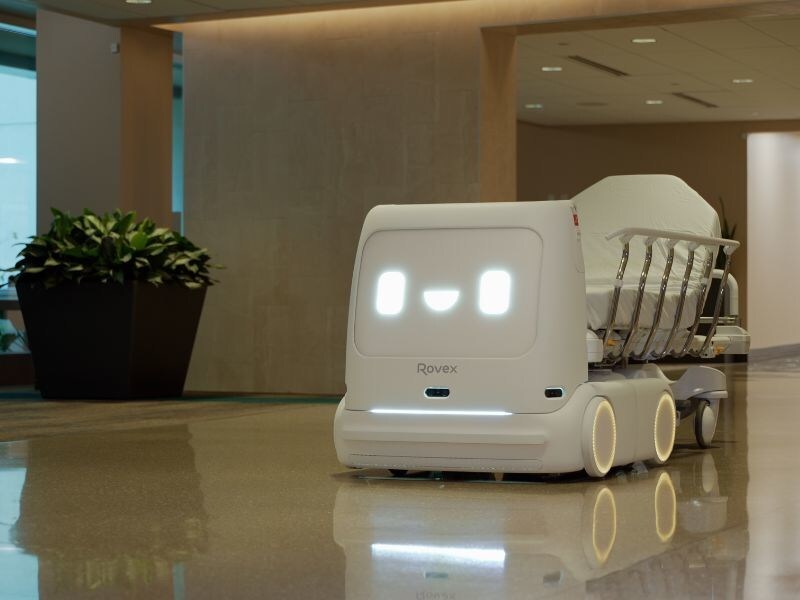 Rovex has developed a robotic transporter for in-hospital patients. The transporter, Rovi, is the world’s first autonomous transport robot that can transport any hospital stretcher yet maintain contact with the care team. It is being piloted without patients at BayCare Health System’s Morton Plant Hospital. The pilot is designed to evaluate workflows, transport patterns, staff burden effects, and operational opportunities within the hospital environment. Later phases will support potential in-hospital robotic stretcher movement. Those of us with hospital experience either in the clinical setting or as patients know how speed of transfer affects the entire clinical workflow and care. BayCare is the largest not-for-profit academic health care system in West Central Florida. Rovex is a two year old company, still in seed funding of $2.27 million (Pitchbook) and headquartered in Gainesville, Florida. BayCare release, Interesting Engineering



Most Recent Comments