TTA’s May closing: Oracle’s acute care EHR share now 20% , Oura tests IPO, Veradigm catches up, Garner’s $100M raise, and the societal effects of the AI ‘religion’


28 May 2026

It’s a lighter news week, but our Must Reads are a little on the ‘heavy’ side. Oracle Health stays in the news with its eroding EHR market share down to 20% and what that means for their future. The Oura ring is testing the IPO market with a preliminary filing. And in more good news, Veradigm is finally catching up with filing its annual reports through 2024 and Garner Health garners $100 million. Our Must Reads are both on the subject of AI’s social and economic effects, coming from two vastly different perspectives. An article of faith, indeed!

Please feel free to comment on the articles and pass along this Alert. Let me know if this is worth it to you!

Weekend Must Reads on AI: its societal and economic effects, and why its developers see it as replacing God

Short takes: Garner Health’s $100M Series E; Veradigm files financial reports for ’23/’24, moved to net loss; Rovex debuts autonomous in-hospital transport robot

Post-holiday news roundup: Oracle Health acute care EHR market share crumbles to 20%–what that means; retail real estate downsizer marketing Walgreens leases; Oura files for US IPO, Swoop buys NimbleRx

Last Week’s Headlines

Holiday weekend roundup: VA asks for ‘cyberspeed’ 25% EHR budget bump, update on EHRM fraud indictment; Commure raises $70M; Innovaccer buys Caduceus, lays off staff; Doximity, OpenEvidence slugfest gets hot

Perspectives: AI Hallucinations in Behavioral Health–Why Access Needs Better Infrastructure, Not Better Chatbots

Perspectives: The Next Phase of Healthcare AI Will Depend on Operational Execution

US Senate Committee on Aging hearings on senior safety 20 May–available online (updated for reports)

* * *
Advertise on Telehealth and Telecare Aware
Support not only a publication but also a well-informed international community.

Contact Editor Donna for more information.

Help Spread the News

Please tell your colleagues about this free news service and, if you have relevant information to share with the rest of the world, please let me know!

Donna Cusano, Editor In Chief
donna.cusano@telecareaware.com

Telehealth & Telecare Aware – covering news on latest developments in telecare, telehealth and eHealth, worldwide.

Short takes: Garner Health’s $100M Series E; Veradigm files financial reports for ’23/’24, moved to net loss; Rovex debuts autonomous in-hospital transport robot

A relatively quiet week woke up at the end.

Garner Health’s doctor finder app now has another $100 million to back it. The Series E was led by Index Ventures with participation from existing investors including Kleiner Perkins, Redpoint, Thrive, Sequoia, Founders Fund, and Kaiser Permanente Ventures. The round brings Garner’s valuation to $2.74 billion. It’s a far cry from the 5x Series E typical raises of a few years ago, but fairly healthy in the current slow recovery of lettered raises and more conservative fundings. Previous funding was $219 million through a 2024 Series D. Garner’s apps (Assistant and Research Agent) are targeted to employers and benefit managers as a service to connect employees with high-performing in-network physicians, based on clinical performance data and claims information, and to save on total healthcare spend. The company claims that they serve over 700 companies. The app is still available to individuals as a free download. Release 

Veradigm finally files its financial reports for 2023 and 2024, and they’re not cheering. This took the form of a ‘Super 10-K’, a comprehensive annual report that covers two fiscal years, as promised on Veradigm’s investor call last February

2023 to 2024 results weren’t cheering for the shareholders, as revenue dropped 5% 2024 compared to 2023, continuing their multi-year decline.  The company in 2024 swung to a net loss, a change of $341 million due to impairments and other costs. Adjusted EBITDA was affected by 29%.  

  • Revenue of $594 million in 2024 compared to revenue of $626 million in 2023, which includes $19 million of non-recurring revenue in 2023 from settlements.
  • Net Loss in 2024 was $292 million compared to Net Income of $49 million in 2023. The net loss in 2024 reflects an impairment of goodwill and other assets as well as the impact from transaction and other costs.
  • Adjusted EBITDA of $94 million in 2024 compared to Adjusted EBITDA of $132 million in 2023.

Veradigm has three main market segments: provider, payer, and life science. It is adjusting its software and implementations to incorporate AI, which was briefly discussed on their earnings summary call 26 May. The transcript and audio is on Seeking Alpha.

According to Veradigm’s release, they will file their 2025 Form 10-K before year-end 2026. Revenue is estimated to be in a range between $584 million and $589 million, flat from 2024. Nothing definite was stated about their 2026 filings with the SEC, which will be required before they can file for relisting on Nasdaq or on any exchange. From the release, “The Company remains focused on getting current and staying current with its SEC filing obligations and subsequently relisting its common stock on a national exchange. As of May 12, 2026, the Company had 109.0 million shares of common stock and 13.3 million of unvested restricted stock units outstanding.”

Veradigm also has a new CFO, Christian Greyenbuhl, replacing interim CFO Lee Westerfield, who came for six months and stayed for two years. He will remain in a ‘strategic advisory role’ until March 2027, a standard workout period. Mr. Greyenbuhl was formerly CFO of Ministry Brands, which provides over 90,000 faith-based organizations and private sector businesses, SaaS payments and background screening solutions. Previously, Christian was a longtime finance and operating executive at ADP. 

It’s now the fourth year of make-up reporting since 2022. Veradigm’s their failure to provide audited reports due to financial software problems has been an embarrassment for a software and once-leading health IT company. In 2025, 15% of staff were cut, three facilities closed, and will exit at least two more as well as their present Chicago HQ by 2027. Our February article also provides a capsule of Veradigm’s recent troubled history and our back file as the situation for the former Allscripts developed.

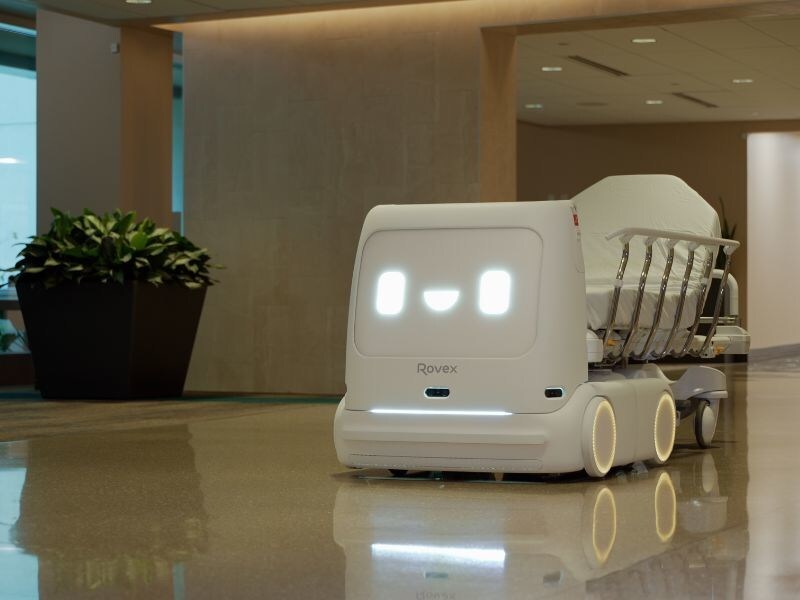
And to wind up with something that could really help in hospitals in moving patients from point A to B…Rovex has developed a robotic transporter for in-hospital patients. The transporter, Rovi, is the world’s first autonomous transport robot that can transport any hospital stretcher yet maintain contact with the care team. It is being piloted without patients at BayCare Health System’s Morton Plant Hospital. The pilot is designed to evaluate workflows, transport patterns, staff burden effects, and operational opportunities within the hospital environment. Later phases will support potential in-hospital robotic stretcher movement. Those of us with hospital experience either in the clinical setting or as patients know how speed of transfer affects the entire clinical workflow and care. BayCare is the largest not-for-profit academic health care system in West Central Florida. Rovex is a two year old company, still in seed funding of $2.27 million (Pitchbook) and headquartered in Gainesville, Florida.  BayCare release, Interesting Engineering

Chutes and Ladders w/o 9 Feb: Biofourmis’ ex-CEO faces 7 major Singapore fraud charges (updated), Doximity’s 17% drop; Devoted Health’s big $366M raise, Garner Health garners $118M, Synthpop’s $15M Series A

Chutes go first…

The worst kind of Chute to go down is one that lands in a coal-scuttle full of fraud and criminal charges–in a country known for its punishments. Biofourmis’ former CEO is facing seven counts in Singapore. Rajput Kuldeep Singh, one of the founders and former CEO, has been charged in Singapore with three counts of abetting the falsification of accounts, three charges of fraud by false representation or abetment thereof, and one charge of forgery for the purpose of cheating. These are connected to the Singaporean company, Biofourmis Holdings Pte Ltd., between 2021 and 2022. Headquarters moved to Boston after its Series B in 2019.

Mr. Rajput (surname is first) is accused of falsely invoicing US$16.5 million to Singapore’s Ministry of Health (MOH), and later false representations such as inflated revenue figures, falsified financial statements, a misrepresentation on payment by the MOH, and subsequently a forged employee stock option plan offer letter. This was purportedly intended to deceive DBS Bank into transferring funds from the bank.

The penalties are high in a country that canes offenders for spitting on the sidewalk. The Singapore Police Force announced the charges in a 3 Feb release. Each fraud charge against Mr. Rajput carries a maximum 20 years plus a fine. Falsifying accounts and forgery max out at 10 years plus a fine. Even if convicted of one charge, Mr. Rajput is looking at perhaps a decade of time in a Singapore prison–on multiple charges, perhaps the rest of his adult life. Mr. Rajput is a 34-year-old Indian national. Presently, he is out on bail of S$600,000 (US$475,000) and through his legal representation Eugene Thuraisingam Asia, indicated in court on Feb 4 that he intends to claim trial. Singaporean law moves fast–the pre-trial scheduled to start on 1 April. The Online Citizen (Singapore) Here’s the original article in the Straits Times.

Update on extradition: Should Mr. Rajput remove himself to the US and try to evade extradition, his attorneys will tell him that it may be futile, but will string out things. Extradition is covered by a foundational 1931 bilateral treaty that originated with the UK (as Singapore was a colony then) and has been honored since with modifications and expansions (e.g. the Extradition Act of 1968 and Amendments 2022). The mechanism is straightforward. A request has to be made by the Singapore ministry for law and subsequently heard in a US Federal court. The charges must be valid under existing bilateral laws and meet the requirement that the charges carry a sentence of 2 years+. The extradition back to Singapore must then be approved by the Secretary of State. Fraud, embezzlement, and the taking of money under false pretenses are all covered. Singapore is also an active cooperator with the US whereas many countries with treaties are not. Another complicating factor is that Mr. Rajput is an Indian national and may hold multiple passports.

What about Biofourmis? It merged in October 2024 with CopilotIQ, a smaller RPM/nursing company in home health that took over Biofourmis’ business in in-home delivery of complex care for health systems, payers, and pharmaceutical companies. It was announced by CopilotIQ. This oddity didn’t square with other financial reporting indicating that Biofourmis was the acquiring party, yet was reasonable considering that CopilotIQ’s CEO and his management were running the combined company. Yet Biofourmis was a much larger company, a unicorn with over $400 million acquired in 10 rounds of financing.  Another oddity: Mr. Rajput transferred his 96.6 million shares (!!) in Biofourmis to 19 existing investors immediately prior to the merger, according to filings with ACRA, Singapore’s Accounting and Corporate Regulatory Authority. Today, the single company runs as two separate brands. In 2024, Mr. Rajput returned to Singapore (and Boston) to found a new company, OutcomesAI, an AI-enabled nurse assistant and voice agent which raised $10 million last October. To be continued….

Doximity, a/k/a LinkedIn for doctors plus virtual visit capability, took a 17% crack on Friday after a wild overnight ride. This is despite the company clocking a decent Q4 2025 beating analysts’ revenue expectations. Sales were up 9.8% versus Q4 2024 to $185.1 million. EBITDA guidance for 2025 is in line at $356 million at the midpoint. What was the problem? Q1 2026. The company guidance is $143.5 million at midpoint, which is below analyst estimates of $151.3 million. It doesn’t seem like much, but the volatility indicates that Doximity has growing competition for the 80% of US doctors who are members. Epocrates and Medscape have for years been the main competition for partner dollars, but the new kid on the block, OpenEvidence, which just clocked a healthy Series D for its medical info search engine, is putting all three in the shade. The pie is also shrinking. Pharma companies are overall spending less and Doximity is spending more on a suite of new tools: DocsGPT, Doximity Dialer, and Doximity Scribe. Share price has stayed flat since Friday. Considering it once traded over $80…. Yahoo Finance, TIKR

Now for the Ladders…climbing them with a ‘barbell’…

Devoted Health raked in $366 million of Series F and post-F funding. This insurtech survivor, a combination of Medicare Advantage (MA) plans with in-house telehealth and in-home care, raised a split Series F: $48 million in November 2025 and at the end of January a Series F-Prime of $317 million. These very late rounds are rare in this constrained funding market. Both were led by long time investor The Space Between (TSB) [TTA 3 Jan 2024], in partnership with Centricus, a London-based global investment firm. This Editor counted 18 additional investors, which is a tell–even when you’re “redefining how healthcare is experienced and delivered” and they are 466,000 members strong, up 121 percent and across 29 states, with 98% of members in 4+ Star plans, they had to knock on a lot of doors for the raise. This raise is also about half of what it would have been in the 2020-22 Silly Money days. One wonders if an IPO is next. Devoted Health release

Garner Health’s latest raise is a $118 million Series D today (Tuesday). The employer-focused provider of health data analytics incentives to guide employees to the best-performing doctors in the employer’s existing health plans now has a total raise of $200 million and a valuation topping $1.3 million. The round was led by Kleiner Perkins with participation from Redpoint, Maverick, Kaiser Permanente Ventures, Mercy, Plus Capital, and other existing investors. Garner is claiming revenue increasing over 130% versus their prior year. Release

On the other end of the barbell, Cambridge MA-based Synthpop (not a music genre) had an early raise of $15 million that closed last week. The new Series A brought their total funding to $23 million. It was led by Ansa Capital, with Defy.vc and Peterson Ventures participating in the round with Storm Ventures and strategic investor Bruce Broussard. Marco DeMeireles, co‑founder and managing partner at Ansa Capital will be joining Synthpop’s board. Synthpop uses AI processes to coordinate document intelligence, payer-aware reasoning, and conversational voice agents to automate up to 80% of healthcare business processes, integrating directly with EHR, billing, and e-prescribe platforms. It was founded in 2023 by CEO Elad Ferber and CTO Jan Jannink, PhD, who have considerable previous founder experience. Release