

Catching up to Masimo’s ‘unfinished’ business: Danaher completes $9.9B acquisition of Masimo. $634 million damages from Apple upheld, but Kiani lawsuits continue

Danaher closing the Masimo acquisition for a eyewatering $9.9 billion in early June definitely flew under this Editor’s  radar. Let’s catch up. As your Editor “Alibi Ike’s” on this (blame it on an airshow, not an injury!), beyond its $9.9 billion “Hollywood Ending” deal in February, here’s the ‘need to know’ about the medtech giant’s final deal for Masimo and the latter’s future.

  • The completion was 10 June, when Masimo stock was delisted at a final price of $179.95 (MASI, Nasdaq). The closing beat the expectation of H2 2026 by a month.
  • The Danaher offer was $180/share (DHR, NYSE). When the offer was made, Masimo stock was trading around $130. This made for a very good deal for long-suffering Masimo shareholders and Politan Capital, which forced out owner/founder/CEO Joe Kiani in a blistering September 2024 proxy fight. Masimo shareholders approved it in May.
  • Masimo will operate as a brand and division under Danaher Diagnostics, led by EVP Diagnostics Julie Sawyer Montgomery with Masimo CEO Katie Szyman continuing as CEO of the division.

Danaher updated its full-year 2026 guidance on 21 July with its Q2 earnings release. “For full year 2026, the Company expects non-GAAP core revenue will increase in the 3.0% to 4.0% range year-over-year. The Company is also increasing its full year adjusted diluted net earnings per common share guidance to a range of $8.45 to $8.60 versus previous guidance of $8.35 to $8.55. to incorporate Masimo’s expected contribution.” The $150 billion market cap Danaher is likely to pursue other acquisitions as well.

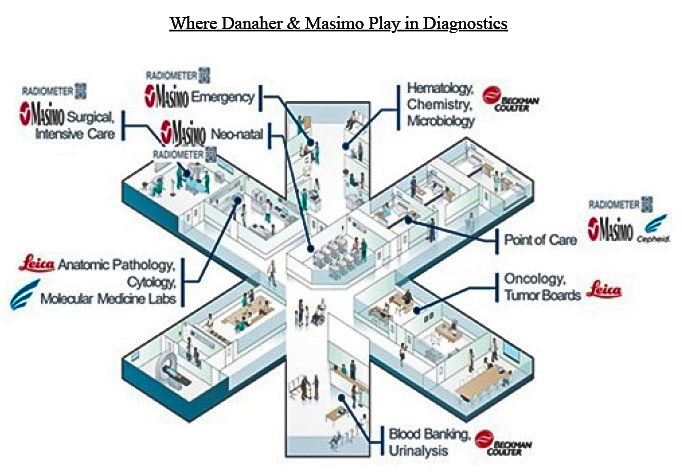
Competitively, it positions Danaher against industry giant Medtronic in patient monitoring, specifically in pulse oximetry and related technology. Masimo’s pulse oximetry and patient monitoring devices overlap somewhat with but extend Danaher’s existing Radiometer products in blood gas analysis and testing. Denmark-based Radiometer is stronger in European markets while Masimo is primarily US/Canada based. There is also diagnostic segment overlap with Beckman Coulter Diagnostics. It also expands Danaher’s offerings in sensor-based technologies and overall to integrated delivery networks, or IDNs. Other Danaher products within Diagnostics are Leica Biosystems and Cepheid. Given Danaher’s extensive and existing footprint in diagnostics and a legitimate fit, Masimo may get some long-overdue capital development and real management attention.

Courtesy of Editor Ted Green at Strata-Gee, in closing out the Masimo/Sound United file at his consumer electronics/AV custom integrations business newsletter here, this is how Danaher’s current products and Masimo’s complement each other in diagnostic market segments.
One caution for Masimo’s independent operation is that Danaher will now start executing on $125 million of annual cost synergies and more than $50 million of annual sales synergies by the fifth full year after the deal closure. “Cost synergies” usually mean shared corporate infrastructure, supply chain efficiencies, and streamlined back-office operations, although Danaher to this point has not filed any WARN notices for Masimo in California or Federally. Another caution is the meshing of Masimo’s corporate operations and ‘culture’ with the Danaher Business System methodology, as Masimo’s recent history has resembled a roller coaster ride at an amusement park with pieces coming off and the occasional passenger doing an aerial. Danaher closing release, MedTech Dive, Yahoo Finance

What’s left in LitigationLand?

  • The Apple Watch litigation ended with a Federal win for Masimo. It won the Federal patent infringement case in November and was awarded $634 million in damages. A Federal appeals court rejected Apple’s request for a new trial last week. Orange County Business Journal, paywalled. 9 to 5 Mac
  • Contrary to this, in April the International Trade Court (ITC) refused to reinstate the import ban on the redesigned Apple Watches imposed in December 2023. Reuters Whether Danaher will continue to pursue this isn’t known, but given the win versus Apple and the Danaher emphasis on diagnostics, the ITC import ban on a consumer product goes far down the list in importance.
  • The Kiani lawsuits over his separation are proceeding in Orange County (California) Superior Court. These are over compensation owed to him when Kiani was ousted as CEO. His argument is that the employment contract is ambiguous about the timing of payments and that the unpaid compensation qualifies as wages. Judge Thomas Lo ruled last month that the suits could continue. The stakes are not small. The contract contained a $450 million severance payout. Kiani is seeking an added $100 million in damages from the company’s former six board directors affiliated with activist investor Politan Capital Management. Kiani is represented by Marshall Camp of Hueston Hennigan LLP. OCBJ In March, Judge Lo disqualified Quinn Emanuel Urquhart & Sullivan LLP from representing the six board members because the firm had originally defended Kiani’s employment agreement and violated ethics around confidentiality and loyalty. Daily Journal-Cal Lawyer 
  • There are other lawsuits active in Delaware and Washington, DC.

And in other June news, Masimo gained FDA 510(k) clearance for an opioid-induced respiratory depression detection capability integrated into the Radius VSM wearable continuous patient monitor. It uses Masimo’s smartSET pulse oximetry sensor platform to identify early signs of respiratory compromise in hospital patients receiving opioid therapy. Release 

One more TTA Hat Tip© to Ted Green of Strata-Gee for being an excellent inside source on Masimo, the agita around the (sold) Sound United, and the culminating proxy fight between Politan Capital and Joe Kiani. Here’s his history of Masimo’s “wild and crazy ride”.  He now returns to being THE newsletter for professionals in the consumer electronics/AV integrations business!

TTA Bright: THINKMD, Save the Children partner for digital child health assessment

Putting digital diagnostics in the pocket of healthcare workers, worldwide. Isn’t a story that is bright and cheerful, about doing something good, needed right now? THINKMD is a digital clinical intelligence platform that uses machine learning (ML) to analyze key clinical data and to provide a dynamic evaluation similar to a physician’s assessment. It uses a web app that works offline as well. What THINKMD does is to basically transfer a knowledge base plus how a physician would logically approach the medical situation, followed by a care plan, to a health worker without those advanced skills in a remote area. Product demo

THINKMD already works with Save the Children in Bangladesh, Indonesia, and Kenya. Save the Children is a well-known, century-old international organization that is on the ground in 120 countries working for the welfare and health of children. Since 2017, in the existing partnership, they have achieved over 366,000 high-quality clinical assessments performed by over 400 frontline health workers. The agreement is to license THINKMD’s platform to Save the Children in order to expand the existing partnership between the organizations, enabling adoption and scaling of THINKMD’s platform to improve the health of children globally. It is the first such agreement for Save the Children. THINKMD is currently being used in a total of 10 countries. Hat tip to Nick Olsson of ‘We Are Explorers’. THINKMD release plus a blog post by co-founder Dr. Barry Finette about the agreement

Mayo Clinic creates AI-powered clinical decision/diagnostics support platform, two digital health portfolio companies

“Changing the nature of healthcare from episodic to continuous”. Mayo Clinic announced the launch of the Remote Diagnostics and Management Platform (RDMP) that will connect data to artificial intelligence (AI) algorithms and create a ‘next generation’ of clinical support tools, diagnostics, and care protocols for faster diagnostics and more continuous care. According to Mayo Clinic Platform president John Halamka, MD, “clinicians will have access to best-in-class algorithms and care protocols and will be able to serve more patients effectively in remote care settings.” Patients will be able to access information to take better control of their health and make more informed decisions.

Mayo Clinic, with partners, is also organizing two portfolio companies to support RDMP:

  • Anumana, Inc. With nference, a synthesizer of biomedical data, Anumana will bring to market digital sensor diagnostics to decipher electrocardiograms (ECGs). The objective is to more effectively spot heart disease at the pre-symptomatic stage, enabling early treatment that saves patients and costs. Their first project will be to develop neural network algorithms based on billions of relevant pieces of heart health data contained in Mayo’s Clinical Data Analytics Platform, including millions of raw ECG signals. nference with Mayo in the past year has released COVID-19 molecular research based on Mayo data. Anumana completed a Series A of $25.7 million funded by the partner companies plus Matrix Capital Management, Matrix Partners, and NTTVC.  nference release.
  • Lucem Health Inc. With Commure, a General Catalyst portfolio technology company that accelerates healthcare software development, Lucem will develop the platform for connecting remote patient telemetry devices with AI-enabled algorithms. Lucem is kicking off with a jointly funded $6 million Series A. 

We noted back in 2019 Dr. Halamka’s move to Mayo to head up a machine learning/AI initiative which took a while (during a pandemic year) but is moving quickly. The Mayo release includes a YouTube video of Drs. Halamka and Friedman explaining Anumana’s objectives in early diagnosis reading ‘those invisible signals’ well ahead of an event, especially needed with heart disease as the first symptom may be devastating or deadly. Hat tip to HISTalk, which also amusingly notes Dr. Halamka’s sartorial changes.


Will there ever be a medical ‘tricorder’?

ZDNet teases us that ‘the race is on’, but is it? It’s a great clickbait headline, but the substance of the article illustrates the distance between today’s tech reality versus the picture of Star Trek’s Bones pointing a Tricorder at a patient and immediately pronouncing that your malady was Sakuro’s Disease or some strange Vulcan malady.

Was it that long ago that the Scanadu Scout was the odds-on bet to be the Tricorder? The hype began in 2012 [TTA 23 May 2013] with Indiegogo funding, competing for the XPRIZE, and breathless pronouncements at nearly every healthcare conference. By 2016, it missed the Qualcomm Tricorder XPRIZE finals (with Northern Ireland’s Intelesens), bricked all sold units to date to comply with FDA regulations on investigational devices, and with Chinese money in hand, moved into other testing devices. Those looking for Scanadu today will be disappointed as their website is unreachable. The DeBrowers and medical director Alan Greene, all of whom were fêted on the healthcare scene, are engaged over at Doc.ai with a new mission of decentralizing precision medicine onto the blockchain using AI, using your medical data gathered on an app (of course).

Google X was up next as Scanadu was fading. There were various devices they were hyping and testing as Google’s life sciences skunk works morphed into Verily, but to date they have all petered out, with some questions raised about people and project churn at the Alphabet unit [TTA 6 April 2016] .

Basil Leaf Technologies (as Final Frontier Medical Devices) wound up winning last year’s final Qualcomm XPRIZE with DxtER, which could diagnose and interpret a defined set of 13 health conditions to various degrees, while continuously monitoring five vital health metrics, using a mix of sensors and an AI-powered diagnostic engine. What they are planning to market first is not DxtER, but a single-disease device to monitor congestive cardiac failure (CCF) since FDA approval for DxtER “would take aeons to be approved.”

Urine tests are also a ‘wet’ way into a tricorder state, with both Basil Leaf and the University of Glasgow working on devices which could quickly scan for metabolites in urine that indicate particular diseases.

QuantuMDx’s Q-POC, from Newcastle UK, is expected to launch in 2019 with handheld diagnostics for bacterial and viral infections. In addition to quick diagnostics for outbreaks in less developed countries, they are also developing diagnostics to prescribe the right antibiotic the first time. This is critical in treatment superbugs such as MRSA and MSSA, as well as more garden variety infections which can go wrong quickly. TTA profiled their crowdfunding launch in 2014.

The ZDNet article wraps up with a bit of romance about how a tricorder is needed for Mars, but down here on Earth, the reality is that a tricorder will likely be a combination of devices and analytics, stitched together by machine learning and AI.