Breaking: 23andMe files for Chapter 11 bankruptcy–whither customer data and security? An impact similar to Theranos?

The exploding plastic inevitable comes to its inevitable end. 23andMe’s board filed for a Chapter 11 bankruptcy with the Eastern District of Missouri (!) Federal bankruptcy court on Sunday night (Case 25-40976). Anne Wojcicki, CEO, 49% controlling shareholder, and board member, stepped down from the CEO position, but remains on the board. Interim CEO is Joseph Selsavage, 23andMe’s chief financial and accounting officer,  according to their SEC Form 8-K filing.

In their announcement, 23andMe will, with court approval, actively solicit asset sales over a 45 day period.

Anne Wojcicki’s final non-binding proposals on 10 and 11 March were rejected by the Special Committee of the board of directors evaluating asset sales and now the bankruptcy.

Anne Wojcicki’s statement on X early on Monday morning was of a piece with her statements as 23andMe entered its death spiral starting in 2023. “We have had many successes but I equally take accountability for the challenges we have today. There is no doubt that the challenges faced by 23andMe through an evolving business model have been real, but my belief in the company and its future is unwavering.” In her post, she also said that she would bid for assets sold by the company. 23andMe has not issued any further statement or response to their former CEO’s comments.

The Chapter 11 versus 7 filing means that 23andMe will continue to operate as it sells assets and eventually shuts. It will be up to the board–including Ms. Wojcicki–and the bankruptcy judge regarding the disposition of the company’s assets, which include teleprescriber Lemonade and the large 23andMe genetic database. Those assets and liabilities essentially cancel each other out: $100-500 million in assets and the same in liabilities, according to the filing.

And about that large genetic database–the California attorney general Rob Bonta has already advised California 23andMe registered users to delete their data and request their samples to be destroyed. However, as previous articles have discussed, your data remains–de-identified, which the AG’s statement doesn’t go into in its “reminder” (more like a press opportunity for a 2026 reelection bid?). Mercury News  See today’s update for how-tos–and experiences in deletion.

23andMe has stated that it will not change the way that consumer data is stored or safeguarded, and will continue to operate as usual through the Chapter 11 process. They published an ‘open letter’ blog for customers that positions them as finding “a partner (Editor’s emphasis) who shares our commitment to customer data privacy and allows our mission of helping people access, understand and benefit from the human genome to live on.” which is frankly, misleading.

Perhaps the Chapter 11 is saving Ms. Wojcicki from a tremendous financial mistake in buying out the rest of the common shareholders, though the filing wipes out her investment in the company. It will be interesting to see the court’s comments on the ownership of what at its peak was a $6 billion-valued public company. CNBC  

This story is developing, but has developed ‘legs’ like Theranos in terms of mainstream impact. When YouTube tarot card readers are covering it….   

Updates 25-26 March   

MedCityNews yesterday recapped the various Wojcicki-led efforts to take the company private as Readers have been following, with the interesting addition that by 10 March, at least one minority shareholder, Zentree Investments, felt slighted. Zentree then bought more Class A stock to boost its ownership stake to 13%. (I wonder how they woke up on Monday.) Unfortunately, there were no further insights on why New Mountain Capital retreated from its short-lived offer to buy 23andMe with Ms. Wojcicki that went sideways by 28 February.  (Perhaps someone found something that led to the mutual conclusion of ‘Are we crazy?’)

The first hearing before the bankruptcy court, the Debtors’ First Day Motions, will be tomorrow, Wednesday 26 March, in St. Louis before the Honorable Brian C. Walsh. 

There is no hint of a pre-packaged bankruptcy leading to a reorganization of the business in any of the materials linked below.

From the Form 8-K and the Kroll case summary (Kroll is the claims agent for the company):

  • 23andMe has agreed with a lender, JMB Capital Partners Lending, LLC, to obtain up to $35 million in a senior secured term loan credit facility (DIP Facility). The debtor-in-possession financing from JMB is to pay for the Chapter 11 administrative costs and for working capital. This is subject to the bankruptcy court’s approval.
  • Subsidiaries of 23andMe (such as Lemonaid) will continue to operate. Lemonaid Health and two pharmacy operations are listed as  debtors in the filing.
  • On 21 March, Joseph Selsalvage was paid a retention cash bonus of $500,000 for his services through 31 December this year or 23andMe’s emergence from bankruptcy, whichever is earliest. If he leaves before the end of the retention period or is terminated for cause, the entire amount will be clawed back. The only exceptions are death, disability, or departure for ‘good reason’ as defined in the retention agreement.
  • The board was increased to five members, adding Thomas B. Walper as a non-employee member of the board and the Special Committee (formed for buyers) through the 2027 shareholders meeting. He will be paid $35,000 per month. Mr. Walper is a partner at Los Angeles’ Munger, Tolles & Olson LLP and specializes in bankruptcy law.
  • Any transaction will be subject to customary regulatory approvals, including, as applicable, the Hart-Scott-Rodino Act and the Committee on Foreign Investment in the United States.

From the 23andMe release:

  • The Special Committee rejected Anne Wojcicki’s final bids in the amended Schedule 13D made on 10 and 11 March.  
  • The company in the Chapter 11 will sell substantially all of its assets in a Section 363 sale.
  • Matt Kvarda, a managing director at Alvarez & Marsal, was appointed as chief restructuring officer.
  • First day motions (tomorrow) include requesting from the court authority to pay employees and certain vendors, reducing operating expenses such as real estate leases, and resolving all outstanding legal liabilities stemming from their October 2023 cyber incident.

Since 23andMe’s database includes personally identifiable information and Lemonaid stores medical information as a prescriber of various remedies, it is possible, but to be confirmed, whether Federal entities such as HHS will be involved in approvals of asset sales that have patient information. Those who submitted their tests for genetic analysis are not covered by HIPAA and in fact signed away many of their privacy rights in their submission. 

Information on deleting your user records if you used 23andMe, or you know someone who needs to know how:

Contrary to what many would like to have or to believe, 23andMe retains parts of user information after user deletion, such as: genetic information, date of birth, and gender “as required for compliance”; deletion request information “including but not limited to, your email address, account deletion request identifier, communications related to inquiries or complaints and legal agreements.”

Despite this, deleting your account is the wisest move, according to every expert this Editor has read.

Basically, you are deleting your account, revoking any research consent, and destroying any samples they may have retained. Simple, eh? Not quite! Step-by-step how-to guides are available on ZDNet (simplest) and TechCrunch (scroll to the end). This Editor cannot test as she never used 23andMe. Arundhati Parmar of MedCityNews‘ experience in attempting this process is chronicled in a LinkedIn video and on TikTok.  Expect website crashes, slow responses at best, and more than a few hitches.

New  FierceHealthcare’s Dave Muoio riffs on the data privacy issues which can be summarized as a “data stewardship crisis”. The few protections that members/users have are based on consumer protection laws. 23andMe’s privacy policy, as noted above, was explicit about the minimal protection they offered and that they had the right to access, disclose to others, and sell your genetic information:  “your Personal Information may be accessed, sold or transferred as part of that transaction and this Privacy Statement will apply to your Personal Information as transferred to the new entity. We may also disclose Personal Information about you to our corporate affiliates to help operate our services and our affiliates’ services.” Mr. Muoio reached out to experts at SOCRadar, QuantHealth, the Future of Privacy Forum, the Holland & Knight law firm, Pixel Privacy, and others. The consensus is that state and Federal safeguards are wholly inadequate.

Editor’s opinion:

23andMe’s cavalier attitude during their 2023 data breach, caused by their sloppy security (well documented by others and analyzed in our article here with previous articles linked within it) but blamed by their management on members reusing passwords, was symptomatic of a certain arrogance and attitude. By 2023, the company was already in trouble. Why would anyone believe that they’d be any less cavalier about personal genetic information?

Will this be another ‘watershed’ event like Theranos? The level of mainstream consumer media coverage the 23andMe bankruptcy has received reminds this Editor of the demise of Theranos. But here, there is no glamorous young founder in a black turtleneck jetting about and working in a Silicon Valley high-tech lab perpetrating a fraud. Here, the founder and key shareholder is a mature wealthy woman who kept a fairly low profile, the technology worked, the consumer business broke fresh consumer ground and, for its time, getting your genetic information and ancestry was a popular concept. GSK’s five year deal was completed–not renewed, but no lawsuits ensued. What was way off was its $6 billion valuation in 2021 after its SPAC and IPO.

Its faltering wasn’t news like Theranos or (for that matter) Walgreens either. The concatenation of failures along the way, save for the 2023-24 data breach/hacking which was news and drove away customers by the carload, was hardly noted at all. Yet suddenly. every one who ever dealt with 23andMe is anxious about their DNA being sold, with rumors of nefarious buyers like Bill Gates and from China popping up with notorious frequency.

We’ll see if this leads to change in genetic privacy laws and policies.

FTC, DOJ float enhanced information requirements for HSR premerger notification filing process–what will be M&A effects?

FTC, DOJ are now coming after M&A–and you thought they were tough before? New information disclosure requirements proposed by the US Federal Trade Commission (FTC) and the Department of Justice (DOJ) Antitrust Division for mergers and acquisitions that fall under the Hart-Scott-Rodino Act (HSR) may put a damper on an already stagnant business area. On Tuesday 27 June, FTC, notably taking the lead with the concurrence of DOJ, released multiple proposed changes to the premerger notification filing process, the most extensive since they were first published in 1978 after HSR was passed in 1976. HSR premerger notification is required for transactions that exceed the threshold currently set at $111.4 million.

These changes will be formally submitted for the standard 60-day public review and comment later this week in the Federal Register. Changes are typically made after that time before final rules are published, a process that may take months.

From FTC’s release, the proposed changes fall under these areas.

  • Provision of details about transaction rationale and details surrounding investment vehicles or corporate relationships.
  • Provision of information related to products or services in both horizontal products and services, and non-horizontal business relationships such as supply agreements.
  • Provision of projected revenue streams, transactional analyses and internal documents describing market conditions, and structure of entities involved such as private equity investments.
  • Provision of details regarding previous acquisitions.
  • Disclosure of information that screens for labor market issues by classifying employees based on current Standard Occupational Classification system categories.
  • These proposed changes also address Congressional concerns that subsidies from foreign entities of concern [North Korea, China, Russia, and Iran–Ed.] can distort the competitive process or otherwise change the business strategies of a subsidized firm in ways that undermine competition following an acquisition.

The National Law Review goes into far more detail on exactly what additional information will be required. This includes disclosure of what foreign jurisdictions are reviewing the deal. The rationale for the changes is that transactions have become far more complex since the original requirements were set and that the additional information will “more effectively and efficiently screen transactions for potential competition issues within the initial waiting period, which is typically 30 days.” According to FierceHealthcare, the FTC said it expects the proposed changes will take merging entities 144 hours per filing, up from the current 37-hour average. It’s clear that the mountain of information already needed to file a pre-merger notification and the time needed to gather such information will be much higher, perhaps to months and reveal far more than perhaps some companies want to disclose.

For those surprised that FTC is taking the lead on this, this once-sleepy agency woke up late last year in a heckuva bad humor and is now (more…)

More gimlety views on CVS-Oak Street Health, Amazon-One Medical acquisitions

Perhaps this Editor is not that much of an Outlier in thinking that these deals don’t beat, say, sliced bread. Oak Street Health (OSH) disclosed its financials in an SEC 10-K filed on Tuesday. One must wonder what CVS is seeing in the company other than bulking up its primary care profile. Their loss grew to $510 million from 2021’s $415 million. While OSH grew impressively in 2022 with a 51% increase in revenue to $2.2 billion, driven by 40 new centers ending with a total of 169 facilities in 21 states, expenses grew exponentially for the new patients: medical claims expenses grew 48%, cost of care went up 49%, and sales and marketing up 38%. Scalable, so they claim; profitable, not till 2025 at earliest.

Other problems were revealed in the 10-K. OSH has substantial business from other payers, which may not be pleased that CVS owns a small payer called Aetna, though has pledged to keep OSH payer-neutral. OSH leases or licenses most of its care centers from Humana. That payer also accounted for 32% of its 2022 capitated revenue. Centene’s plans and HealthSpring made up an additional 23%. Other, more routine concerns are regulatory review, attrition of physicians and clinician staff, and last but not least, breakup fees ($500 million if CVS walks away, $300 million if it’s OSH). When you add these to other factors as outlined in our earlier article, such as the Medicare Advantage and high-need populations, CVS is cutting off a hefty slice of loaf, especially considering that the more complex Signify Health buy is due to close this quarter. Earlier opinions on the buy [TTA 16 Feb], Healthcare Dive

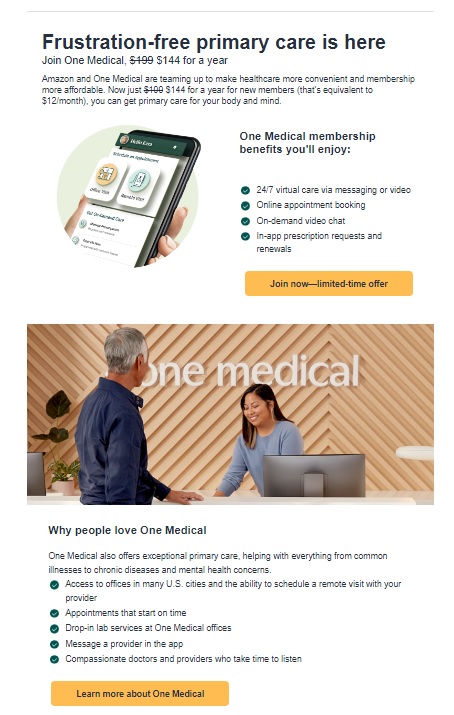
Now to Amazon and One Medical. This Editor received her invitation to buy a One Medical membership earlier this week (left). Countering this Editor’s analysis from last week, which maintains that Amazon is already under a broad antitrust microscope viewed by the Federal Trade Commission (FTC) and the Department of Justice (DOJ), Healthcare Dive counters, quite logically and in the view of their experts, that if either agency was going to object, they would have done so before the closing, and the grounds were likely too novel. The article concedes that the FTC could take action further down the road, for instance if Amazon violates HIPAA or consumer privacy with ad trackers. Instead, the focus is on objections by consumer groups, Amazon leveraging health data, privacy violations, and a general consumer unease around Amazon dealing with their health issues.

  • Consumer protection group Public Citizen urged regulators to block the deal in a letter to regulatory groups after it was announced last summer. For instance, it could bundle One Medical and Prime membership (a no-brainer). By tying the two together, Amazon could gain consent for using patient data from health records. Amazon could also serve ads for products related to medical conditions without that access (that old Pixel/ad tracker business again). These concerns are publicly shared by two FTC commissioners.
  • Analysts said that data acquisition was likely a big driving factor for the deal. After linking One Medical’s data with that from its other products and services, Amazon can analyze petabytes of healthcare data in the cloud and use the findings to better manage the health of One Medical’s Medicare population, build new products and pinpoint people with rare diseases to solicit participation in clinical trials, according to (market research firm) Forrester’s (Natalie) Schibell.” [Editor] That would, of course, require patient consent. 
  • Forrester noted that the consumer unease around Amazon in healthcare is substantial. 34% of surveyed adults weren’t at all comfortable with Amazon for healthcare needs with an additional 17% only somewhat more comfortable (tier 2). Trust levels are low, and it would take only one or two incidents, such as a security breach or HIPAA violations, to destroy it. This Editor would add that if One Medical practices were not managed impeccably, that would go viral among individual and corporate members, in a way that Amazon Care did not.

Breaking: Amazon closes One Medical $3.9B buy, despite loose ends–and is the Antitrust Bear being poked?

The Big Deal closes, but loose ends and larger issues remain. Today’s news of Amazon closing its purchase of the One Medical primary care group is being received in the press, especially the healthcare press, enthusiastically. This Editor cannot blame her counterparts, as since last year there’s not been much in the way of good news, compared to 2020-21’s bubble bath. Her bet as of a couple of weeks ago was that the deal would not go through due to Amazon’s financial losses in 2022 and/or that the FTC would further hold it up, both of which I was wrong, wrong, wrong on. (Cue the fresh egg on the face.)

Wiping off said egg, here is what Amazon is buying and their first marketing move. (Information on size and more from the 1 Life 2022 year end 10-K):

  • Amazon acquired 1Life Healthcare Inc. for $3.9 billion, or $18 per share in cash.
  • The practices are primarily branded as One Medical, closing out 2022 with 836,000 members and 220 medical offices in 27 markets
  • It is a value-based primary care model with direct consumer enrollment and third-party sponsorship across commercially insured and Medicare populations. Their Net Promoter Score (NPS) is an extremely high 90. (NPS is a proprietary research metric that indicates customer loyalty and satisfaction.)
  • They also have at-risk members from the $2.1 billion Iora Medical acquisition in seven states, in Medicare Advantage (MA) and Medicare shared savings value-based care (VBC) arrangements [TTA 27 July 22].
  • One Medical has contracts with over 9,000 companies, establishing Amazon at long last in the desirable corporate market.
  • One Medical also provides a 24/7 telehealth service exclusively to employees of enterprise customers where there are no clinics.
  • Amazon will be offering a discounted individual membership of $144 versus $199 for the first year, without an Amazon Prime subscription.

The Federal Trade Commission (FTC), which had additional questions about the buy as part of a Second Request in the Hart-Scott-Rodino Act reporting process, did not act in time to prevent the closing. Nor did the SEC or DOJ. This is CEO Andy Jassy’s first Big Deal at Amazon and certainly, the champagne and kvelling are flowing at HQ plus One Medical’s investors and shareholders for a successful exit. But should Amazon be looking over their shoulder? 

What are the open issues? Is a large, hungry Bear called Antitrust being poked, or lying in wait for its prey?

  • The FTC has the right to probe into the transaction despite the closing and a deadline passing for antitrust review. In FierceHealthcare and STAT, FTC spokesman Douglas Farrar is quoted as telling the WSJ (paywalled) in a statement that “The FTC’s investigation of Amazon’s acquisition of One Medical continues. The commission will continue to look at possible harms to competition created by this merger as well as possible harms to consumers that may result from Amazon’s control and use of sensitive consumer health information held by One Medical.”
  • As previously reported here, only in December did the FTC send out subpoenas to current and former One Medical current and former customers as part of its investigation. That’s late to stop a buy–unless FTC had something else larger in mind.
  • Early February reports in Bloomberg and the WSJ indicated that this may be part of a larger FTC action in developing a wide-ranging antitrust lawsuit against Amazon on multiple anticompetitive business practices. Their chair, Lina Khan, is highly critical of Amazon’s business practices. Amazon’s buy of iRobot, maker of Roomba, which at $1.7 billion was a comparative snack, is still not closed and has received a lot of negative attention for possible misuse of consumer information. 
  • Sidebar: This FTC is ‘feeling its oats’ on antitrust. GoodRx found itself making history as FTC’s first culprit of the 2009 Health Breach Notification Rule, used to prosecute companies for misuse of consumer health information. This was for their past use of Meta Pixel, discontinued 2019, to send information to third-party advertisers. One Medical is a HIPAA-covered entity which puts it at a far higher risk level. 
  • The Department of Justice (DOJ) has not publicly moved to approve or disapprove–yet. 
  • The change of ownership has not been reported as passing muster by regulators in multiple states. Example: Oregon approved it, but with multiple stipulations [TTA 6 Jan]–and there are only five One Medical clinics in Oregon. States like New York, Massachusetts, Connecticut, and California are not exactly pushovers for approval, with California alone having two approval entities.
  • Congress is increasingly feisty on data privacy–consumer health information and its misuse in telehealth [TTA 9 Feb]. 

Will this be ‘buy now, regret later’, a lá Teladoc’s expensive acquisition of Livongo, or Babylon Health going public with a SPAC? Is this a clever trap laid for Amazon?

  • Amazon is already under a Federal and state microscope on data privacy. Information crossing over from One Medical to their ecommerce operations such as Pharmacy and Prime will just add to the picture. 
  • Accepting Medicare/Medicare Advantage increases scrutiny on quality metrics and billing, to name only two areas. At-risk patients in Medicare and other VBC models, especially Medicare Shared Savings Program (MSSP) fall under CMS scrutiny. Amazon may take a look at that and spin-off/sell off the former Iora Health practices/patients.
  • Amazon has failed in healthcare previously, as a partner in the misbegotten Haven and in its own Amazon Care ‘home delivery’/telehealth model selling to companies, now closed. Its asynchronous virtual care service, Amazon Clinic, is too new to judge its success. 
  • Office-based, brick-and-mortar healthcare provided by doctors, nurses, and allied health professionals is an entirely new area for Amazon. Will they be satisfied with their new masters–and new metrics? It is also expensive. One Medical has never been profitable and did not project breakeven for years. (If one asks how this is different than CVS acquiring Oak Street Health, or Walgreens acquiring VillageMD and Summit Health, CVS and Walgreens have experience for decades in multiple aspects of providing healthcare–profitably and in compliance.)
  • One wonders how heavy of a hand Amazon will place on One Medical’s operations. How their management, doctors, and other professionals will feel after a year or two of Amazon ownership is anyone’s guess. This Editor doubts they will remain in place or silent if unhappy.
  • Selling to enterprises–and account retention–is a vastly different relationship-building process and buyer journey than 1:many consumer transactions. One Medical made a go of it with 9,000 companies and enrolling employees at about a 40% rate, so they did something right. By contrast, Amazon failed to sell Amazon Care well to companies. Humility and service, for starters, are required.
  • Last but certainly not least, is how Amazon will deal with regulation and compliance at multiple levels.

Expect that the FTC and DOJ will not be done with Amazon any time soon in what looks like a wider antitrust pursuit that may take some time, which they have. Amazon has tens of millions in government business (AWS) at stake and shareholders expecting a reversal of losses. Pro tip to Amazon: run One Medical as a separate operation with minimal integration and no information sharing until past this. And then some.  Healthcare Dive, Becker’s

News roundup: of logos and HIMSS roundups, Rock Health’s Digital Health Consumer Adoption survey, and the millennial/Gen Z walkaway from primary care

HIMSS19 was last week. Onsite reports to this Editor declared it ‘overwhelming’, ‘the place to be’, ‘more of the same’, and ‘stale’. With a range of comments like these, everyone’s HIMSS is different, but HIMSS is well, a place that for most of us in digital health, have to be (or their companies have to be). It is still a major commitment, and if you are small, a place where you might be better off with no display and simply networking your way through. 

HIMSS must be conscious of a certain dowdiness, because HIMSS is ‘reforming’ with a preview of a new logo and graphics here that changes out their Big ’80s curvy lettering and muted colors to hard edges in typefaces and equally hard blues.

Mobihealthnews (a HIMSS company) delves into blockchain (Boehringer Ingelheim and IBM Canada) and Uber Health’s continuing foray into non-emergency medical transport. Dimensional Insight’s blog takes some of the sessions from the data governance and healthcare business intelligence perspective, including the opioid crisis, AI to detect cancer (the link between falling hemoglobin rates and a cancer diagnosis), and pediatric disease registries. And there is the always incisive HISTalk with last Monday Morning’s Update, their 2/14/19 roundup, and Dr Jayne’s Curbside Consult on John Halamka’s world travels, including nascent care coordination in China and interoperability in Australia.

Rock Health’s survey of consumer attitudes towards digital health adoption leads with these insights:

  • Wearable use is shifting away from fitness toward managing health conditions
    • There was a 10% increase in use of wearables to manage health, corresponding to a 10% decline in physical activity tracking
  • Telemedicine adoption is climbing, with urban consumers more than twice as likely to use live video telemedicine than rural consumers
    • Paradoxical but true, in terms of adoption of at least one form, it was 67 percent for rural residents and 80 percent for urban residents.
  • Highly trusted entities like physicians and health plans lost credibility in 2018—consumers were less willing to share data with them than they were in 2017. There’s an increasing distrust of ‘big tech’ and confidence in their ability to keep private data private–a wise takeaway given the Cambridge Analytica and Facebook scandals.

More acceptance of healthcare tools, less intermediation–and not trusting that data is secure spells trouble down the road unless these issues are addressed. Rock Health surveyed 4,000 respondents of US adults age 18 and over.

They’re not trad, dad. Accenture’s survey (released at HIMSS) also tracks the rejection of intermediation and gatekeepers when it comes to millennials and Gen Z in choosing non-traditional modes of healthcare, such as retail clinics, virtual and digital services. They are two to three times more likely than boomers to dislike in-person care; over half use mobile apps to manage health and use virtual nurses to monitor health and vital signs. Over 40 percent prefer providers with strong digital capabilities. Also Mobihealthnews 

‘Tis the season of mellow fruitfulness..and consultations

Suddenly it seems there are consultations all over the place that are important to the digital health world. If you can spare some time, you will be doing society a great turn by responding to as many as possible. They include:

The Accelerated Access Review (disclosure, which is editor is very involved with) is holding a consultation on pricing & reimbursement schemes. This is important because in the area of digital health (one of three areas covered by the AAR, the other two being medicines and medtech), selling at scale almost always involves a competitive tender (either at the time or previously in establishing framework contracts, or sometimes at both stages). We therefore have much to learn from the pharma sector in particular who have established a wide range of price-setting, and thus tender-avoiding, mechanisms. We are very keen for the digital health and medical technology voices to be heard.

Deadline for submissions is Friday 20th November.

Next we have an EC consultation with a characteristically long-winded title Public consultation on the preliminary opinion on ‘Disruptive Innovation. Considerations for health and health care in Europe’. For this, the EC is partnering with an organisation previously unknown to this editor: the Expert Panel on Effective Ways of Investing in Health (EXPH). Having learned about disruptive innovation at the feet of the man himself, Clayton Christensen, this editor gets just a little uncomfortable when experts seek to impose order on the process (especially ‘taxonomies’), as by definition it is chaotic and opportunistic. However the four areas that the survey seeks views on are:

1. New models of person-centred community-based health delivery that allow a decentralisation from traditional health care venues like hospitals to integrated care models (e.g. transfer of records to patients);

2. New technologies that allow early diagnostics, personalised medicine, health promotion, community-based therapy and care and the empowerment of patients/citizens, as well as potential curative technologies (e.g. regenerative medicine, immunotherapy for cancer);

3. Person-oriented approaches for the treatment of patients with multiple chronic diseases, situations of frailty and/or of loss of functionalities in a multi-cultural context;

4. Education of the health workforce and transfer of skills and tasks from highly trained, high cost personnel to personnel that have less specialised trained and are more affordable; (e.g. from specialists to generalists, from generalists to nurses, from nurses to health care assistants and to other care providers such as pharmacists, and ultimately to citizens themselves.)

The preliminary opinion is just 95 pages long, and here. The consultation closes on 16th December.

Closer to home and potentially of more immediate significance is the consultation on the draft EU Code of Conduct on data privacy for medical apps which is now being opened up for general consultation prior to a meeting in Brussels of the group producing the Code (of which this editor is a member) on December 7th. Please send your comments directly to charles.lowe@DHACA.org.uk and I will pass them on.

Finally, London’s Southbank University is planning to establish a set of qualifications for digital health-related topics and is keen to understand the likely willingness to pay for them. They are currently in discussion with the Royal Society of Medicine regarding use of educational material. They have produced this short survey which they would appreciate as many TTA readers as possible completing.

Hat tip to Dee O’Sullivan for alerting me to the disruptive innovation consultation.


Facebooking health: good for communities, not for privacy?

In a Reuters exclusive, Facebook is reportedly considering creating online communities which will support those with various medical conditions, as well as ‘preventative care’ applications for those minding their healthy lifestyle. According to Reuters’ sources, Facebook representatives have been meeting with medical industry experts and entrepreneurs. They are also starting a research and development unit to test new health apps. It is not a far reach to assume that Facebook, which is always seeking to maximize its profitability dependent on digital ad revenues (second only to Google), yet finding its younger audience on the decline, is attempting to grapple with the concerns of its older-skewing audience–and also seeking a way to monetize another slice of data. Yet the 55+ audience is wary of Facebook given (more…)

Driving up medical app usage in the UK – part I

Our recent post on ‘the last mile’ for medical apps in the US is a great introduction to some work I have been doing over the past three months: attempting to answer the question of how best to improve the perception by clinicians and patients of the efficacy of health-related apps. This work has been done for the i-Focus project, part of the Technology Strategy Board’s dallas programme.

As the research is quite detailed, and as I’m keen to get as much feedback as possible, I have split the work into three parts, to be delivered over the week – comments to this article or a direct email to me (on charles.lowe@btinternet.com) on errors, omissions or additions would be hugely gratefully received.

This post aims to answer the question of what regulations affect the development, sale and usage of health-related apps and, in particular, when an app is a medical device. (more…)

mHealth data privacy: a worrying finding

We reported last August on a YouGov poll that found nine out of ten people not knowing what the term ‘telehealth’ meant.  Now they’ve been at it again, this time looking at mHealth, sponsored by Pinsent Masons.  From a poll of 2000 people, they found that:

“Prior to being given a definition of mHealth, the majority (73%) of respondents didn’t know what the term meant, and when explained 90% stated they never used mHealth services, despite the examples given including established applications such as fitness apps.”

Perhaps there’s a little encouragement (more…)

Mainly mHealth: a few predictions for 2014, and some speculation

Editor Charles on what to watch for in 2014

As we have covered previously (and here), there’s no shortage of forecasts that the mHealth market will continue to grow faster, or of penetrating comments like that that won Research2guidance a What in the Blue Blazes award that smartphone user penetration will be the main driver for the mobile health (mHealth) uptake. mHealth apps continue to proliferate – there’s even shortly to be a Pebble apps store. There are a few straws in the wind that not is all well though – for example, as we covered recently, Happtique ceased, at least temporarily, its apps approval process, citing security concerns.  Elsewhere Fierce Mobile described serious data privacy issues with the iPharmacy app, and the ICO recently produced security guidelines for app developers in the UK.  The EU is also strengthening data privacy, moving from individual country directives to a pan-EU regulation. This leads us to our first prediction (more…)