Mid-week roundup: TytoCare’s Wheeze Detection clears FDA, OpenLoop telehealth’s $15M Series A, PointClickCare buys PatientPattern EHR, last info session for Health Wildcatters’ 2023 accelerator

TytoCare receives FDA clearance for its lung sound monitoring algorithm. Wheeze Detection, which analyzes lung sound data for adults and children aged two and above, will be added to Tyto Insights for the remote diagnosis of developing lung conditions. The AI algorithm in Tyto’s decision support software analyzes their database of lung sounds against the patient’s, recorded by TytoCare’s stethoscope device, to determine if wheezing or other abnormal sounds are detected. Wheeze Detection was previously CE-marked for Europe. It’s an important addition as respiratory conditions account for 40% of their diagnoses over time through the TytoCare home-based telehealth + device diagnostic kit. Tyto Insights is part of TytoCare’s Home Smart Clinic, released last November, for at-home remote care targeted to providers and health plans. It includes Tyto Engagement Labs configured for each specific program and cohort that delivers on expected ROI and improved health outcomes. Tyto release

A substantial Series A round to OpenLoop. OpenLoop is a turnkey white-label telehealth with staff platform that targets two interesting segments: providers and digital health companies. Their $15 million Series A was led by Nava Ventures, with participation from new investors UnityPoint Health Ventures and PrimeTime Ventures, and existing investors SpringTide Ventures and ManchesterStory, adding to their existing $25 million in funding. Their network has 6,000+ certified clinicians across all 50 states, offers 30+ digital health specialties, and has capabilities in 15 languages. Also announced was the addition of a nationwide insurance payer network that allows clients to offer reimbursable services to patients instead of cash pay-only options, plus a payer coverage and revenue cycle management (RCM) service. Release

Senior/home care coordination platform PointClickCare acquires EHR Patient Pattern. Patient Pattern adds to PointClickCare’s position with long‐term and post‐acute care providers as well as with other high-needs populations with its EHR and care management platform that serves Medicare Advantage Special Needs Plans, ACO REACH participants, and PACE programs. Terms, timing, and management transitions were not disclosed. Release

And down in Dallas, Health Wildcatters is rounding up the dogies for its 2023 Accelerator. Their last info session on the application process is on 4 April from 2-3pm CDT. Their Accelerator is a three-month program, September-November, that includes only 8 to 12 startups. There’s intensive training, introductions to their 200-strong mentor and investor network (hopefully none from SVB or Signature Bank!), plus investment from Health Wildcatters. More information on the Accelerator here, registration for the application info session here, and 2023 application here. Final applications are due by 31 May.


News from ATA 2023: debate over DEA in-person prescribing requirement, winners of Telehealth Innovators Challenge, 2024 board chair announced

The American Telemedicine Association’s annual conference, ATA2023, which wrapped two weekends ago, had some major debates, awards, and some board changes.

Special ‘listening’ session on DEA’s proposed changes on telemedicine prescribing of controlled substances. This would resume the in-person visit requirement for Schedule III-V non-narcotic controlled medications. A 30-day limit on a prescription would be permitted for a telehealth remote visit and prescription, but an in-person visit would be required during that period or thereafter before any renewal. The DEA proposed rule issued 24 February (draft here) includes allowing care to be delivered uninterrupted for 180 days after the end of the public health emergency (PHE) ending 11 May, but then requires an in-person physician visit. ATA opposes this new requirement for patients who were prescribed these medications solely during telehealth during the PHE (release 25 Feb). Public comment on the proposed rule is open for 30 days (27 March). A representative of the DEA was in the audience for the Monday 6 March discussion moderated by Kyle Zebley, ATA’s senior vice president of public policy. Other telehealth measures were extended for two years in last year’s passage of the 2023 Federal budget bill [TTA 4 Jan]. Healthcare Finance

Winners were announced for ATA’s Telehealth Innovators Challenge. The four categories and winners were:

Femtech and Women’s Health Winner: SimpliFed. SimpliFed is a virtual breastfeeding and baby feeding provider network that improves access to professional lactation support.

In-patient Care Solutions Winner: Great Speech. Great Speech provides speech therapy through a network of 200+ therapists and adds artificial intelligence (AI) technology and proprietary algorithms.

The Patient Experience: Clearstep Health. Clearstep guides healthcare consumers to the best next steps for care based on their symptoms, insurance, location and preferences via a virtual triage system set up for providers. 

Tools That Deliver Care: Strados Labs. The Strados Cardiopulmonary Platform, using the RESP Biosensor, captures wheezing, coughing, and other lung sounds plus respiratory dynamics, then to a clinician portal supported by machine learning algorithms.

SimpliFed also won the overall Judges’ Choice Award. Oshi Health, a virtual-first gastrointestinal care clinic integrating evidence-based medical care and behavioral health support into a convenient, high-touch, data-driven care model, received the overall People’s Choice Award. Release

Sree Chaguturu, MD, has been named Chair-elect of ATA’s Board of Directors for a two-year term starting May 2024. Dr. Chaguturu is executive vice president and chief medical officer, CVS Health. He has served on the ATA Board of Directors since December 2020. He will follow Kristi Henderson, DNP, CEO, MedExpress and senior vice president of the Center for Digital Health and Innovation for Optum Health, who is now Immediate Past Chair. Release

News roundup: Transcarent buys 98point6’s virtual care; Best Buy-Atrium hospital-at-home; Walgreens/VillageMD buys another practice group; WW-Sequence digital weight management; UKTelehealthcare events; 300 out at Color

Enterprise health navigator Transcarent is buying 98point6’s virtual care platform and related assets. 98point6’s tech is a text-based virtual care platform that uses an AI chatbot to collect and relay health information to a provider. According to CEO Glen Tullman’s interview with Forbes, the assets picked up in addition to the tech include 98point6’s physician group, self-insured employer business, and an irrevocable software license in a deal worth potentially $100 million. This fits in Transcarent’s platform that works with large employers to steer their employees to higher quality, lower cost care settings based on actual users only in risk-based agreements, versus the more common per member per month care management model. 98point6 will continue in a leaner form, licensing its software to third parties, but out of the treatment business. Its major relationship is with MultiCare Health System in Washington state. 98point6 had raised over $260 million from 2015 through a 2020 Series E.  Mobihealthnews

Best Buy Health is providing telehealth equipment and installation to North Carolina-based Atrium Health’s hospital-at-home program. In the three-year deal, Best Buy’s Geek Squad will install peripherals based on the patient’s needs, transmitted through a Current Health telehealth mobile connectivity hub and using their software. Terms were naturally not specified, but Atrium is purchasing the devices from Best Buy. The Geek Squad services serve for both installation and retrieval after care. Atrium is paid via insurance including Medicare and Medicaid. Atrium, part of Ascension Health, has 10 hospitals in the program already and is aiming for 100 patients in the program each day. CNBC

VillageMD expands again, adds Starling Physicians in Connecticut. Starling has 30 primary care and multi-specialty practices, including cardiology, ophthalmology, endocrinology, and geriatric care. VillageMD’s total is now over 700 locations. Transaction costs were not disclosed. VillageMD has been on an acquisition tear, powered by Walgreens’ and Evernorth-Cigna funding for Summit Health, Family and Internal Medicine Associates in central Kentucky, and Dallas (Texas) Internal Medicine and Geriatric Specialists. HealthcareFinance, Healthcare Dive.

WW (the former Weight Watchers) has an agreement to acquire Sequence, a subscription telehealth platform for clinical weight management. Sequence is targeted to healthcare providers specializing in clinical care, lifestyle modification, and medication management for patients being treated for overweight and obesity. It also manages the navigation of insurance approvals. Terms were not disclosed, but Sequence since going live in 2021 serves 24,000 members and has a $25 million annual revenue run-rate business. WW is building out a clinical weight management pathway and intends to tailor a nutrition program for this segment. Release

UKTelehealthcare has an upcoming digital event, TECS Innovation Showcase 2 on Wednesday 15th March 2023 (10:30-12:30 GMT). Also, there are links to the webinars given during today’s event, TECS Innovation Showcase 1, January’s Analogue to Digital Transformation Update, and several more. Register for the 15 March event and links/passwords for previous events here or click on the UKTelehealthcare advert at the right and go to the Events page. These events concentrate on the analogue-digital switchover and TECS in the UK.

Color, a population health technology company that expanded into Covid-19 testing and later telemental health during the pandemic, is now laying off 300. Their CEO Othman Laraki confirmed in a post on LinkedIn (which seems to be a corporate communications trend) that this reflects decreased demand for Covid testing and the end of the public health emergency. Their future direction will be in distributed testing and telehealth for government programs and prevention tools for employers and large healthcare companies. The CEO’s post included a spreadsheet of the laid-off individuals including links to their LinkedIn profiles and desired positions, another corporate trend in addition to those laid off posting about it almost immediately. It seemed to be heavy on software engineers, data scientists, support leads, and product managers.

The company pivoted from genomics to public health with major Series D and E raises of $167 and $100 million respectively in 2021, totaling $482 million since start in 2014, and was valued at $4.6 billion by November 2021. It bought into behavioral health services with the acquisition of Mood Lifters, an online guided group support system, in 2022. The (happy) decline of Covid is affecting testing-dependent businesses across the board. Lucira Health, which had received a EUA for its combination Covid/flu testing, filed for Chapter 11 bankruptcy reorganization in February.  Beckers, Mobihealthnews 3 Mar, 27 Feb

Did Theranos collapse because of Holmes’ criminal conduct? Holmes says no–and no to investors’ claims

Restitution–and Holmes’ ability to pay–may be similar to squeezing blood out of the rock at left. In the latest filing from Elizabeth Holmes’ defense, they claim that 1) her crimes didn’t cause the collapse of Theranos and 2) that the prosecution had not shown that the investors “relied on the offense conduct when deciding to invest.” Even Judge Edward Davila of the US District Court had said in a January ruling that 1) was not established by the prosecution.

What the prosecution is trying to establish is that Holmes’ restitution should be in the vicinity of $878 million, up from an earlier estimate of $804 million. This contrasts with the $381 million that Judge Davila used for sentencing purposes, but under Federal law the guidelines for the latter differ. The prosecution is calculating the full loss of the investors “directly harmed” by Holmes’ criminal conduct, which is why (2) is important to the defense.

The next date to watch for is 17 March, where Judge Davila will rule on the restitution. He will evaluate submissions by those defrauded of their investment, with an order then specifying how much goes to which investors in proportion to their loss, covered by whatever she owns and from future earnings. The number on what’s owed may be academic. The defense has already stated that Holmes is, to put it bluntly, broke. In a court filing last month, Holmes said she “has essentially no assets of meaningful value” though she continues to work on patents. 

Holmes and her defense continue to fight to prevent her surrender and remain free until her appeals are exhausted. The second date of note is 27 April–her surrender date to the Federal prison in Bryan, Texas. Sunny Balwani’s surrender date is a month earlier on 15 March to the Federal prison in Lompoc, California. Like Holmes, his defense has filed motions for his freedom through his appeals. Balwani also has prosecutors pressing for restitution around $900 million and likely he has not much left in the way of assets either. [TTA 22 FebHavasu News (from paywalled Mercury News)

Week’s end roundup: Theranica clears, Pixel Watch fall alert, Veradigm delays, Walmart adding 40+ clinics by 2024, Bright Health’s dim future, Ontrak founder charged with insider trading

Theranica received FDA 510(k) clearance for its Nerivio device for migraine prevention in patients 12 and older. Theranica’s devices are based on a pain inhibition mechanism known as Conditioned Pain Modulation (CPM) where someone who suffers pain has a dysfunctional response to harmless stimuli. According to their product information, Nerivio wraps around the upper arm and uses non-painful remote electrical modulation (REN) to activate peripheral nerves to modulate pain. In addition to the device, the app allows users to customize their migraine treatments, receive reminders for preventive treatments, track patterns, and share migraine data with their doctor, as well as a guided relaxation routine. Theranica is based in Israel and New Jersey. Release, Mobihealthnews

Google’s Pixel Watch added fall detection to capabilities. It uses the motion sensors already in the watch and machine learning to detect a hard fall. If the wearer hasn’t moved within 30 seconds, it will vibrate, sound an alarm and display an on-screen notification that can be called off by pressing ‘I’m OK’ (left) or ‘I need help’. If the former, the alarms escalate until an automated call to 911 is made. The user has to activate the feature and Google claimes that the ML will help it avoid false positives. A very useful feature for older people, lone workers, and runners/walkers, but at the price point of $350 at Best Buy or $11/month via AT&T or Verizon, perhaps not all that attractive to cost-conscious users.    Engadget, Google blog post, Mobihealthnews

And in the Delays Must Be Catching Department, Veradigm, the former Allscripts, is delaying its Q4 and FY 2022 reporting due to a software flaw that affected its revenue reporting. Originally 1 March, the new date is yet to be determined, but they anticipate a reduction of $20 million dollars against what was previously reported from Q3 2021 into estimates for Q4 2022. Not exactly confidence-making for a company in the data management/software business. Coincidentally, the company which bought then-Allscripts’ large hospital/practice EHRs, now called Altera, Canadian giant Constellation Software, is also delaying its Q4/FY 2022 reporting, in this instance due to the Altera acquisition [TTA 15 Feb]. Veradigm’s release gives you the more complicated explanation.

Walmart Health’s Big Announcement is that it will be doubling the number of its Health Centers from the current 32 to over 75. By Q1 2024, Walmart’s plan is to open 28 new locations in the following metros: Dallas (10), Houston (8), Phoenix (6) and Kansas City MO (4). Missouri and Arizona are new states. All these will include the Epic EHR and the infrastructure improvements previewed earlier this week [TTA 1 Mar]. Release

Insurtech Bright Health may have a dim future. 18 months ago, Bright Health seemed to be the most promising insurtech out there, with a healthy Medicare Advantage plan base, family and individual plans, substantial growth, acquisitions of Zipnosis (‘white label’ telehealth triage for health systems) and development of the NeueHealth value-based care provider management network. Bright Health had a buttoned-up management team from UnitedHealth Group, investment groups, Target, CVS, and the Advisory Board. They raised $2.4 billion from prestige investors, including Cigna Ventures and Bessemer, went public on the NYSE in June 2021, and added $925 million in two post-IPO raises in December 2021 and October 2022 (Crunchbase). Fellow insurtechs Oscar and Clover struggled through their own financial and management challenges after an IPO and SPAC respectively. Oscar was sued last year by shareholders for misleading information; Clover lost $558 million in 2021, but reduced to $338.8 million in 2022 and promising a path to profitability. Healthcare Finance

Bright Health now appears to be a broken-bulb-filament away from default and bankruptcy. They ended 2021 with a $1.2 billion loss which is not unusual with companies of this type (see above). Bright exited individual and family plans in six states plus cut back MA expansion plans, also not atypical. Healthcare Finance This didn’t appear to help. By last December, their stock declined to below $1 triggering a notice of delisting from the NYSE if it’s not above $1 by May. The stock continues to trade below $0.50. They reported a 2022 loss of $1.4 billion, $0.2 billion up from 2021, on increased revenue. This week, it’s been reported they have told investors that they are facing credit insolvency, having run through $350 million in revolving credit, violated a liquidity covenant, and need $300 million to cover it by end of April. Further analysis in FierceHealthcare and on an interesting LinkedIn post by Ari Gottlieb, ‘Pay for Failure’.

And if there weren’t enough proof that the High Wide and Handsome Days Are Over, the Department of Justice (DOJ) indicted CEO Terren Peizer of Ontrak, a telemental health provider, with insider trading using Rule 10b5-1 trading plans. This rule was actually set up by the SEC to allow insiders to safely trade their shares by setting up a predetermined plan that specifies in advance the share price, amount, and transaction date, plus certifying that they are not aware of non-public information that can influence the price. The last is the rub. DOJ alleges that during mid-year 2021, Peizer was aware that the largest Ontrak customer, Cigna, was at high risk of departing on the heels of Aetna, and sold his stock. If convicted, Peizer may be facing up to 45 years in Club Fed plus disgorgement of funds. Ontrak trades on Nasdaq, today at about $0.60. FierceHealthcare

FTC takes off the gloves: $7.8M fine for Teladoc’s BetterHelp, warns Amazon (and everyone else) on One Medical patient privacy

The Federal Trade Commission (FTC) goes to ‘bare knucks’. BetterHelp, Teladoc’s promising telemental business, settled a complaint brought by the FTC in a 4-0 vote over ad trackers and sharing consumer health data with third parties. The ad trackers shared data with  Facebook, Criteo, Pinterest, and Snapchat for ad retargeting to these customers, knowing their situation. While the $7.8 million fine has to be approved by a Federal judge (as does GoodRx’s), the $7.8 million will be returned to consumers whose data was shared. How this will be done is a question mark to this Editor, but the tracking was done from 2013 (prior to Teladoc’s buy in 2015) to 2021, so quite a few will be eligible. According to the complaint, BetterHelp made false and deceptive statements to users about the disclosure of their information and formally “disseminated, or caused to be disseminated, misleading and deceptive representations regarding its compliance with federal health privacy laws.”

BetterHelp did not disclose to users that it was sharing personal information with third parties and never obtained consent. In fact, they assured users on intake that their information would be private, between them and their therapist. BetterHelp did not offer disclosure of information sharing and an opt-out form until October 2021. The information shared was extensive:

  • Intake questionnaire answers, such as whether the user was experiencing suicidal thoughts, and if they belonged to a group such as LGBTQ, teens, or Christians
  • Prescriptions
  • Prior therapy history if any
  • Email addresses and IP addresses
  • Financial status

The decisions on sharing information were delegated to a junior marketing analyst without training in PHI and protecting privacy from 2017. There was no formal compliance review or employee training in HIPAA practices. BetterHelp also displayed various logos, including HIPAA, to assure users that their information adhered to governmental standards and practices for health, when it clearly did not. (Editor’s note: as a marketer, both are shocking with Teladoc as a parent company well aware of these issues.)

Why this is important: Ad tracking is a form of revenue for companies, which now will be effectively shut off. This presents a decline in revenue hopes for Teladoc, which in January positioned BetterHelp as a bright spot of ‘balanced growth’. Expect that BetterHelp will be only the first of these companies in telemental health counseling to receive a working over from a newly-aggressive FTC–and with a return to in-person visits required for Schedule 2 meds, further depressing the entire category.  Complaint, Healthcare Dive, Mobihealthnews

FTC’s shot across the bow to Amazon and everyone in DTC digital health. With Amazon closing the buy of One Medical, the FTC issued a 1 1/2 page public statement warning both companies that because of privacy representations they have made prior to and after the acquisition, any failure to maintain consumer privacy will be in violation of Section 5 of the FTC Act. FTC will be looking at ‘false net impressions’ and “make clear not only how they will use protected health information as defined by HIPAA but also how the integrated entity will use any One Medical patient data for purposes beyond the provision of health care. ” And in closing, a broader warning:

The Commission has long taken the position that personal health information is sensitive data and has reaffirmed this position through recent enforcement actions. Further, companies that fail to have adequate safeguards or controls in place to protect sensitive data or fail to obtain consumers’ express affirmative consent for marketing based on sensitive data such as health data may be in violation of the law.

The law requires companies to treat sensitive data with great care. Accordingly, the parties and the market more broadly should be on notice that the Commission will continue to monitor this space and bring enforcement actions whenever the facts warrant.

Hat tip to HISTalk 3 March   TTA on FTC issues with Amazon post-closing 23 Feb

More VA-Oracle Cerner fallout? Deputy secretary, EHR executive director depart agency

EHR Trouble falls with a thud on two senior VA leaders. The Department of Veterans Affairs announced yesterday (1 March) that Deputy Secretary Donald Remy will be stepping down from his post. He will be replaced on an interim basis by VA Assistant Secretary for Enterprise Integration Guy Kiyokawa. This follows the resignation effective 25 February of Terry Adirim, MD, EHR modernization (EHRM) program executive director. Her duties will be taken over, also on an interim basis, by Senior Advisor to the Assistant Secretary for the Office of Information and Technology (OIT), Dr. Neil Evans. The Deputy Secretary position requires nomination by the President and Senate confirmation. The EHRM position is an internal fill.

Both Deputy Secretary Remy and director Adirim were named to their posts in mid-to-late 2021, Dr. Adirim from Acting Assistant Secretary of Defense for Health Affairs. Remy specifically oversaw the EHRM among other duties while Dr. Adirim led the implementation of the Oracle Cerner Millenium EHR that started with an analysis of the failures of the initial tests and the formation of an EHR Integration Council [TTA 3 Dec 21]. But from this ‘go forth and fail no more’, the rethought rollout was fraught with failures, including the 2022  ‘unknown queue’ that created 149 adverse events, a two-day slowdown in both the VA and MHS EHRs in late January 2023, and delayed rollouts to June this year. Perhaps the topper was the chair of the House Veterans Affairs Committee and the chair of the House Veterans Affairs Subcommittee on Technology Modernization co-sponsoring a bill to cancel the Oracle Cerner EHR and return to VistA [TTA 1 Feb]. At the end of February, Ann Arbor Healthcare Center pointed out that VA’s research centers were having specific problems with the EHR cutover that had not been addressed and were cause for further delay, possibly to end of year. Will this change lead to progress with Oracle–or more delay? FedScoop 1 March, 10 Feb. Hat tip to HISTalk 3 March

More gimlety views on CVS-Oak Street Health, Amazon-One Medical acquisitions

Perhaps this Editor is not that much of an Outlier in thinking that these deals don’t beat, say, sliced bread. Oak Street Health (OSH) disclosed its financials in an SEC 10-K filed on Tuesday. One must wonder what CVS is seeing in the company other than bulking up its primary care profile. Their loss grew to $510 million from 2021’s $415 million. While OSH grew impressively in 2022 with a 51% increase in revenue to $2.2 billion, driven by 40 new centers ending with a total of 169 facilities in 21 states, expenses grew exponentially for the new patients: medical claims expenses grew 48%, cost of care went up 49%, and sales and marketing up 38%. Scalable, so they claim; profitable, not till 2025 at earliest.

Other problems were revealed in the 10-K. OSH has substantial business from other payers, which may not be pleased that CVS owns a small payer called Aetna, though has pledged to keep OSH payer-neutral. OSH leases or licenses most of its care centers from Humana. That payer also accounted for 32% of its 2022 capitated revenue. Centene’s plans and HealthSpring made up an additional 23%. Other, more routine concerns are regulatory review, attrition of physicians and clinician staff, and last but not least, breakup fees ($500 million if CVS walks away, $300 million if it’s OSH). When you add these to other factors as outlined in our earlier article, such as the Medicare Advantage and high-need populations, CVS is cutting off a hefty slice of loaf, especially considering that the more complex Signify Health buy is due to close this quarter. Earlier opinions on the buy [TTA 16 Feb], Healthcare Dive

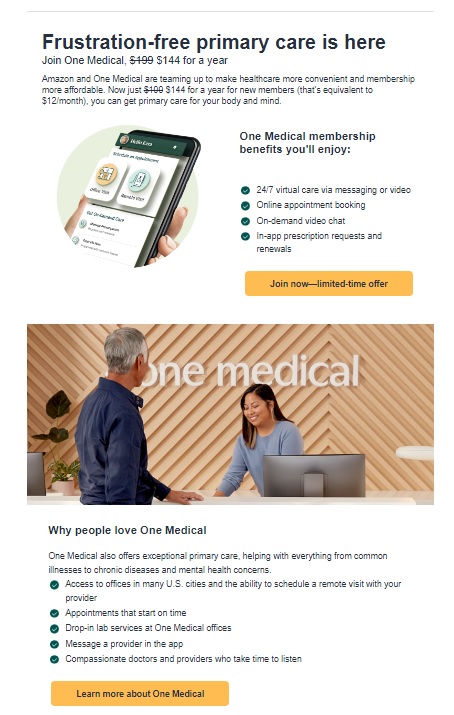
Now to Amazon and One Medical. This Editor received her invitation to buy a One Medical membership earlier this week (left). Countering this Editor’s analysis from last week, which maintains that Amazon is already under a broad antitrust microscope viewed by the Federal Trade Commission (FTC) and the Department of Justice (DOJ), Healthcare Dive counters, quite logically and in the view of their experts, that if either agency was going to object, they would have done so before the closing, and the grounds were likely too novel. The article concedes that the FTC could take action further down the road, for instance if Amazon violates HIPAA or consumer privacy with ad trackers. Instead, the focus is on objections by consumer groups, Amazon leveraging health data, privacy violations, and a general consumer unease around Amazon dealing with their health issues.

  • Consumer protection group Public Citizen urged regulators to block the deal in a letter to regulatory groups after it was announced last summer. For instance, it could bundle One Medical and Prime membership (a no-brainer). By tying the two together, Amazon could gain consent for using patient data from health records. Amazon could also serve ads for products related to medical conditions without that access (that old Pixel/ad tracker business again). These concerns are publicly shared by two FTC commissioners.
  • Analysts said that data acquisition was likely a big driving factor for the deal. After linking One Medical’s data with that from its other products and services, Amazon can analyze petabytes of healthcare data in the cloud and use the findings to better manage the health of One Medical’s Medicare population, build new products and pinpoint people with rare diseases to solicit participation in clinical trials, according to (market research firm) Forrester’s (Natalie) Schibell.” [Editor] That would, of course, require patient consent. 
  • Forrester noted that the consumer unease around Amazon in healthcare is substantial. 34% of surveyed adults weren’t at all comfortable with Amazon for healthcare needs with an additional 17% only somewhat more comfortable (tier 2). Trust levels are low, and it would take only one or two incidents, such as a security breach or HIPAA violations, to destroy it. This Editor would add that if One Medical practices were not managed impeccably, that would go viral among individual and corporate members, in a way that Amazon Care did not.

Mid-week roundup: another hurdle for Oracle Cerner VA delay, Walmart builds out clinic infrastructure, Cerebral round 3 layoff of 15%, Evolent Health’s 9% layoff, Quil Health age-in-place tech shuts

Oracle Cerner EHR rollout faces yet another hurdle. The Department of  Veterans Affairs (VA) announced that the next go-live, Ann Arbor (Michigan) Healthcare System, originally scheduled for completion by July 2023, would be delayed until much later this year or even early 2024.  It turns out that a key reason for the delay is that Ann Arbor is a VA research center, and there are major concerns that the EHR changeover won’t blend well with their medical research. VA Under Secretary for Health Dr. Shereef Elnahal told FedScoop during a media roundtable that “…there are many VA medical centers that are heavy with clinical research because of their academic affiliations, and so those centers will need this research functionality. It’s not just an issue with the Ann Arbor Hospital.” In the article, Dr. Elnahal also lamented that the VA health system running on two separate EHRs, VistA and Oracle Cerner, presented additional risks to security. Also FedHealthIT   Hat tip to HISTalk 24 Feb

Walmart’s 32 clinics are building out their infrastructure. Working with their Epic EHR, all the clinics are now operating on the Horizon Cloud on Azure platform paired with VMware cloud infrastructure and digital workspace technology services. A blog published by VMware interviewing BreAnne Buehl, director of life sciences solutions for VMware, and David Rhew, MD, global chief medical officer at Microsoft, details the ambitions of Walmart to move beyond ‘minute clinic’ to broader primary care and chronic disease management, into proactive predictive analytics. Becker’s Hospital Review, VMWare

And on the less cheerful side:

  • Beleaguered telemental health/ADHD provider/prescriber Cerebral announced another 15% layoff, cutting 285 people. It is its third layoff in one year, following a 20% cut last October.  Cerebral is also closing its medication-assisted treatment (MAT) program for opioid use disorder (OUD). A Cerebral spokesperson said the decisions were made to reorganize the company to “refocus on the most important service offerings for our patients.” Another reason for the MAT program closing is the pending renewal of requiring in-person visits for certain mental health medications. For instance, the Drug Enforcement Agency (DEA) is proposing that buprenorphine can be prescribed via telehealth for treating OUD for 30 days but then an in-person exam would be required.  Last year, Cerebral faced still-unresolved DOJ and FTC actions on their telehealth prescribing of ADHD and other controlled Schedule 2 medications, from deceptive advertising (FTC) to overprescribing (DOJ) [TTA 18 Nov 22]. Topping this off are dueling lawsuits with former CEO Kyle Robertson [TTA 30 Nov 22]. Cerebral at the end of 2021 was valued at $4.8 billion by Softbank and other investors, but no one wants to talk about its worth today.  Reuters, Layoffs Tracker, Behavioral Health Business
  • Payer/provider management services organization Evolent Health quietly laid off 460 positions in its Chicago operations, about 9% of their 5,100 person staff, starting in December 2022 into last month.  Their Q4 net loss doubled to $11.25 million on $382 million in revenue, doubling 2021’s $5.65 million loss, though full year 2022 closed with a final loss of $19 million, about half of 2021. The company projects Q1 revenue of $420 million to $440 million, with 2023 revenue of $1.92 billion to $1.96 billion with a shift of emphasis to specialty care, bolstered by its closed acquisition in January of Magellan Specialty Health from Centene. Layoffs Tracker, Washington Business Journal
  • Quil Health shut down operations, with employees departing 10 February and executives 24 February. The Philadelphia-based Comcast-Independence Blue Cross joint venture was founded in 2018 to support older adults and caregivers in ‘aging-in-place’ alert and monitoring technology. The sole report in HISTalk states that the website is offline plus their CEO Carina Edwards updated her LinkedIn profile for Quil with a February 2023 end date and changed the company description to past tense, pushing up her board positions. Their Facebook page is still live but no posts after 16 January after announcing their joining the AARP AgeTechCollaborative. In 2019, this Editor wrote that they were developing pre- and post-care support through TV (!) with Comcast working on an ambient sensor-based device to monitor basic vital signs and fall detection, which launched in 2020 as Quil Assure. To this Editor, it sounded like a home version of QuietCare circa 2009 with multiple sensors and diagnostics. 

Should your healthcare organization become a public benefit corporation (PBC)?

Is it this year’s ‘IT’ social trend–or a way to return companies to their purpose? Public benefit corporations (PBCs) are finding a foothold within healthcare and digital health organizations. Developed in 2010, the PBC form is a for-profit corporation that is structured to pursue a social mission and recognized in that structure to create a long-term public good or benefit by providing services and generating revenue. It can be publicly traded (though relatively rare). 36 states, including the ever-popular Delaware, and the District of Columbia permit PBCs to be formed. In terms of corporate accountability, achieving their stated social mission or purpose must work alongside maximizing value for shareholders. Otherwise, they are structured like standard for-profit corporations. 

Examples of healthcare PBCs are Aledade (practice management services in value-based care models which just acquired Curia in VBC analytics), Mark Cuban Cost Plus Drugs, Osmind (behavioral EHR), and startup Crescendo Health (health data). Other well-known PBCs are Lemonade (insurance), Veeva (cloud software for life sciences), Patagonia (clothing), Ben & Jerry’s (unusually within Unilever), and Coursera (online learning). Companies like Veeva have converted from traditional publicly traded corporations to PBC.

Would this form be right for your company? From what this Editor has read (see below) if the company is truly purpose-driven from the top and the bottom. A PBC company’s board of directors is required to balance its mission/purpose with the financial interests of shareholders and investors. A mission focus can be attractive to both. It also orients management on the long term versus living and dying by quarter-to-quarter performance. Part of this can be environmental, social, and governance (ESG) criteria. For many companies in healthcare that are oriented to service and to benefit health (beyond the loose ‘transformation’) but must generate profitable revenue, a PBC can differentiate your company from competitors that are standard corporations that answer to VCs and PEs. 

Intertwined with this is the B Corporation (B Corp) certification, granted by a third-party organization called B Lab. It is not necessary to be a PBC to have it but it helps the ‘look’. Like most third-party certifications, it’s a high and distracting bar, requiring assessments and changes in corporate governance, and has to be renewed every three years. (This Editor worked for an internationally known travel organization starting with an ‘A’ before healthcare that attempted to achieve the Malcolm Baldrige Quality Award after high scores with J.D. Power. That effort served to distract everyone for an entire year from real business. And then we missed! And then we got bought–and moved!)   FierceHealthcare, Kiplinger’s, US News

News roundup: UHG closes $5.4B LHC deal, Teladoc’s record $13.7B ’22 loss, Olive AI divesting UM, Cigna exec can’t join CVS, VA anti-suicide program awards, Equiva-Infiniti ACP initiative, Newel Health’s Parkinson’s device

UnitedHealth Group added more home care to its Optum unit with the close of the LHC Group deal on 22 February. Final cost was $5.4 billion or $170 per share of the now-delisted Nasdaq company. The acquisition was announced in March and survived two reviews: a request from the Federal Trade Commission (FTC) for additional information which held up the close past the original December date and a shareholder suit on ‘material nondisclosure’ in the SEC filing. FTC requested information on worker pay and ‘vertical harm’ on market competition, but did not proceed with further action prior to the closing. LHC Group serves 960 locations in 37 states, with 30,000 employees and revenue of $2.2 billion last year. The original announcement indicated that the Louisiana-based management team will be coming over to Optum Health and co-founders Keith and Ginger Myers will personally invest $10 million in UHG following the acquisition close. Interestingly, as of today (Thursday noon ET), neither company has announced the closing on their websites. Home Health News, FierceHealthcare  For those into value-based care, as previously noted, Optum is acquiring via LHC Imperium Health, a good-sized ACO, population health, and management services company. It’s another fit as Optum is a major physician group owner, many of whom are also in ACOs, and made LHC even more attractive. According to their website, Imperium now manages 16 ACOs and is in partnership with a large ACO group. 

Unsurprisingly, Teladoc notched a record loss for 2022– $13.7 billion on revenue of $2.4 billion. This included the Q1 2022 $6.6 billion write-off of the Livongo acquisition. On the investor call, company executives scaled down 2023 revenue forecasts to $2.55-$2.68 billion, which is about 9% growth. Teladoc remains at about 80 million members. The company’s ‘balanced growth’ plan to move toward profitability has already resulted in January’s announcement of 6% of staff being laid off and a reduced geographic footprint, presumably including real estate and leases. Healthcare Dive, HISTalk 2/24/23 which also cross-references the MedCityNews Livongo ‘lemon’ interview

Olive AI continues to shrink and juggle, with today’s announcement of their putting their utilization management service line up for sale. Earlier, they announced divesting their population health and 340B service lines to a sister company. The UM line buyer would take on the accounts and the 100-person staff. Olive AI is an automator of routine health system administration tasks such as these. Their pivot will be in automating revenue cycle management for health systems. Last week, Olive announced the release of 215 employees, about 35% of its remaining staff, in addition to its July layoff of 450 employees, then about 33% of staff. If this Editor’s calculations are correct, Olive is down to about 900 or less. Becker’s  Original report in Axios is paywalled, but indicates problems with the software’s efficacy, multiple executive departures, and a previous asset sale.

Yes, Virginia–non-competes ARE enforceable. So Amy Bricker, Cigna’s former head of pharmacy benefits unit Express Scripts, found out when she tried to join CVS as a senior executive as chief product officer for its consumer area, not Caremark which is a direct competitor. She had signed a two-year non-compete/non-disclosure barring her from any employment with any direct competitor. Cigna apparently imposes non-competes on only their most senior executives, a total of 16. This is a temporary restraining order from the US District Court for the Eastern District of Missouri to bar her from joining the company, duration unknown. Cigna had to post a $250,000 bond for possible future damages. FTC (again) is attempting to ban non-compete use both in future and retroactively. Restraining order, Healthcare Finance News, Healthcare Dive

Some blue side up news: 

  • Mission Daybreak Grand Challenge awarded by the VA. 10 companies were awarded $20 million to pursue digital health approaches to prevent veteran suicide as part of a 10-year VA initiative. The first-place winners were Stop Soldier Suicide and Televeda, awarded $3 million each. Healthcare IT News has additional details on all the finalists.
  • Digital health is leveraging an existing $14.2 billion FCC initiative called the Affordable Connectivity Program (ACP). Two companies, Equiva Health, a digital patient engagement and health relationship management solution provider, is partnering with internet provider Infiniti Mobile to create Equiva ACP Connect. The product configures tablets and mobile devices for care management and patient education distributed by hospitals, nursing homes, insurers, and other healthcare organizations. Release
  • Newel Health has received a grant from the Michael J. Fox Foundation to further development for Soturi, a digital therapeutic solution for Parkinson’s disease management. Soturi utilizes data collected from a wearable sensor, using an algorithm-based decision-making method, for personalized treatment. The project will be presented at the SINdem conference in Bressanone, Italy on 24th February. Release (PharmaPhorum)

Breaking: Amazon closes One Medical $3.9B buy, despite loose ends–and is the Antitrust Bear being poked?

The Big Deal closes, but loose ends and larger issues remain. Today’s news of Amazon closing its purchase of the One Medical primary care group is being received in the press, especially the healthcare press, enthusiastically. This Editor cannot blame her counterparts, as since last year there’s not been much in the way of good news, compared to 2020-21’s bubble bath. Her bet as of a couple of weeks ago was that the deal would not go through due to Amazon’s financial losses in 2022 and/or that the FTC would further hold it up, both of which I was wrong, wrong, wrong on. (Cue the fresh egg on the face.)

Wiping off said egg, here is what Amazon is buying and their first marketing move. (Information on size and more from the 1 Life 2022 year end 10-K):

  • Amazon acquired 1Life Healthcare Inc. for $3.9 billion, or $18 per share in cash.
  • The practices are primarily branded as One Medical, closing out 2022 with 836,000 members and 220 medical offices in 27 markets
  • It is a value-based primary care model with direct consumer enrollment and third-party sponsorship across commercially insured and Medicare populations. Their Net Promoter Score (NPS) is an extremely high 90. (NPS is a proprietary research metric that indicates customer loyalty and satisfaction.)
  • They also have at-risk members from the $2.1 billion Iora Medical acquisition in seven states, in Medicare Advantage (MA) and Medicare shared savings value-based care (VBC) arrangements [TTA 27 July 22].
  • One Medical has contracts with over 9,000 companies, establishing Amazon at long last in the desirable corporate market.
  • One Medical also provides a 24/7 telehealth service exclusively to employees of enterprise customers where there are no clinics.
  • Amazon will be offering a discounted individual membership of $144 versus $199 for the first year, without an Amazon Prime subscription.

The Federal Trade Commission (FTC), which had additional questions about the buy as part of a Second Request in the Hart-Scott-Rodino Act reporting process, did not act in time to prevent the closing. Nor did the SEC or DOJ. This is CEO Andy Jassy’s first Big Deal at Amazon and certainly, the champagne and kvelling are flowing at HQ plus One Medical’s investors and shareholders for a successful exit. But should Amazon be looking over their shoulder? 

What are the open issues? Is a large, hungry Bear called Antitrust being poked, or lying in wait for its prey?

  • The FTC has the right to probe into the transaction despite the closing and a deadline passing for antitrust review. In FierceHealthcare and STAT, FTC spokesman Douglas Farrar is quoted as telling the WSJ (paywalled) in a statement that “The FTC’s investigation of Amazon’s acquisition of One Medical continues. The commission will continue to look at possible harms to competition created by this merger as well as possible harms to consumers that may result from Amazon’s control and use of sensitive consumer health information held by One Medical.”
  • As previously reported here, only in December did the FTC send out subpoenas to current and former One Medical current and former customers as part of its investigation. That’s late to stop a buy–unless FTC had something else larger in mind.
  • Early February reports in Bloomberg and the WSJ indicated that this may be part of a larger FTC action in developing a wide-ranging antitrust lawsuit against Amazon on multiple anticompetitive business practices. Their chair, Lina Khan, is highly critical of Amazon’s business practices. Amazon’s buy of iRobot, maker of Roomba, which at $1.7 billion was a comparative snack, is still not closed and has received a lot of negative attention for possible misuse of consumer information. 
  • Sidebar: This FTC is ‘feeling its oats’ on antitrust. GoodRx found itself making history as FTC’s first culprit of the 2009 Health Breach Notification Rule, used to prosecute companies for misuse of consumer health information. This was for their past use of Meta Pixel, discontinued 2019, to send information to third-party advertisers. One Medical is a HIPAA-covered entity which puts it at a far higher risk level. 
  • The Department of Justice (DOJ) has not publicly moved to approve or disapprove–yet. 
  • The change of ownership has not been reported as passing muster by regulators in multiple states. Example: Oregon approved it, but with multiple stipulations [TTA 6 Jan]–and there are only five One Medical clinics in Oregon. States like New York, Massachusetts, Connecticut, and California are not exactly pushovers for approval, with California alone having two approval entities.
  • Congress is increasingly feisty on data privacy–consumer health information and its misuse in telehealth [TTA 9 Feb]. 

Will this be ‘buy now, regret later’, a lá Teladoc’s expensive acquisition of Livongo, or Babylon Health going public with a SPAC? Is this a clever trap laid for Amazon?

  • Amazon is already under a Federal and state microscope on data privacy. Information crossing over from One Medical to their ecommerce operations such as Pharmacy and Prime will just add to the picture. 
  • Accepting Medicare/Medicare Advantage increases scrutiny on quality metrics and billing, to name only two areas. At-risk patients in Medicare and other VBC models, especially Medicare Shared Savings Program (MSSP) fall under CMS scrutiny. Amazon may take a look at that and spin-off/sell off the former Iora Health practices/patients.
  • Amazon has failed in healthcare previously, as a partner in the misbegotten Haven and in its own Amazon Care ‘home delivery’/telehealth model selling to companies, now closed. Its asynchronous virtual care service, Amazon Clinic, is too new to judge its success. 
  • Office-based, brick-and-mortar healthcare provided by doctors, nurses, and allied health professionals is an entirely new area for Amazon. Will they be satisfied with their new masters–and new metrics? It is also expensive. One Medical has never been profitable and did not project breakeven for years. (If one asks how this is different than CVS acquiring Oak Street Health, or Walgreens acquiring VillageMD and Summit Health, CVS and Walgreens have experience for decades in multiple aspects of providing healthcare–profitably and in compliance.)
  • One wonders how heavy of a hand Amazon will place on One Medical’s operations. How their management, doctors, and other professionals will feel after a year or two of Amazon ownership is anyone’s guess. This Editor doubts they will remain in place or silent if unhappy.
  • Selling to enterprises–and account retention–is a vastly different relationship-building process and buyer journey than 1:many consumer transactions. One Medical made a go of it with 9,000 companies and enrolling employees at about a 40% rate, so they did something right. By contrast, Amazon failed to sell Amazon Care well to companies. Humility and service, for starters, are required.
  • Last but certainly not least, is how Amazon will deal with regulation and compliance at multiple levels.

Expect that the FTC and DOJ will not be done with Amazon any time soon in what looks like a wider antitrust pursuit that may take some time, which they have. Amazon has tens of millions in government business (AWS) at stake and shareholders expecting a reversal of losses. Pro tip to Amazon: run One Medical as a separate operation with minimal integration and no information sharing until past this. And then some.  Healthcare Dive, Becker’s

Theranos’ Balwani seeks to remain free during appeal, argues he owes nothing in restitution (updated for Holmes appeal)

12.9 year Federal sentence set to begin 15 March. On Friday 17 February, Ramesh ‘Sunny’ Balwani, former Theranos president/COO, his defense attorneys, and the prosecution were in Judge Edward Davila’s Federal District courtroom to argue that Balwani should remain free during appeal, and–surprisingly–should owe nothing in restitution to investors.

Balwani is scheduled to report is scheduled to report to the minimum security Federal prison at Lompoc, California to begin his 155-month sentence on 15 March. During the hearing, Judge Davila did not issue a decision on Balwani’s freedom through appeal, nor about restitution. In play are the parallel sentences and appeals of Balwani’s boss and lover, Elizabeth Holmes, with her delay of surrender based on appeals being filed and restitution being decided in the same court.

Balwani’s defense is taking a different tack than Holmes’ defense regarding restitution. His attorney, Amy Walsh, presented that the company was still valuable at the time of Balwani’s dismissal in May 2016. Theranos still had $350 million in cash and intellectual property worth $100 million. Judge Davila seemed skeptical of that:  “Are you saying his conduct was completely divorced from Theranos’ demise?” The prosecution is seeking a far higher restitution–$900 million–than the $120 million Judge Davila estimated at the time of Balwani’s sentencing.

Elizabeth Holmes is also seeking to remain free while appealing her 11.25 year sentence in the Ninth Circuit Court of Appeals, with filings in December and January [TTA 24 Jan, 10 Jan] with Balwani’s filings on a similar timetable. Her defense team also filed for a new trial [TTA 15 Jan] based on purported errors by Judge Davila during her trial. Her restitution hearing on the $121 million Judge Davila has estimated during her sentencing is now scheduled for 17 March. As with Balwani, the prosecution is seeking a far higher restitution–$804 million.

Holmes’ surrender date is scheduled for 27 April to the Federal prison in Bryan, Texas–a change by the Federal Bureau of Prisons from Dublin, California, as rumored in November [TTA 30 Nov]. The women-only minimum security Bryan facility is considered in the Federal system to be ‘heaven’ compared to the Dublin satellite camp, though the latter is only about an hour from her home, partner Billy Evans, and her soon-to-be two children. The selection is important because Federal inmates serve in general 85% of their sentence.

Updated  Holmes’ second child has been born, according to a court filing on Thursday. Her defense continues to press for postponing her surrender during the appeals process. Defense and prosecution continue to wrangle on Holmes’ flight risk, based on the never-taken January 2022 Mexico trip and one-way ticket, now on the basis that she has never directly denied that she intended to flee nor explained her lack of a return ticket [TTA 24 Jan].  Mercury News

Balwani’s defense also maintains that government misconduct during the trial makes success for appeal likely, that he is not a flight risk based on his behavior since 2018, and has no history of violence. The clock is ticking down on both Balwani and Holmes. AP

Breaking: AliveCor wins presidential review on ITC Final Determination on Apple patent infringement

Enforcement held for PTAB appeal decision. As anticipated after the International Trade Commission (ITC) decision, finding that Apple Watches infringed three AliveCor patents on ECG readings [TTA 3 Jan], the Final Determination issued 22 December 2022 has passed the 60-day mandatory presidential review and is now in effect.

The penalty in the bond assessed against Apple–$2 per watch–applies to Apple Watches with the ECG feature imported or sold during the presidential review period. It is the first Limited Exclusion Order (LEO) with a cease and desist order against Apple. However, the penalty cannot be enforced until AliveCor’s appeal of the US Patent and Trademark Office’s Patent Trial and Appeal Board’s (PTAB) ruling is decided. PTAB’s ruling in early December not only ruled that Apple did not infringe on AliveCor’s patents, but also threw out the AliveCor patents that were the basis for the infringement as unpatentable: No. 10,595,731 (“the ’731 patent”); No. 10,638,941 (“the ’941 patent”); and No. 9,572,499 (“the ’499 patent”) in their Apple Watches 4, 5, and 6.

The PTAB appeal is in progress. AliveCor also has a separate action against Apple through its Federal antitrust case in the Northern District of California. That will not go to trial until early 2024. AliveCor has about 170 patents, but the loss of any patents is important to a company’s IP and ultimately, funding. It’s also a clear signal to innovative companies that a David can win against a Goliath. AliveCor release

ATA 2023 Annual Conference 4-6 March–a special deal for our Readers

The American Telemedicine Association (ATA) annual conference and expo is only two weeks away–4-6 March in San Antonio, Texas. ATA2023 is the only US event solely focused on telehealth and virtual care, with three full session days, an interactive exhibit floor, two receptions, a research track, and more. More information is available here.  This Editor will also note that average temperatures in San Antonio at this time of year will be warm without Texas stickiness–in the high 70s F°–so if you are looking to defrost, Go Texas! 

Registration link is here. But as a media partner of ATA (see above), our Readers are eligible for a discount of $250. On registration, enter this code: ATA23TAW250. If you attend, love to hear your feedback!

Short takes: Avaya’s Ch. 11; Aetna sells India telehealth; fundings for IncludeHealth, Senniors, Thatch, Previa, MDI; layoffs at Collective Health, Vicarious, Olive AI

Avaya files second Chapter 11 reorganization in six years. The company, which provides virtual care and collaboration tools (and has contributed to our Perspectives series), is restructuring with a financing of $780 million. This was anticipated from August-September last year when they announced accounting problems with their cloud subscription revenue, resulting in substantial layoffs, $250 million in cost cuts, a CEO change, and a continuing crash in the stock value which was close to 99%. In December, they announced a likely delisting from the NYSE. Major creditors include Microsoft, Wistron Corp., and SHI International. Current customers will continue to be served. Upon completion of the restructuring process in a projected 60 to 90 days, Avaya will reduce its total debt by more than 75%, from nearly $3.4 billion to about $800 million. CRN 14 Feb, CRN 7 Sep 22, Yahoo Finance    Hat tip to HISTalk

Aetna’s subsidiary Indian Health Organisation (IHO) is selling its telehealth business to MediBuddy. Transaction cost was not disclosed. Bangalore-based MediBuddy is buying what is currently called vHealth by Aetna and will be rebranded over the next six months to MediBuddy vHealth, to be integrated with its other services. vHealth is a subscription-based primary healthcare service that offers telehealth consultations, an extensive outpatient network, pharmacy, diagnostics, dental services, delivery of medicines, blood tests, and other home healthcare products across 38 Indian cities. IHO employees will continue with MediBuddy. Last February, MediBuddy scored a $125 million Series C funding, led by Quadria Capital and Lightrock India.  Press release (Hospitals Management India), Mobihealthnews

A few early-state digital health fundings rounded up by Mobihealthnews:

  • Ohio-based digital musculoskeletal (MSK) health care and training company IncludeHealth raised $11 million in a funding round led by CincyTech with participation from Tamarind Hill and other investors. The fresh funds will be used to expand the MSK-OS remote care platform. Ray Shealy joined as COO and Grant Koster joins the board of directors. Also Finsmes 
  • Madrid, Spain-based Senniors raised $5.6 million in seed funding. Senniors provides home care services including therapy, mental healthcare, and nutrition counseling for older people and others who need support. The seed round was led by SixThirty with Sevenzonic, KIMPA, Zubi Capital and Invertidos.
  • Thatch, a health benefits startup, raised over $6 million in total funding across pre-seed and seed rounds from 16z and GV, with participation from Lux Capital, Quiet Capital, Not Boring Capital and BrightEdge. It includes a tech-enabled Health Savings Account, a Thatch debit card for all healthcare expenses, and on-demand access to experts who can resolve billing issues via text. Release
  • Previa Medical, based in Lyon, France, raised €2.1 million for its AI-based predictive medical device to alert providers to early signs of sepsis and raised $2.2 million in seed funding. It included participation from Kreaxi, M2care, Veymont Participations, Hopla Memory, CCI Capital Croissance, Holding Seraip, Bpifrance and BNP Paribas, with equity and debt financing from Banque Populaire AURA. SEPSI-SCORE analyzes patient risk factors for sepsis in real time through patient records drawn from hospital software to alert providers up to 48 hours before symptoms develop. Finsmes
  • And one more: $20 million in Series A funding to healthcare analytics company MDI Health. MDI uses AI in pharmacology to prevent negative outcomes in chronic polypharmacy patients and at-risk populations. Mobihealthnews

While layoffs in healthcare have slowed down somewhat, they do continue: 

  • San Mateo-based Collective Health, a benefits administration software provider for enterprises, laid off 54 of an estimated 500-1,000 employees. LinkedIn corporate posting
  • Vicarious Surgical, a robotic surgical developer which has received funding from Bill Gates and BD, is planning to reduce its workforce by 14% to conserve cash. Ironically, they are making a 510(k) submission for a robotic system to compete against giant Intuitive Surgical’s da Vinci. Med tech has tightened up substantially with giants like Baxter whacking 3,000 jobs (5%) in its global workforce and Abbott releasing temporary workers hired to produce COVID-19 test kits in Maine. Medtech Dive
  • Olive AI, which automates routine administrative healthcare processes such as revenue cycle management, laid off an additional 215 employees last week, about 35% of its remaining staff, due to account losses. In July, 450 employees or about 33% of staff were released. Axios