News Roundup: Doctor on Demand’s $75M Series D, Google’s Fitbit buy scrutinized, $5.4 bn digital health funding breaks record

More evidence that telehealth has advanced 10 years in Pandemic Time. Doctor on Demand, estimated to be the #3 telemedicine provider behind Teladoc and Amwell, announced a Series D raise of $75 million, led by VC General Atlantic plus their prior investors. This increases their total funding to $240 million.

Unlike the latter two, DOD actively courts individual users in addition to companies and health plans. In May, they announced that they were the first to be covered under Medicare Part B as part of the CMS expansion of telehealth services in response to the pandemic (and for the duration, which is likely to be extended past July), which would reach 33 million beneficiaries. Other recent partnerships include a pilot with Walmart for Virtual Primary Care in three states (Colorado, Minnesota, Wisconsin) in conjunction with Grand Rounds and HEALTHScope Benefits as well as with Humana for On Hand Virtual Primary Care (regrettably only a video clip on the DOD press site with the noisome Jim Cramer). DOD covers urgent, chronic, preventative care, and behavioral health and claims about 98 million users, doubled the number of covered lives in 1st half 2020, and passed 3 million visits. Crunchbase NewsMobihealthnews

Google’s Fitbit acquisition scrutinized by EU and Australia regulators, beaten up by consumer groups in US, EU, Canada, Australia, and Brazil. None too happy about this acquisition is a swath of powerful opponents.

  • EU regulators have sent 60-page questionnaires to both Google and Fitbit competitors asking re the effect the $2.1 bn acquisition will have on the wearables space, whether it will present disadvantages to competitors in Google’s Play store, and how Google will use the data in their advertising and targeting businesses. While #2 and 3 are no-brainers (of course it will present a competitive disadvantage! of course, they’ll use the data!), it signals further investigation. The next waypost is 20 July where EU regulators will present their decision.
  • The Australian Competition and Consumer Commission (ACCC) announced in mid-June their concerns in a preliminary decision, though they don’t have the jurisdiction to block it. “Buying Fitbit will allow Google to build an even more comprehensive set of user data, further cementing its position and raising barriers to entry to potential rivals,” according to ACCC Chairman Rod Sims. This adds to the controversy Down Under on how Google and other internet companies use personal information. Final statement is 13 August. Reuters
  • The US Department of Justice is also evaluating it, as is the Federal Trade Commission. But an acquisition like this doesn’t easily fall under antitrust regulation as Google and Fitbit aren’t direct competitors. Fitbit has only about 5 percent of the fitness wearable market. However, this plays into another related investigation by DOJ — Google’s abuse of advertising data and its dominance of the market in tech tools such as Google Ad Manager in the US. DOJ asked competitors for information at the end of June. There are separate investigations by state attorneys general and also by Congress of Google and Apple. Reuters
  • The consumer group opposition rounds up the usual suspects like Open Markets Institute, Omidyar Network, Center for Digital Democracy, Open Knowledge and Public Citizen in the US, and in the EU Open Society European Policy Institute and Access Now. Their grounds expressed in a letter to regulators in the above countries are the usual dire-sounding collection of “exceptionally valuable health and location datasets, and data collection capabilities.” Sound and fury….

It will keep Google’s attorneys in DC, Brussels, and elsewhere quite busy for a lot longer than perhaps Google anticipated. Meanwhile, Fitbit is in the Twilight Zone. The Verge, Android Authority, FierceHealthcare 

US digital health companies smash funding records in 1st half 2020. Despite–or because of–the pandemic, US digital health investment funding tracked by Rock Health is at a torrid pace of $5.4 bn–$1.2 bn above the record first half posted in 2019.  That is despite a pullback in 1st Q + April.

Investors came roaring back in May and June, spurred by telehealth success and a rallying market, closing 2nd Q with $2.4 bn in investment. That was 33 percent higher than the $1.8 bn quarterly average for the prior three years. And the deals were big: on average $25.1 million, with the big boosts in Series C and bridge financing. M&A is still cloudy, but what isn’t? Notably, Rock Health is not projecting a final year number, a good move after they stubbed their collective toe on last year’s final investment total, down from both forecast and 2018. [TTA 7 Feb]

The big moves of 1st half in real digital health (not fitness) were Teladoc-InTouch Health (just closed at $600 million stock and cash) and Optum-AbleTo (at a staggering $470 million, which has apparently not moved past the ‘advanced talks’ state). Two of last year’s Big IPOs–Phreesia and Livongo— are doing just fine; Health Catalyst not so much. The bubble bath we predicted turned out to be a cleansing one–but there’s six months more to go. Also Mobihealthnews
Kent County Council announces videophones for vulnerable residents in £1.5 million COVID response initiative (UK)

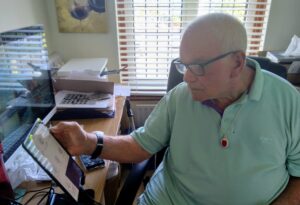
Kent County Council has launched an initiative to connect 2,000 of its most vulnerable residents to KCC support staff. Alcove, an assisted care technology provider, and care transformation consultancy Rethink Partners will set up the videophone tablet-type units. The £1.5 million Video Carephone program will support “vulnerable and digitally disadvantaged elderly residents and those with a learning disability (who) will be able to receive virtual video care and health consultations, as well as video contact with friends and family while minimising the infection risk to other residents and care staff.” The unit is delivered to the person’s home, ready to go; presumably there is already in place an internet connection with a router as the KCC website release is not specific on the technical side.

This was rolled out in response to the COVID pandemic, but this program is also aligned with the national digital switchover program starting in 2023. The release also includes a testimonial from Robert Greenfield of Gravesend (above left). Diagnosed with multiple sclerosis 20 years ago, he set it up himself, using it not only to communicate with his home care provider but also friends and family. An interesting sidelight is that Mr. Greenfield edits a magazine (MS) for others with the MS diagnosis and will be writing about it. 

Walgreens Boots goes big with billion-dollar medical office deal with VillageMD

Go big or go home. That seems to be Walgreens Boots Alliance’s’ theme in its 8 July announced deal with and investment in primary care provider VillageMD. They will set up 500 to 700 co-located full-service Village Medical offices in more than 30 markets over the next three to five years. The “Village Medical at Walgreens” offices will be staffed by a projected 3,600 primary care providers and fully integrated with Walgreens pharmacists for one-stop shopping. According to the release:

  • Most of the Village Medical medical offices will be approximately 3,330 square feet each, up to 9,000 square feet, and utilize existing store space. “80% will be used by VillageMD to fund the opening of the clinics and build the partnership.”
  • 24/7 care will be available via telehealth and at-home visits
  • Fees will be covered by insurance or for those without, on a sliding scale
  • Over 50 percent will be located in Health Professional Shortage Areas and Medically Underserved Areas/Populations, as designated by HHS. These would reach underserved “older, sicker, and poorer patients” without regular access to care, said VillageMD CEO Tim Barry in an interview with CNBC
  • Capacity would be 100 to 120 patients per day 

This follows on a pilot of five Village Medical clinics at Walgreens locations in Houston, and Village Medical’s eight-state expansion in the Find Care telehealth program announced in April.

Walgreens Boots Alliance will invest $1 billion in equity and convertible debt in VillageMD over the next three years, including a $250 million equity investment to be completed today which will culminate in about 30 percent ownership.

To this Editor, Walgreens is sitting at a giant poker table, stacking the $1,000 chips, and saying to its rivals, ‘see ya and raise ya’. These are full-service offices, not urgent care clinics, and they are investing in their provider. It could be transformative–or flop on executional niceties such as location, medical competition, or even COVID keeping down physical visits. The competition is also daunting on the retail side. Recently Walgreens has pared back hundreds of locations and faces the deep pockets of CVS-Aetna, which plans to open 1,500 HealthHUBs which integrate stores, MinuteClinics with nurse-practitioners, pharmacies, and health data, Amazon with PillPack aimed at its pharmacy business, and Walmart with its toe in the water with clinics. 

Village Medical, formerly Village Family Health, is a multi-state primary care provider which is part of Chicago-based VillageMD. Both include more than 2,800 physicians across nine markets, so the Walgreens deal will more than double their size. Also Forbes (Photo: Walgreens)

News roundup: Teladoc closes InTouch, Samsung bets on tele-genomics, SURE Recovery app, Optimize.health’s seed round, Walgreens’ Microsoft boost

Teladoc completed the acquisition of InTouch Health on 1 July. The purchase, announced at the JP Morgan soireé in January (and an eternity ago) took place just before the ’10 years in 2 months’ leap forward in telehealth services. InTouch’s telehealth offerings are primarily for hospitals and health systems, heavily based on multi-feature carts and camera setups. The purchase price of $150 million in cash and 4.6 million shares of Teladoc Health common stock, valued then at $600 million, may be a great bargain for Teladoc considering the rich prices that other telehealth-related companies commanded during the peak of the pandemic, and that Teladoc’s revenue boosted to almost $181 million in revenue in Q1 2020, up 41 percent versus Q1 2019. Release

Samsung makes a telemedicine bet with Genome Medical. Through its Catalyst Fund, Samsung is the lead among 15 investors in a $14 million Series B extension financing that includes LRVHealth, Revelation Partners, and Kaiser Permanente Fund. Genome Medical’s connection to telemedicine is on-demand, standard-of-care genetics and genomics through virtual health services, including counseling, patient drug response, and provider-to-provider consults through its platform. Release. CNet. Crunchbase.

Mindwave Ventures, which this Editor noted last December was opening up an office in the Leeds health tech hub, has continued its development and research with multiple platforms and apps in partnership with NHS and academic/research clients. One that came on our ever-whirling radar screen is the release of the SURE Recovery app, for those in recovery from alcohol and drug problems. It enables users to work with the SURE (Substance Use Recovery Evaluator) and SUSS (Substance Use Sleep Scale) measures, plus a personal diary, to track their recovery over time. Mindwave developed the app in conjunction with The King’s College London and theInstitute of Psychiatry, Psychology & Neuroscience (IoPPN) at King’s College London. The app is now available to download; search ‘SURE Recovery’ on the App Store or Google Play. The page on the Mindwave site is on their Clinical Research page–click the tab for SURE. Hat tip to Ellis Noble of KC Communications.

Connected to telehealth and RPM is provider reimbursement. Optimize.health is an early-stage company which provides a turnkey setup for practices for its remote patient monitoring platform, with the usual features such as patient engagement, integrated devices with the platform, and call center support. The apparent difference is the emphasis on sharing data and simplifying reimbursement, the hard part of any RPM or telehealth platform. Announced this week: a $3.5 million seed round led by Bonfire Ventures. A small boost to this part of the telehealth field which has not had the great success of virtual consults. Release.

Back in January 2019, Walgreens Boots announced a partnership with Microsoft to migrate their IT over to the Azure platform. It took a while for results to manifest to the public. When COVID happened, they rolled out a COVID-19 risk assessment tool on its website and mobile app based on Azure. Their Find Care platform doubled the number of virtual care providers and services available. Walgreens also provided a link to COVID-19 clinical trials through the Find My Clinical Trial program on its mobile app. This article in FierceHealthcare touts how they are maneuvering to stay even with CVS Aetna and Amazon, which is hardly waiting for its partners in the gone-pearshaped Haven.

Hackermania runs wild, Required Reading Department: The Anatomy of a Ransomware Attack

Cue the Duke Ellington score and Jimmy Stewart for the defense, we now have a moment-by-moment look at how a ransomware attack on an organization unfolds. The example is from a Ryuk ransomware attack last October on an unnamed organization.

      • The first step was a probe of the network via the Trickbot malware
      • Hackers then explored the network to determine a valuation–to monetize data
      • They then unleashed other tools in the Pivot and Profile phase–PowerTrick and Cobalt Strike–to search for open ports and other devices
      • The hackers, finding what they want, deploy their Anchor backdoor and Ryuk ransomware to secure their hold on the network
      • Total time from initial malware to Ryuk ransomware encryption: about two weeks

Ryuk has been a highly successful ransomware, netting its extortioners $61m in ransom between February 2018 and October 2019 according to the FBI. UK’s National Cyber Security Centre advisory indicates global attacks starting in later 2018.

The value in this study is substantial–the SentinelOne article is chock full of terminology and screenshots a programmer or white hat would love. It also reveals a multi-step process that if stopped at step 1 (the Trickbot malware) means a tougher nut to crack for the hackers, and a nearly two-week window for a response. ZDNet’s article is written for us ‘civilians’. The sidebar has links to several articles, including this horror compendium from UK victims, ‘The most stressful four hours of my career‘.  Earlier: Hackermania runs wild…all the way to the bank!

Do Huawei and ZTE present security threats to the US and global communications networks? The FCC says yes.

In two little-noted decisions formally announced yesterday (30 June), the Federal Communications Commission (FCC) banned the funding by the FCC Universal Service Fund (USF) of the purchase or use of equipment or services provided by China’s Huawei and ZTE. The USF funds rural internet, Lifeline for low-income consumers, Indian Tribal initiatives, schools and libraries, and the Rural Health Care program–a substantial part of the national network which will also discourage private companies from use of their equipment as Verizon, Sprint, et al participate in these programs.

Both Huawei and ZTE have been found by the US government–and many others–to be extensively tied to the Chinese government and military, obligating these two companies to permit their systems to be used for espionage, plus numerous known cybersecurity risks and vulnerabilities in their equipment. Other national governments have felt likewise including the UK, which is reevaluating its former permission for their participation in the 5G rollout. FCC release, Huawei order, ZTE order, ZDNet (UK)

FCC approves 70 more COVID-19 telehealth funding applications for an additional $32 million

The US Federal Communications Commission (FCC) today (1 July) approved 70 additional applications for funding telehealth during the COVID-19 pandemic. This funding covers both urban and rural providers, from large health systems to local community health centers. The funds for this thirteenth group totals $31.63 million of the $189.27 million in total funds awarded. To date, the FCC’s COVID-19 Telehealth Program, authorized by the CARES Act, has approved 514 funding applications in 46 states plus Washington, D.C. Equipment covered includes telehealth, computers, smartphones, tablets, remote patient monitoring equipment, and software.

A small sample of this group of healthcare organizations:

  •  Avera Health, South Dakota
  • Barnabas Health in NJ for remote patient monitoring equipment
  • Boston Children’s Hospital
  • Greater Philadelphia Health Action
  • Lehigh Valley Health Network in Allentown PA
  • Montefiore Medical Center in the Bronx, NY
  • Ryan Health in Manhattan
  • University of Alabama at Birmingham Hospital
  • UPMC in Harrisburg PA

FCC release. Full list of Telehealth Program recipients here.

Hackermania runs wild…all the way to the bank! Ransomware strikes Crozer-Keystone, UCSF med school, others

News to make you livid. After surviving (to date) the COVID pandemic, health systems and medical schools are being attacked by ransomware criminals. Both the small Crozer-Keystone Health System and the globally known University of California San Francisco School of Medicine have been attacked by the ever-so cutely named Netwalker (a/k/a MailTo). Yes, this criminal hacker gang isn’t outside banging pots for first responders or donating money, or even sticking to a brief truce (Emsisoft), but figuring ways to spread malware into healthcare organizations for fun and profit. 

And profitable it’s been. UCSF paid Netwalker the princely sum of $1.14 million (£910,000) in 116.4 bitcoins after an attack starting 1 June that was also (to add insult to injury) published on Netwalker’s public blog. In the timeline presented by BBC News, it was negotiated down (professionally) from $3 million; BBC also obtained some key parts of the negotiation via an anonymous tipoff, and it’s fascinating reading. Netwalker leads the victim to a dark web ‘customer service’ site where there’s a countdown to double payment or deletion of your now-encrypted data. They are also able to live chat with the victim.

UCSF was able to limit the malware encryption damage to servers within the School of Medicine (according to the BBC, literally unplugging computers; according to UCSF, isolating servers) but decided to pay the ransom to unlock the encrypted data and return data they obtained, stating in its public release “The data that was encrypted is important to some of the academic work we pursue as a university serving the public good”. They will work with the FBI on the incident and have brought on board outside expert help.

According to FierceHealthcare, Netwalker was also behind the attack on the Champaign-Urbana Public Health District (Illinois) website in March and Michigan State University’s network in May.

Paying ransom is contrary to the advice of the major world security services such as the FBI, Europol, and the UK’s National Cyber Security Centre, on the simple basis that it encourages them. It’s a true damned-if-you-do, damned-if-you-don’t situation, as Brett Callow, a threat analyst at cyber-security company Emsisoft, said to the BBC: “But why would a ruthless criminal enterprise delete data that it may be able to further monetise at a later date?” 

Crozer-Keystone to date has refused to pay ransom. On 19 June, bitcoin publication Cointelegraph published a screenshot of Netwalker’s dark web auction page of the data. Apparently it is all financial and not medical records or PHI. Crozer also isolated the intrusion and took systems offline. Crozer is a small system of four hospitals in suburban Philadelphia (Delaware County) and serves parts of the state of Delaware and western New Jersey.

Neither Crozer nor UCSF have gone public with the source of the breach, but it is known that the main lure during the pandemic has been phishing emails with COVID-19 results or news, loaded with malware downloads.

As this Editor wrote back in May 2018 on the anniversary of WannaCry, it’s not a matter of if, but when, at highly vulnerable organizations like healthcare and academia with high-value information records. Right now, the Hakbit spear-phishing ransomware connected to an Excel spreadsheet macro is targeting mid-level individuals at pharma, healthcare, and other sectors in Austria, Germany, and Switzerland, according to tech research firm Proofpoint. TechGenix

More: Becker’s 22 June on Crozer-Keystone, 29 June on UCSF, 12 largest healthcare breaches to date, 10 healthcare system incidents for June, Kroger hacking incident exposing 11,000 health records. DataBreaches.net news page.

COVID effect on US practices: in-person visits down 37%, telehealth peaks at 14%; ATA asks Congress to make expansion permanent

A Commonwealth Fund/Harvard University/Phreesia tracking study of outpatient visits in 50,000 US healthcare practices, specialty as well as primary care, has tracked the effect of the COVID pandemic on practice visits during the period 8 March through 20 June. Using as their baseline the week of 1-7 March, which was the last ‘normal’ week in line with February, the results are not unexpected:

  • From 15 March to 20 June (three months), practice visits, including telehealth, plummeted 37 percent
  • Disproportionately affected were pediatricians, pulmonologists, and surgical specialties such as orthopedics
  • Against the baseline, week of 14 June visits are still down 11 percent
  • The nadir was 29 March, off 59 percent
  • The rebound tracks the same by US region, with the least dip in South Central and Mountain regions. (The most affected, of course, are New England-Mid-Atlantic and Pacific, with the highest COVID rates and the least rebound.)
  • Looking at the ‘rebound week’ of 14 June, the effects linger on in pediatrics, pulmonology, and (interestingly) behavioral health. (Anecdotally, behavioral health patients are continuing with telehealth for convenience versus the physical visit.)
  • Telehealth visits took off starting 8 March and at their peak were 13.9 percent of visits (19 April)
  • Since 26 April, telehealth visits have declined as in-person visits resume, and are at 7.4 percent as of 14 June (46.7 percent less). However, compared to the baseline of nearly zero (0.1 percent), it’s nearly a 140 percent increase.

Phreesia is a scheduling and patient check-in platform. The practices surveyed are Phreesia clients, covering 1,600 provider organizations, with 50,000 providers in 50 states.

Physicians were also interviewed as part of the study. The office operation has had to change, and the patient experience in returning to practices is very different. Making up deferred care is complicated, and precautions to mitigate risk of viral transmission inevitably slow care down. 

Much of the press around this study is that telehealth is receding quickly. As a trend in an extraordinary time when there was no alternative, as practices reopen a shift back to the office is to be expected, and often there is no substitute for in-person exams and procedures. Still, there are elements of long-term uncertainty on the future of practice telehealth. Both CMS and payers announced that payments for telehealth (audio/visual and telephone only) would remain in place only for the duration of the pandemic. What are their long term plans? Providers are having difficulty getting paid or paid enough even in parity states. State Medicaid presents even more of an unwanted ‘discount’.  Telehealth also demands a commitment to (ultimately) a HIPAA-compliant platform, workflow/staff support, and input in the practice’s EMR/population health platform. STAT, HealthcareITNews

The American Telehealth Association (ATA), coming off their virtual annual meeting last week, sent a letter to Congress with 340 signatories supporting a permanent expansion of telehealth after the public health emergency (PHE) ends in four priority areas:

  • Remove location restrictions 
  • Maintain HHS authority to determine eligible practitioners who may furnish clinically appropriate telehealth services
  • Authorize Federally Qualified Health Centers (FQHC) and Rural Health Clinics (RHC) to furnish telehealth services 
  • Make permanent the HHS Temporary Waiver Authority to respond to emergencies

Release and letter

The TeleDentists now in 14 states with Anthem

Updating our May article about The TeleDentists expanding their coverage via Anthem Blue Cross and Blue Shield (BCBS), our initial information was that Anthem was offering teledentistry in only nine states. The current total since May is actually 14 states and covers by state and plan:

  • CA – Anthem Blue Cross
  • CO, CT, GA, IN, KY, ME, MO, NH, NV, OH, VA, WI – Anthem Blue Cross and Blue Shield
  • NY – Empire BlueCross BlueShield

Part of this Editor’s puzzlement is that each health plan issues releases for its plan by state, and when our original article was written, only nine states had issued releases. This is in addition to their agreement with Cigna in employer-sponsored plans announced in April [TTA 15 April]. Hat tip to FischTank PR’s Kate Caruso-Sharpe for the update on behalf of Anthem.

Breaking: NHSX COVID contact tracing app exits stage left. Enter the Apple and Google dance team.

Breaking News: The NHS finally abandoned the NHSX-designed COVID contact tracing app in favor of the app based on the Apple and Google API.

The NHSX version had issues, seemingly intractable, on the BTE features on distancing and contact duration between devices, as well as the app being inaccurate on the iPhone.

The “Gapple” app is already in use in Italy, Switzerland, Denmark, Latvia, and Poland. As this Editor noted on Tuesday, Austria is in test, Germany just launched their ‘Corona Warning App’ and reported 6.5 million downloads in the first 24 hours. 

The BBC reported that the lead on the NHSX app, Matthew Gould and Geraint Lewis, are “stepping back” and former Apple executive Simon Thompson is joining NHSX to manage it

Depending on reports, the NHS either rejected the Gapple app in April or were working on it in tandem from May. More likely, they revived the latter with the NHSX problems. The Gapple version is decentralized in storing information about user contacts on individual phone handsets because of issues over user privacy, versus the NHSX centralized app.

According to the FT and TechCrunch, the government is de-emphasizing the utility of the app, and relying on its small army of contact tracers. 

But what about all those folks on the Isle of Wight?

More on this: Digitalhealth.net, TechCrunch, Financial Times     Hat tip to Steve Hards for alerting this Editor at the end of a busy day!

News Roundup (updated): Proteus files Ch. 11, VA’s EHR tests now fall–maybe, making US telehealth expansion permanent, Rennova’s rural telehealth bet, Oysta’s Lite, Fitbit’s Ready to Work jumps on the screening bandwagon

Proteus Health, the company which pioneered what was initially derided as a ‘tattletale pill’, filed Chapter 11 bankruptcy today (16 June). As early as December, their layoffs of nearly 300 and closure of several sites was a strong clue that, as we put it, Proteus would be no-teous without a big win. Exactly the opposite happened with the unexpected early end of their Otsuka partnership with Abilify [TTA 17 Jan]. Proteus had raised about $500 million in venture capital from Novartis plus technology investors and family offices. Their combination of a pill with an ingestible sensor, a patch that detects ingestion and that sends information to a smartphone app was ingenious, but in a business model was meant for high-cost medications. Proteus’ current partnerships include TennCare (TN Medicaid), plus Xealth and Froedtert to integrate medication information into electronic health records. At one point, Proteus was valued at $1.5 bn by Forbes, making it one of the early healthcare unicorns.  CNBC, FierceHealthcare

VA further delayed in implementing Cerner-Leidos EHR. POLITICO’s Morning eHealth earlier this month reported from congressional sources that further testing would be delayed to the fall at the earliest and possibly 2021. The project to replace VistA stands at $16 bn. Contributing to delay was an April COVID outbreak in Spokane at a veterans’ home, which pushed patients into the VA medical center. 

In further DC news, several senators are advocating that the relaxing of restrictions on telehealth during COVID should largely be made permanent. According to the lead senator, Brian Schatz (D-HI), Medicare beneficiaries using telehealth services increased 11,718% in 45 days. Many telehealth requirements were waived, including geographic, coding of audio-video and telephonic telehealth billing, and HIPAA platform requirements. Other senators are introducing bills to support remote patient monitoring programs in community health centers’ rural health clinics. FierceHealthcare

The climate for telehealth has improved to the point where smaller players with side bets are now betting with bigger chips. Rennova Health, a mid-South healthcare provider with a side in software, is merging its software and genetic testing interpretation divisions, Health Technology Solutions, Inc. (HTS) and Advanced Molecular Services Group, Inc., (AMSG) with TPT Global Tech. The combined company will be called InnovaQor after an existing subsidiary of TPT and plans to create a next-generation telehealth platform targeted to rural health systems. Release, Becker’s Hospital Review

Oysta Technology has launched the Oysta Lite with an SOS button, GPS, safety zone mapping for travel, and two-way voice. The SOS connects to their IntelliCare platform which provides status monitoring, reporting, and device management plus connecting to the telecare service provider. They are specifically targeting post-lockdown monitoring of frail elderly.  Press flyer/release.

Fitbit jumps on the crowded COVID workplace screening bandwagon with Ready to Work, a employer-sponsored program that uses individual data collected via the Fitbit device such as resting heart rate, heart rate variability and breathing rate. Combined with self-reported symptoms, temperature, and potential exposure, the Daily Check-In app then provides guidance on whether the employee should go to work or remain at home. According to the Fitbit release, a higher heart rate–as little as two beats a minute–can be indicative of an immune system response before the onset of symptoms. TTA has earlier reported [19 May] on other COVID workplace screeners such as UHC/Microsoft’s ProtectWell app, Appian, and (in-house) PWC. FierceHealthcare also lists several others on the cart: Castlight Health, Collective Health, Carbon Health, VitalTech, and Zebra Technologies. However, at this stage, few employees are leaving remote work for in office, and fewer still may even return to the office.

Where in the world is the NHS COVID contact tracing app? Apps rolling out globally, but will they roll out before it’s treatable ?

It does seem that the NHS contact tracing app, debuted after various tests on 5 May in the Isle of Wight, has vanished from the radar screen. A scan of recent news indicates that the app is further delayed in favor of a manual track and trace system with 25,000 contact tracers, starting 28-29 May A Telegraph article indicates that the app had the Bluetooth blues, with further detail from Wired UK around emerging worries within NHSX about BTE’s ability to accurately calculate the distance between two users.

Folks in the Isle of Wight, who enthusiastically adopted the app (Week 1’s 52,000 downloads), would like to know how they’re doin’, in the immortal words of a real NYC Mayor, Edward Koch. That data about contacts and alarms seems to not be forthcoming from the NHS–as well as an updated app with more questions about symptoms and test requests and results integrated into the process, according to BBC News today 16 June. Yes, it was an odd choice, but often beta tests take place in relatively small and isolated places, not big cities where factors can’t be controlled. But the app appears not to be moving forward in favor of the manual system. Nevertheless, the sound of crickets is deafening.

Some articles like Wired’s blame the NHS’ centralized approach, where a report of COVID goes straight to the NHS server, with outbound messages going to those with whom the person was in contact, defined by BTE tracing within 6 feet for 15 minutes +. Observers like our own Editor Emeritus Steve Hards noted in comments on the 29 May article that “It will only take a few well-publicised malware or phishing incidents to make the job of the genuine trackers unworkable and for any trust in the app to evaporate.”

A great deal of fuss has been made of other countries adopting contact tracing apps that actually work. Most of these are built on a platform developed by Apple and Google. These have been used in Italy, Switzerland, Latvia, and Poland. Austria is in test, Germany just launched. Japan’s is on a Microsoft platform. Countries that launched earlier have had their wrinkles. Italy is feuding over issues of data privacy. Norway’s Smittestopp app, which used both GPS and BTE to advise those contacted to self-isolate, was stopped by the Norwegian Data Protection Authority on disproportionate intrusion into users’ privacy. A bug in the programming affects Australia’s CovidSafe iPhone users in logging matches when the other iPhone is locked. Singapore, after seeing only one-quarter of the population adopting the app,  is going the wearable dongle route that you hand over if you test positive. BBC News

By the time the apps are developed, debugged, and rolled out, the lockdowns will have ended, and the virus will have abated or mutated for next season. Meanwhile, progress has been made on treatment protocols. HCQ, zinc, azithromycin, vitamins C and A in early-stage treatment are already well known, like Tamiflu for the first few days of the flu. In later treatment, nasal oxygen (not ventilators), high dose vitamin C, heparin (a common blood thinner to prevent lung clotting), methylprednisolone (a steroid) and also HCQ were published by the Front Line COVID-19 Critical Care Consortium as early as 6 April. Now another BBC News report reveals that the University of Oxford’s RECOVERY Trial is mass-testing several approaches, including an inexpensive steroid, dexamethasone ($1 a dose). Sadly, they estimate that 5,000 lives in the UK could have been saved. Between cheap and common HCQ, heparin, steroids like dexamethasone and methylprednisolone, and high dose vitamins like A, C, and zinc, let’s hope that the spread in Africa and Latin America, especially Brazil, can be quelled.

Another COVID casualty: a final decision on the Cigna-Anthem damages settlement

Remember Cigna and Anthem, a Merger Made In Hell? This Editor loves to follow up a good public slugfest which has been going on in Delaware Chancery Court since May of 2017. As our Readers may recall, the Doomed To Fail merger, finally pounded into the ground by the Federal courts, soon degenerated into what a former VP of your Editor’s would call a ‘Who Shot John’ scenario. Anthem would not pay Cigna the breakup fee of $1.85 bn. Cigna then demanded an additional $13 bn in a ‘Funny Valentine’ of damages, accusing Anthem of harming Cigna’s business. Anthem then in turn claimed $20 bn in damages. Three years later, other than a blip of news in March 2019, the imminent decision was to be at the end of February or even March this year (Axios, Reuters). We all know what happened in March–a pandemic that shut the courts. The timing could not be worse, as COVID has bitten hard into payer profits, and a settlement could bite even harder, putting either company into the red–going back years.

Whatever company wins may, after legal fees, may have enough money to buy one of these–before the concours restoration.


ATA’s annual conference now 22-26 June–and fully virtual; announces three awards and Fellows

The American Telemedicine Association has reimagined their annual conference and gone fully virtual–including an exhibit hall and poster displays. This year’s theme is “Moving at the Speed of Innovation…. Accelerating Telehealth Adoption”–if it hasn’t accelerated enough during the COVID pandemic, there’s always consolidating the gains.

Perhaps due to the complete cancellation of HIMSS and the addition of Joe Kvedar, MD, incoming ATA President, this year’s ATA has a five-day menu of healthcare leaders and over 300 speakers in 100+ sessions. Here’s a sample from the keynotes:

  • Ken Abrams, MD, Chief Medical Officer, Deloitte Consulting
  • Rachel Dunscombe, CEO, NHS Digital Academy; Tektology
  • Jesse Ehrenfeld, MD, Chair, AMA Board of Trustees
  • Thomas Goetz, Chief of Research, GoodRx
  • Jennifer Goldsack, Executive Director, Digital Medicine Society
  • Victoria Guyatt, Head of Ethnography, IPSOS
  • Joe Kvedar, MD, Professor, Harvard Medical School; Senior Advisor, Mass General Brigham (Partners HealthCare); Incoming President, the ATA
  • Ali Parsa, Founder and CEO, Babylon Health
  • Suchi Saria, Assoc. Professor, Machine Learning & Data Intensive Computing Group, Johns Hopkins University and Bayesian Health
  • Jennifer Schneider, MD, President, Livongo
  • Michelle Segar, Director, Univ. of Michigan Sport, Health and Activity Research & Policy Center
  • Jeroen Tas, Chief Innovation & Strategy Officer, Philips Healthcare

Registration is priced gently at $450. Full information, schedule, and registration here.

ATA 2020 Awards

The ATA Champion award this year is to the Veterans Health Administration, US Department of Veterans Affairs. The VA has been a leader in telehealth and store-forward technologies since, well, 2002 or so. VA Video Connect last year had 1.3 million appointments. (Sadly, your Editor’s former company, Viterion, which pioneered with VA in a RPM platform, is not currently a telehealth/RPM vendor–VA’s sole vendor is Medtronic.)

The President’s Award for the Transformation of Healthcare Delivery went to The Children’s Health Virtual Care Program at Children’s Health in Dallas. They have pioneered telemedicine programs for children.

The ATA’s Woman of the Year is  Tania S. Malik, J.D., an entrepreneur and a lawyer focused on healthcare, and specifically, telehealth solutions that facilitate online patient-provider interactions for primary care, mental health treatment, and naturopathic and integrated medicine.

Six Fellows were also named to ATA’s College of Fellows. Release.


‘Thank and Praise’ to healthcare workers continues (UK)

One of the few bright spots in the low spot of early April was learning of Thank and Praise [TTA 10 Apr]. James McLoughlin of the organization reached this Editor with an update on their social thanking of the ‘unsung heroes’ in healthcare in the continuance of the COVID-19 pandemic. They have a new television commercial out (viewable on YouTube) that highlights the ability of anyone to use their platform to thank a healthcare worker. According to Mr. McLoughlin, “So far we have received 1,000 inspiring messages of thanks which have been viewed over 500,000 on our website and social media channels.” Another feature is that those who leave messages on the Thanking Wall for healthcare workers are also invited to donate to NHS Charities Together. TAP is now also inviting companies to adopt their platform or to participate as sponsors. Find out more here. Also catch them on Facebook, Instagram, and LinkedIn