Comprehensive “clinic-on-the-wrist” digital health sensor system debuts. Apple Watch of future? (UK/US)

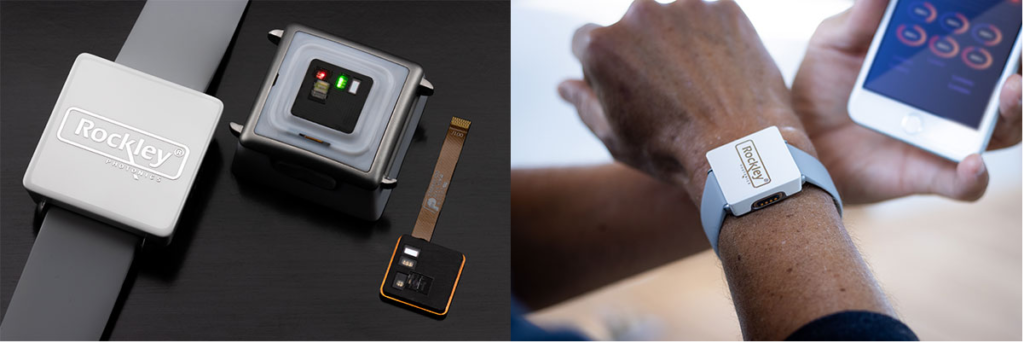
The likely future of the Apple Watch and medical monitoring. Rockley Photonics, a silicon photonics company based in Oxford England and Pasadena, has debuted a sensor module that can enable wearable devices to monitor multiple biomarkers, including core body temperature, blood pressure, body hydration, alcohol, lactate, and glucose trends, among others. The module (exterior above far left and mid-right) combines with hardware and application firmware for consumer applications, such as wrist-worn diagnostics.

The mid-left-hand view shows the reverse (skin) side of the module with the photonic ICs and application firmware. Current sensors use green-light emitting diodes (LEDs) and the Rockley system uses an infrared (IR) spectrophotometer that generates a large number of discrete laser outputs from a single silicon chip covering a broad optical band which can penetrate underneath the skin. The module communicates with custom cloud-based analytical engines via a Rockley smartphone app (far right).  

Obviously, Rockley is seeking to commercialize this through partnerships with consumer electronics companies in digital health and fitness monitoring. Rockley is a key supplier to Apple for sensors. Release, FierceHealthcare 

Financially, on 9 August they closed their SPAC with SC Health Corp. of Singapore after the UK courts approved the business combination. As of 13 August, it is trading on the NYSE as Rockley Photonics Holdings, Ltd. (RKLY). Rockley received $167.8 million in gross proceeds, including $17.8 million from SC Health, as well as $150 million from the financing completed in connection with the announcement of the business combination, led by top-tier institutional investors including Senvest Management LLC and UBS O’Connor and participation from Medtronic. According to their 22 July shareholders letter, all their revenue is attributable to two companies: Apple and Hengtong Rockley, a Chinese joint venture, and an accumulated deficit of $298 million.   Release

Home care rocked: Honor Technology acquires home care provider Home Instead

Honor Technology, which provides tech-based management services to home care agencies, has acquired home care provider Home Instead. Home Instead, the world’s largest network and international franchiser of home care services, has 1,200 offices in 14 countries with 100,000 caregivers (and largest in the UK with 13,000). Home Instead will retain its name and operate as a subsidiary of Honor. No financial or management terms were disclosed, but the valuation of the company will top $2.1 billion (£1.5bn). 

It’s a bit like the guppy swallowing the whale. Honor is only six years old, compared to 25-year-old Home Instead. Honor, which started out as a West Coast-based on-demand care company, now provides an operational platform to generally smaller home care agencies for services such as billing, scheduling, staffing, and other back-office functions for a negotiated share of its agency partners’ revenue. The guppy has to date a modest $255 million in financial backing, including last October’s $140 million Series D, from firms such as T. Rowe Price, Baillie Gifford, and Andreessen Horowitz. Supposedly the deal was inked in months, starting with a speculative phone call between Honor CEO Seth Sternberg and Home Instead CEO Jeff Huber.

Home Instead definitely saw value in Honor’s analytics, which profiles caregivers’ motivations to find the best fit for what shifts and duty suits them best. Recruitment and retention of caregivers is a major worldwide problem. According to LaingBuisson’s article on the acquisition, the UK alone has a shortage of 4,500 caregivers. This also converges into staffing health systems’ moves into hospital-at-home care. Martin Jones, Home Instead’s UK chief executive noted that ‘The hospital of the future is the home. And our future will be fuelled by a vibrant, respected workforce delivering care with skill and compassion.”

“To drive innovation, Honor will substantially increase its investment in research and development through engineering and technology. Honor and Home Instead also plan to extend their advocacy and social purpose initiatives. The combination will empower professional caregivers and enable millions more older adults across the globe to receive the support they need now and in the future.” 

It’s a huge deal in the sleepy home care business, and it vaults Honor into a position to shake up the home care business even further. Honor release, Honor blog, HomeHealthCareNews, McKnight’s Senior Living  Hat tip to reader Adrian Scaife. Laurie Orlov in her Aging and Health Technology Watch also has an interesting take on the acquisition being exactly right. 

News roundup: update on UnitedHealth/Change Healthcare DOJ check, Tunstall adds new CTO, Amwell’s gloomy second half, Teladoc’s Aetna deal, Fitbit and LifeScan diabetes

Just the news, no deals. UnitedHealth Group’s $13 billion acquisition of diversified health IT/imaging/payments company Change Healthcare has hit another snag. Back in March, the US Department of Justice requested specific information as part of DOJ’s review of the merger under the Hart-Scott-Rodino Antitrust Act (HSR). Both UHG and Change have agreed with DOJ to not certify compliance with the request before 15 September, then wait an additional 120 days, based on a 7 August Securities & Exchange Commission (SEC) filing. This could be shorter if DOJ formally advises them that their investigation is closed. Announced in January as a giant addition to UHG’s Optum unit, this now looks like the sale will close sometime in December–if it is not derailed. Becker’s Health IT with a brief recap. This was not a good week for UHG as they had to pay $15.6 million to settle a US Department of Labor finding that they did not pay out-of-network mental health claims at parity, wrongfully denied others, and flagged still others for utilization reviews. FierceHealthcare

Tunstall Healthcare announces a new Group Chief Technology Officer. Gary Steen joins Tunstall from broadband provider TalkTalk where he was Group Managing Director for Technology. He will lead Tunstall’s innovation and development function globally including all solutions and products from Tunstall’s technology delivery centres in the UK, Sweden and Germany. Previously, he was with MDS Global, a software services business active in Europe, Australia, and the US. Tunstall release.  Hat tip to Jenny Marston at Lucky North.

Amwell projects that Covid-19 will depress second half telehealth results by 200,000 visits and $8 million. CEO Ido Schoenberg MD made this surprising projection on the second quarter investor call, but the projection may be sound. His rationale is that there will be not much of a cold and flu season, as the latest virus variants will have people masking up and social distancing (and presumably avoiding indoor crowds. As we’ve noted previously, the Brothers Schoenberg tend to be contrarians on various headline trends (e.g. looking askance at Amazon Care biting into the enterprise telehealth business and hospital-grade in home care). One would assume that if more stay away from in-person care, telehealth would increase beyond the current claims rate of 5% especially in mental health which is half of telehealth claims. But this could be some clever sandbagging for investors, as he went on to say in the call that if the impact of Covid isn’t as bad as we think, there’s always the flu! FierceHealthcare

Amwell’s frequent sparring partner in various courts, Teladoc, announced that they would be powering Aetna Virtual Primary Care for their Aetna members in national self-funded employers. This is a trifecta of Teladoc’s physician-led care team model, Aetna’s provider network, and CVS Health services at MinuteClinics and where available, CVS HealthHUBs. The virtual visits will have no co-pay for as well as select in-person CVS Health services. CVS Health release, FierceHealthcare

Fitbit is, believe it or not, still around. They announced a partnership with LifeScan diabetes monitoring to integrate its health tracking apps with the company’s glucose monitoring devices for diabetes management. The Fitbit tools that track activity such as daily activity, nutrition, and sleep will provide tracking of impact on blood glucose levels. FierceHealthcare

Hearing voices: Cigna-Ellipsis AI-powered voice stress test; UCSF/Weill neuroprosthesis decodes attempted speech

The Next Voice You Hear? Two advances in voice analysis and restoring speech to those who’ve lost it.

The first is from Cigna International based in Hong Kong which through speech and choice of words can determine your stress level. Your Editor took the Cigna StressWaves test, which requires 90 seconds of answering a question based on one of four topics. To her utter shock as she’s rushing to get out an article or two after a busy day at work and the loss of a good friend in the past week, she was told her stress level was low! The StressWaves test is followed up with an email with your results and a questionnaire pitching Cigna’s health insurance. The test was developed for Cigna by machine-learning medical technology company Ellipsis Health. Other Ellipsis tools for clinicians can quantify anxiety and depression symptoms with 2-3 minutes of speech for initial screening and ongoing monitoring. Mobihealthnews.

The second is about restoring a measure of communication to people who have lost the power to speak through decoding their cortical activity. The research by a team from the Weill Institute of Neuroscience and the University of California (among others) implanted a subdural, high-density, multielectrode array over the area of the sensorimotor cortex that controls speech. This was performed on a person with post-brain stem stroke anarthria (the loss of the ability to articulate speech) and spastic quadriparesis. What the neuroprosthesis did was decode directly from the cerebral cortical activity while the participant attempted to say individual words from a vocabulary set of 50 words. Using computational models plus a natural-language model on next-word probabilities in sentences, the researchers were able with a high degree of accuracy to decode full sentences from the cortical activity. The New England Journal of Medicine article is available in abstract but paywalled for the full study (limited free access with registration). The clinical trial was funded by Facebook and is on ClinicalTrials.gov here for the device and related neurological studies. Also Mobihealthnews.

News and funding roundup: patient outreachers Relatient, Radix merge; health apps top 350,000; Morgan’s $50M in Vera Health; Communicare247, Doro, TeleAlarm join Scottish Digital Telecare’s list

Patient engagement meets…patient engagement. Two relatively small players in patient outreach, Relatient and Radix Health, are merging. By no coincidence, the former announced that they received $100 million in growth equity capital from Brighton Park Capital and its affiliates. Brighton Park led an undetermined investment round for Relatient in November 2019. No valuation or management transitions were announced.

Tennessee-based Relatient sends text messages to patients as appointment reminders, patient chat, and broadcast messaging. It is a 2020 Best in KLAS winner for Patient Outreach. Relatient claims that in 2020 it sent 200 million messages and integrates with over 85 practice management systems and electronic health databases. Atlanta-based Radix Health has a somewhat different software set for patient scheduling, contactless check-in, appointment reminders, and reminders for medical groups, health centers, and hospitals prior to procedures. Earlier this year, Radix rolled out a Covid-19 vaccine location and scheduling system for their mid-sized and large provider clients, which by February scheduled 200,000 appointments and about 100,000 vaccinations. Both companies were founded in 2014. The merged organization will be headquartered in Franklin, Tennessee, with offices in Cookeville TN, Atlanta, and Pune, India. Release, Mobihealthnews

Consumer health apps top 350,000. The IQVIA Institute for Human Data Science latest report on digital health trends tracked over 90,000 released last year alone. Managing health conditions makes up nearly half (47%, up from 28% in 2015) of apps. About two-thirds of digital therapeutics and 40% of digital care products treat either neurologic or mental health conditions. At this point, who’s counting? And are all of them working? Mobihealthnews, link to IQVIA report (registration and download required).

JP Morgan Chase’s new Morgan Health invested $50 million in Vera Whole Health, a western US primary practice group. Vera Whole Health operates on a membership flat-fee model and is fully at risk in a value-based, technology-enabled coordinated care model. Morgan Health adds to Vera’s coffers after the majority sale of the company to CD&R for an undisclosed amount and a valuation at $400 million. JP Morgan sunsetted its unsuccessful three-year joint venture, Haven, in January, but remains interested in health for profit and for employees, who will be given the opportunity to join Vera. Healthcare Dive, Mobihealthnews

Communicare247, Doro, and TeleAlarm receive Scottish Digital Telecare nod for digital alarms. Communicare247’s Archangel Care Cloud, Doro’s CareIP Mobile, Eliza 4G, and the icareonline platform, and the TeleAlarm TA74 GSM and TeleAlarm Cloud Services have been added to the Scottish Digital Telecare Security-Assessed Suppliers Scheme. They join Alcuris and Enovation, as reported in the past two weeks. Communicare247, Doro, and TeleAlarm releases.

News and funding roundup: BioIntelliSense ‘stickers’ $45M, Exo ultrasound scans $220M, Enovation gets Scotland OK, WellSky snaps up Healthify, Cerner’s good quarter despite VA

Sticker shock? BioIntelliSense, which has been flying under the radar for over a year [TTA 17 July 2020] since inking a deal with Philips to integrate their BioSticker sensors into their post-acute remote patient monitoring (RPM) systems, scored a $45 million Series B funding for a total of $82 million since 2018. Lead investor is Chimera (UAE) with participation from 7wire Technology Partners, Mary Tolan of Chicago Pacific Founders, James Murren, formerly of MGM Resorts International, as well as Pendrell Corporation, Royal Philips, and Fresenius Medical Care North America.

BioIntelliSense has two wearables: the BioSense on-body sensor for 30 days of continuous vital sign monitoring, and the new BioButton for up to 60 days of RPM. The BioButton is touted for Covid-19 monitoring. “Temperature checks have proven to be unreliable and even amplified testing (PCR) has proven to be ineffective in identifying the virus in the early days of infection.” The button will be connected to the BioMobile screening survey app which will feed the user the latest CDC health screener and then scan for ‘subtle physiological changes’ in temperature, respiratory rate and heart rate at rest. The app generates a non-PHI report indicating ‘cleared’ or ‘not-cleared’. The BioSticker is 510(k) FDA-cleared; the BioButton is not, but is being marketed as an enterprise solution for employee health clearance. Mobihealthnews

Hand-held ultrasound gets ultra-funding. The Exo hand-held ultrasound snagged a hefty $220 million in Series C funding for a total of over $320 million since last year. Their point-of-care tool includes nano-materials, sensor technology, and advanced signal processing and computation in a platform called Exo Works. Exo is in a crowded field pioneered by GE Healthcare’s Vscan [TTA 27 March] back in 2010, but including Butterfly IQ, Mobisante, and Philips LumifyMobihealthnews

Enovation also approved by Scotland. With our news from Alcuris last week that they were selected by Scottish Digital Telecare as a security-assessed supplier, Enovation (formerly Verklizan), notified your Editors that they also were selected. Our quote from their management is from Andy Grayland, Chief Information Security Officer, Digital Office for Scottish Local Authorities. “The Scottish digital telecare security-assessed suppliers scheme reviewed a submission from Enovation for an Alarm Receiving Centre application. The assessment panel was very impressed with pre-existing security security culture and standards within Enovation. Both this assessment scheme, and Enovation’s positive response to it, will help ensure that vulnerable telecare users across Scotland are protected against the threat posed by cyber criminals when using these services.” 

WellSky to acquire SDOH provider Healthify. WellSky is a provider of software, analytics, and services for community care. Healthify builds and manages accountable networks for SDOH services, working with health plans, providers, and community partners in all fifty states. Previously, Healthify had raised $25.5 million in five rounds from 2013 (Crunchbase). Healthify is the fifth company WellSky has acquired since 2018, the last CarePort Health for $1.4 billion in 2020 (Crunchbase). Terms were not disclosed. Closing anticipated in Q3. The release does not indicate management transitions or HQ location.  

Despite their VA troubles and layoffs, Cerner had a very good quarter indeed: revenue up 10%, adjusted EPS $0.80 versus $0.63, exceeding analyst expectations for both. They laid off 500 employees in the quarter and eliminated 300 open positions, which will deliver $70 million in annualized savings. plus half their owned space is now unneeded so up for sale. Their Department of Defense EHR rollout is going well with 42 commands and 663 locations with 41,000 activated users. The Coast Guard’s deployment will be completed this year. As to VA, “results of the VA’s strategic review focused on governance, training, and readiness rather than Cerner-caused problems.” More in the lead article in HISTalk 8/2/21. Cerner’s announcement, transcript of earnings call on Seeking Alpha

2021’s bubbly $14.7 billion in digital health funding–six months that beat all of 2020

Rock Health’s roundup for the first half of 2021 definitely floats that rubber ducky. $14.7 billion in funding went to digital health companies in the US, breaking through full year 2020’s $14.1 billion, itself a record. However, the year to date is skewed by mega deals that may proved to front-load the year.

The first half boasted:

  • 372 deals and an average deal size of $39.6M
  • 48 mega deals which accounted for 59% of total H1 2021 funding
  • 11 closed IPOs and SPACs, with another 11 SPACs expected to close in 2021
  • Tripling prior year in the final month: June 2021 $3.1 billion versus $1.1 billion June 2020

It was no surprise that mental health continued in the lead for the second year, with cardiovascular, diabetes, primary care, and oncology following. Rock Health also tracks ‘value propositions’ which are led by research and development, plus on-demand healthcare neck-and-neck.

Size and stage of deals continued to enlarge. 

  • Average deals per week in 2021 totaled 11 and $548 million, compared to 2020’s seven deals and $285 million
  • The funding shift to Series D and higher levels was profound–$76 to $131 million for about the same number (51 to 54) deals. Series A through C had positive gains but relatively flat
  • Private equity firms and growth funds were more active in digital health venture investment versus venture capital
  • $100+million rounds are becoming ‘average’, comprising 59% of total funding–prompting one to think that the definition of ‘mega’ needs to be upscaled

The mix of businesses is also changing towards B2C. Direct to consumer (B2C) digital health is gaining and now is 27% of all investment, with B2B/B2C and B2B-only declining. This change was driven by big B2C players Noom ($540M), Ro ($500M), and Capsule ($300M).

Consolidation is real. Providers with broad scope are buying niche startups to fill gaps, as well as giants like Microsoft snapping up a Nuance medical transcription. To be expected when there’s pressure to acquire and sell, but often these acquisitions don’t integrate well into large parents. (Ask Philips how Lifeline worked out for them.)

One company–New York City-based Tiger Capital or Tiger Global Management–is a name that popped up repeatedly this year. Their strategy is ‘blitz-funding’: participating in 14 funding rounds totaling $1.8 billion–12% of digital health funding in first half and generally at C or D. OODA, Hinge Health, Komodo Health, and ACO organizer Aledade (not digital health) received investments from Tiger. This isn’t unprecedented, but may scare off other investors except in earlier rounds.

And SPAC salad days are likely over. The easy pickings are over, as investment funding flows in, IPOs remain attractive, the SEC’s increased scrutiny, plus SPAC investment insurance premiums are more costly.

No forecast yet for the year though. (A mistake from a few years ago they won’t repeat!) But if July is any indication, not much is cooling down unless COVID really hits again. Rock Health H1 2021 Report

The Roy Lilley-Sir Simon Stevens ‘Health Chat’ interview

Sir Simon Stevens, NHS England’s chief executive who leaves this post on 31 July after seven years, was interviewed by Roy Lilley (nhsManagers.net) for his recurring Institute of Health and Social Care Management Health Chat. This Editor has found a summary of the interview and it makes for interesting reading.

Sir Simon started with the NHS out of their graduate training program. Assigned to run a mental health facility in the North East, he introduced himself to some people on the drive by the facility and asked what they were doing. “Scattering the ashes of your predecessor” they said. From that macabre start, he went on to craft public policy under two very different Labor governments, the first ‘The NHS Plan’ in 2000 and then returning after stops at Downing Street and United Health to take over a ‘traumatized’ NHS in 2012. “The NHS was out of New Labour’s money, facing rising demand from an ageing and increasingly unequal society, and struggling to pick up the pieces from a broken social care system. It needed a new approach, and Sir Simon provided one with the ‘Five Year Forward View’ and its successor the ‘NHS Long Term Plan’” that controlled demand and improved efficiency by introducing population health management and integrated care. He was also able to secure funding, more than other agencies. Sir Simon was then expected to leave with the change of government, but then Covid-19 hit.

About halfway down, you’ll read some tart comments about the mix of digital health in the total picture of the NHS and whether digital first will stick.

With deputy Amanda Pritchard taking over, only weeks from the appointment of the new health secretary Sajid Javid replacing Matt ‘Man in a briefcase’ Hancock, the snapback in care demand, and apparently another round of a virus which should get the Henry VIII treatment (‘Will no one rid me of this meddlesome virus’?), it will surely be interesting times. Hat tip to Highland Marketing which is the strategic communications partner for the Institute of Health and Social Care Management and the Academy of Fab Stuff, and article writer Lyn Whitfield. 

News and deal roundup: another big mental health app funding, Happify Health’s prescription therapy app debuts, Alcuris approved by Scottish Digital Telecare for cybersecurity

It does seem that behavioral health apps are falling from the trees and into pots of gold. Unicorns have become so…everyday. The latest is SonderMind, a Denver-based therapist matchmaking site for both video telehealth or in-person sessions. With a $150 million Series C round, it is claiming a valuation ‘well north’ of $1 billion. Main funders were Drive Capital and PremjiInvest. Previous funding was $32 million since 2017. The new funding will support expansion from the current 10 states to national. SonderMind first asks the prospective patient to complete a short questionnaire on care needs, insurance, and payment information, then connects them to a licensed mental health professional within a day or two. For their approved therapist group, they work with them to determine the types of patients they’d like to treat. FierceHealthcare

Another behavioral health company, Happify Health, announced Ensemble, its first prescription app. Formally called a PDTx (Prescription Digital Therapeutic), it will be for Major Depressive Disorder (MDD) and Generalized Anxiety Disorder (GAD). It’s a cognitive therapy with ‘Anna’, an intuitive support app with a patented dialogue flow. Ensemble is classified as an investigational medical device at this point. Happify plans to seek a 510(k) clearance in the future. It is designed to be used in support of other mental health treatments and can be integrated into a physician’s EHR.

The app’s development was facilitated by a recently renewed FDA guidance issued in April of 2020 that lets digital health companies go to market without clearance for digital health treatments for eight psychiatric disorders including those in Ensemble. Chris Wasden, head of DTx at Happify Health, was interviewed by Mobihealthnews. We note that Happify has been around since 2012 when mental health wouldn’t get you more than one free drink at a digital health conference. In March, they scored a $73 million Series D.

And in the UK, social alarm system Alcuris announced that their Memo Hub, Memo App and the Connec+ platform have been added to the list of Scottish Digital Telecare security-assessed suppliers. They were reviewed as part of cybersecurity for third parties which process personal data. Digital Telecare is part of the Scottish Local Government Digital Office and evaluates suppliers on their business processes as well as requiring independent Penetration testing (PEN testing). In their statement, “Alcuris welcomes the Digital Offices’ “Once for Scotland” approach and recognises the value it provides across Scotland. We would like to see a “Once for the UK” approach adopted and today we have written to the Telecare Services Association (TSA), to ask if they can collaborate with the Digital Office to enable the benefits of their security assessment programme to be available across the rest of the UK.”  Hat tip to Adrian Scaife of Alcuris for the release.

Telehealth Wars: Amwell’s raises game with buys of SilverCloud and Conversa Health (updated); Teladoc’s slow member, hospital growth lead to $133M Q2 loss

Updated. Amwell’s announcement today (28 July) of the twin acquisitions of SilverCloud Health and Conversa Health for the tidy total sum of $320 million in cash and stock was, if not quite a ‘see ya and raise ya’ move, a confirmation that Amwell was going to raise its game, at long last, versus Teladoc. SilverCloud provides digital telehealth programs for common behavioral health conditions. A spinoff of Trinity College Dublin, it counts as US clients Kaiser Permanente, Optum, and Providence Health, plus over 80 percent of NHS’ mental health service. Conversa is a StartUp Health portfolio company that developed a scalable care management triage system for at-risk patients that provides automated patient outreach and engagement tools that can move them to higher levels of care where needed. Clients include Northwell Health, UCSF Health, UNC Health, Merck, MedStar Health, and Prisma Health. 

For Amwell, this expands their capabilities in the hot behavioral health area and, with Conversa, into a care management platform targeted to providers, pharma, and payers. They see digital workflows, patient engagement, a longer-term relationship with their consumer base through the continuum of care, through these two companies’ hospital, health system, health plan, and employer clients.

The wrinkle? Neither company is all that far along–SilverCloud has total funding of only $26 million but is more established with 750,000 clients and 300 organizations. Conversa’s Series B was a tiny $8 million for total funding of $34 million. Amwell also paid a premium price. According to Healthy Skeptic, a blog written by long-time UnitedHealth Group senior healthcare executive Kevin Roche, their combined revenue was $15 million–more than a 20x multiple of the purchase price. The other challenge for Amwell? Making all the systems work together in a meaningful way–and to market what can be a confusing picture properly. Amwell press release, Mobihealthnews

Update 2 August. The Irish Times, undoubtedly working a local contact at Silver Cloud, ascertained that Silver Cloud was purchased by Amwell for a price in excess of $250 million. That means a tidy payday of €23 million ($27.3 million) for the company’s founders – Ken Cahill, James Bligh, Karen Tierney, Dr John Sharry, and Gavin Doherty. If that is so, Conversa was bought for $70 million or less. One wonders why a shell game tactic was used, as Conversa is known to be an early-stage company. Hat tip to HISTalk today.

For Teladoc, growing beyond urgent care, plus integrating the former Livongo and InTouch Health, presents difficulties. Telehealth usage continues to shrink as in-person visits rebound save for behavioral health, which is also bad news for the payers as utilization goes up. Teladoc now struggles to add new members after last year’s pace. Their hospital business that came with last year’s acquisition of InTouch Health is growing more slowly than expected [TTA 16 July]. The expected cross-sales traction with the former Livongo hasn’t caught fire yet, but that may change with myStrength Complete and the myStrength app going live with health plans or employers starting this month. The first enterprise customers are a major Blues plan (likely HCSC) and a Fortune 100 employer. [TTA 14 May]. Teladoc is also growing into other areas with more continuous user engagement, such as chronic care, weight management, and primary care. That program, Primary360, is in “very very late-stage” discussions with multiple payers. Teladoc, which has never been profitable, lost $133.8 million for Q2.   Healthcare Dive

Cerner execs to VA Congressional committee: “We are committed to getting this right”

Two Cerner executives had their say in testimony to the Senate Veterans Affairs Committee last week, and they hung on by, presumably, their fingernails in their commitment to having working tests and a workable rollout of the Cerner Millenium system. This will replace the warhorse VistA system in use for decades in the VA, but incompatible with the Department of Defense’s Cerner MHS Genesis and earlier EHRs in use in military care facilities.

The EHR implementation, which is at last report costing $16 billion, failed miserably at Mann-Grandstaff VA Medical Center in Spokane, Washington in late 2020 into this year. The three-month review of the program “raises more questions than it answers,” said Committee Chair Frank Mrvan, D-Indiana. Other members concurred in being less than impressed by Cerner. Ranking Member Matt Rosendale, R-Montana, wasn’t interested in “shoveling more money into a flawed program just to keep the paychecks flowing.”

However, Brian Sandager, senior vice president and general manager of Cerner government services, pointed out that wait times at Mann-Grandstaff, with nearly 70% of veterans seen within 15 minutes of their scheduled appointment time, with urgent care patients seen within 13 minutes of arrival. Opioid treatments were flagged for alternative treatments. HealthcareITNews   Our earlier coverage here.

Cerner Government Services has a great deal riding on the successful implementation of the VA contract, including their extensive government work with DOD on MHS Genesis and other healthcare organizations within the US Government, including those listed on their website: the US Coast Guard, CDC, HHS, and CMS. 

Over 400 telehealth groups urge Congress to retain CARES Acts gains on remote care

430 telehealth and remote care companies, along with major health providers and associations, have organized to petition Congress to make permanent the changes instituted by the Coronavirus Aid, Relief, and Economic Security (CARES) Act for the duration of the COVID-19 public health emergency (PHE). These changes will expire this year unless the pandemic emergency extends into 2022.

Like the Senate Telemental Health Care Access Act of 2021 that would extend telemental health Medicare coverage to patients without a prior in-person visit [TTA 16 June], the extension of CARES Act coverage would require Congressional action to amend the Social Security Act: for telemental health, Title XVIII; for telehealth, Section 1834(m). While the Telemental bill is actually in the Senate, the permanent expansion of telehealth and remote care would require its own and far more complicated bill and corresponding regulations.

Based on the letter (PDF link), these changes would include:

  1. Remove Obsolete Restrictions on the Location of the Patient and Provider. This is the rural geographic restriction.
  2. Maintain and Enhance HHS Authority to Determine Appropriate Providers, Services, and
    Modalities for Telehealth. This would expand the list of practitioners, services, and also expand telehealth in some cases to audio-only consults.
  3. Ensure Federally Qualified Health Centers, Critical Access Hospitals, and Rural Health Clinics
    Can Furnish Telehealth Services After the PHE. These are the ‘safety net’ providers for underserved and rural areas.
  4. Remove Restrictions on Medicare Beneficiary Access to Mental and Behavioral Health Services
    Offered Through Telehealth. This covers much the same ground as the Telemental bill.

What is unclear, of course, it being Washington, is how quickly Congress will bestir itself to enact these changes to existing law before the end of 2021 and the expiration of the CARES Act window with, presumably, the end of the PHE. American Telemedicine Association (ATA) releaseHealthcareITNews, FierceHealthcare

Softly, softly: GPDPR comes to screeching halt, indefinitely, to be reworked

UK GPs and offices can now take an August holiday. The entire process of GPs extracting their data for the NHS GP Data for Planning and Research (GPDPR) database and patients opting out has been halted–or “deferred” per the letter from Parliamentary Under Secretary of State Jo Churchill. Formally, the Data Provision Notice was withdrawn on 19 June–and quietly. That means no more deadline of 1 September–or, in fact, any deadline, right now. 

According to the letter to GPs:

Instead, we commit to start uploading data only when we have the following in place:

  • the ability to delete data if patients choose to opt-out of sharing their GP data with NHS Digital, even if this is after their data has been uploaded [This is a significant feature that is expanded on later in the letter–Ed.]
  • the backlog of opt-outs has been fully cleared
  • a Trusted Research Environment has been developed and implemented in NHS Digital [Security based on OpenSAFELY and the Office for National Statistics’ Secure Research Service best practices–Ed.]
  • patients have been made more aware of the scheme through a campaign of engagement and communication

The revised scheme will be created in collaboration with the Royal College of General Practitioners (RCGP) and the British Medical Association (BMA). One wonders why these logical steps weren’t taken before deadlines were set, moved, and about five medical associations plus at least one MP excoriated the NHS publicly. Undoubtedly more tap dancing to come. Our most recent and previous coverage here. Also Pulse and HealthcareITNews EMEA.

News and deals roundup: Owlet’s $1B SPAC, Carbon Health’s $350M Series D, Series Bs by Woebot Health and b.Well, digital health rakes in $15bn

Baby monitoring system Owlet closed its SPAC late last week with Sandbridge Acquisition Corporation. It is now trading on the NYSE (OWLT) for around $8 per share. With Sandbridge’s investment and the concurrent private placement (PIPE), Owlet now has $135 million and a valuation of over $1 billion, far exceeding the $325 million estimated [TTA 17 Feb]. Owlet started in 2013 with a ‘Smart Sock’ (right) at $299 using pulse oximetry to monitor baby heart rate, oxygen levels, and sleep patterns with readouts via their app, but has expanded to include an Owlet Cam and a Dream Lab to encourage good baby sleep, which parents will be the first to appreciate. Mobihealthnews

Carbon Health, which is certainly an odd name for a primary care provider plus virtual health with a streamlined patient record/EMR system and makes insurers happy because they charge only Medicare rates, received a hefty $350 million Series D raise. Led by Blackstone Horizon Partners with Atreides, Homebrew, Hudson Bay Capital, Fifth Wall, Lux Capital, Silver Lake Waterman, and BlackRock participating, along with returning investors Dragoneer Investment Group and Brookfield Technology Partners along with a slew of private investors, it follows on last November’s Series C of $100 million for a total raise since 2016 of $522 million. Valuation is what used to be an eye-blinking $3.3 billion. Carbon’s locations are a bit strange–concentrated in California and SF area with outposts, many of which are limited service or ‘pop-ups’, in Florida, Arizona, Kansas, and NYC. Unlike the recently covered One Medical, it does not require any kind of annual concierge fee. The model is an interesting one in positing high service and low cost. The founders are also staking out becoming the largest US primary care provider, which Village Medical or UnitedHealth Group would not be delighted about. One wonders if all this staking out will work, or is to attract payer investment when the VCs decide to exit. FierceHealthcare, Mobihealthnews (referring to them as multimodal, which sounds like ocean/rail transport or articulated lorries), Forbes

Also in the Mobihealthnews article: a Series B $90 million raise by Woebot Health, developer of a mental health chatbot (ok, relational agent), and the $32 million Series B raise of b.well Connected Health, a patient-facing health management platform that will get a big boost from interoperability around patient records required under the Cures Act. Woebot’s twee infographic about their therapeutic bond study in the JMIR is woeful, though, as large parts are unreadable.

No surprise that digital health funding hit a $15 billion high in the first half of 2021, up 138%, driven in large part by telehealth investment. This is based on a report from Mercom Capital Group. FierceHealthcare

Oh, MAMA! The Medical Alert Monitoring Association meeting, 28-29 September, Chicago

If you are in the medical alert business in the US or are looking at investing here, you’re likely a member of MAMA. This year, the two-day members-only MAMA Annual Conference will take place in-person and virtually at the Park Hyatt Chicago for two days, 28-29 September. There are special rates for first-time participants upon advance application.

  • Day 1 includes a deep dive into the industry, technology trends, as well as an overview of the annual industry survey. Also on Day 1 is the Medical Alert Financial Summit. It’s included with the Annual Conference, but if you only want to attend the financial summit, a separate registration is required. With major deals such as the sale of Philips Lifeline to Connect America and VRI being on the market, it will be interesting!
  • Day 2 is for MAMA members only and includes strategic round table discussions on supply chain, the 3G to 4G conversion, government funding, remote patient monitoring, and telehealth.

Information, hotel booking, and registration page here. Hat tip to PERS Insider (free subscription here) which will be covering the conference.

Three healthcare startup events: MedStartr NYC Thursday 21 July, Dallas Startup Week starts 1 August–and apply now for UCSF Health Awards

The startup events return….

Move fast–this one is tomorrow! MedStartr (a/k/a Health 2.0 NYC) is returning to NYC with a pitch event that is both live and video. Six startups are listed to be participating: Emedevents, Pelex, Beam, Gravitas Labs, Umbrosys, and ShereHealth.co/BrooklynMinds.com. If you would like to attend live at the location in Midtown, registration and tickets are here through Eventbrite. However, do note that proof of vaccination in advance must be sent in. For the unvaccinated and vaccinated without cards, a rapid test will be performed and those with a positive test will be sent home. Negatives may stay, masked if unvaxed. (So much for the indoor removal of same!) You may feel more comfortable opting for the video version which will be presented on MedStartr.TV or on Clubhouse (app requires installation). Hat tip to our old compadre Alex Fair 

And Hubert Zajicek and the Health Wildcatters have their Dallas Startup Week kicking off on Sunday 1 August with a full five days, with 21 tracks plus special events and summits. It will both in-person at the Southern Methodist University Cox School of Business and live-streamed on Brushfire. Registration is here (and reasonable).

Health Wildcatters is also collaborating with UCSF Health Hub for the 3rd annual UCSF Health Awards. There are 18 selected award categories, including telehealth, remote and hospital diagnostics, patient cost savings and life sciences. Applications are due on 31 July. Those making it to the quarterfinal will be notified by 16-20 August, with semifinalists notified 13-17 September. Final awards are 7 October at a live ceremony in Mission Bay, San Francisco.