Theranos, The Trial of Elizabeth Holmes, ch. 2: the lab director’s contradictions, competence questioned

The grilling of former Theranos lab director Adam Rosendorff continued Tuesday, with the defense hammering Dr. Rosendorff about his activities there prior to his departure in August 2014, catching him on contradictions in his testimony, painting him as self-serving and, through his actions there and with later companies, essentially incompetent.

Lance Wade, the defense attorney handling today’s redirect, returned to Dr. Rosendorff’s testimony about the lower-than-normal HDL levels recorded by the Edison lab machine. Earlier, he had testified about his major issue with it, urging Ms. Holmes and COO Sunny Balwani to discontinue the test but got “pushback”. Using a long trail of emails, Mr. Wade continued what’s proving to be a theme at this trial–that the government is showing only limited information to witnesses and the jury, that Holmes and Balwani addressed problems, and that Dr. Rosendorff often used his own judgment to resolve problems without discussion with Holmes or Balwani. Dr. Rosendorff admitted, contradicting his earlier testimony, that Balwani and others “jumped” on the HDL readings right away, and that the real problem was with a Siemens machine.

Mr. Wade also got Rosendorff to admit that in a civil case, he testified that complaints about Theranos “weren’t more common than what usually sees in … some labs with high volume” and, even more specifically, that “I don’t think I had a greater number of tests that were anomalous that I had to review at Theranos than at other places I’ve been like University of Pittsburgh.”

Dr. Rosendorff, according to reports, kept commenting on his earlier testimony to reinforce that decisions made at Theranos were ‘not good solutions’, no matter what he believed or how he acted at the time. Mr. Wade tried to have these comments struck from the record, but Judge Davila ruled that both should move on.

Finally, Mr. Wade brought up as confirmation of Dr. Rosendorff’s incompetence his subsequent employment and termination at now out of business uBiome, charged with health fraud (but not fraudulent lab tests) but was not permitted to go beyond basic statements. He was permitted to ask about Dr. Rosendorff’s current employer, PerkinElmer, which has also violated CMS (Centers for Medicare & Medicaid Services) regulations by the same inspectors who audited Theranos, and which may cause the loss of his license for two years. NBCBayArea, CNBC, Ars Technica

(Editor’s note: unfortunately the Mercury News, Bloomberg, and WSJ coverage are heavily paywalled after one or two views. The WSJ focused on text messages between Holmes and Balwani, and the Mercury News added color coverage of Holmes’ lifestyle with Balwani and vegan diet.)

To be continued…

Theranos, The Trial of Elizabeth Holmes: ch. 1

“The company believed more about PR and fundraising than about patient care”, from Tuesday’s testimony by former lab director Adam Rosendorff, could be the prosecution’s strategy in the proverbial nutshell. Mr. Rosendorff, who quit in November 2014 after a long struggle to get Ms. Holmes and Theranos management to address persistent problems in patient lab results and to implement a legally required verification process, was a witness for the prosecution. The defense tried to paint his testimony in cross-examination as inconsistent and self-serving in accounts of Ms. Holmes’ state in hearing concerns about three particular blood tests, the launch date of public blood tests, proficiency tests versus ‘precision tests’, when the California Department of Public Health audited the lab, and exactly why he quit Theranos 18 months after hire. The questioning twice grew so heated that District Circuit Court Judge Edward Davila deemed it inappropriately argumentative. One example from Lance Wade to Mr. Rosendorff was that supervising quality control tests and making sure laws were followed was “why you get the big bucks, right?” “Not as big bucks as you get paid,” Mr. Rosendorff replied. Mr. Rosendorff did get caught up in an email trail and on narrowing the proficiency testing to FDA-approved devices versus the Edison labs. The cross and the bickering went on into Friday and probably will resume on Tuesday next week (@doratki).

Also on Tuesday was brief testimony from Celgene manager Victoria Sung, who drew a picture of more Theranos fabrications around how pharmaceutical companies (Celgene owned by Bristol Myers-Squibb) had not  “comprehensively validated” Theranos technology. 2012 results showed that Theranos labs performed “out of range” versus standard tests, and other tests were not run. Last week, Theranos employee Surekha Gangakhedkar in her testimony stated that she did not think GSK’s report validated Theranos’ tests. Mercury News, The Verge

Today, John Carreyrou, who broke la scandale Theranos in The Wall Street Journal and authored the book Bad Blood, filed a motion to stop being barred from court. Cleverly, La Holmes’ defense put him on the witness list but not subpoenaed him. Being on the witness list, however, means he cannot attend any part of the trial or publicly discuss his testimony, if given, without permission from Judge Davila. “Placing Carreyrou on the witness list was done in bad faith and was designed to harass him,” the motion claimed, calling his placement on the list “a cynical ruse” that violates the First Amendment. Also cited in the motion were the company chant about him and various text messages between Ms. Holmes and Sunny Balwani. Mercury News  Mr. Carreyrou and six years before the Theranos mast, interviewed in The Verge in an interview that diverges fascinatingly into the psychiatric drives of the players….

And earlier in September (Wednesday 22nd), General James Mattis, Ret. testified about how he initially wanted to pilot the Theranos labs on ships and remote locations, where space and swiftness are at a premium. The Verge article does take liberties in the psychology between the two (bachelor general, young female CEO), including his joining the board after retirement, sticking around despite his growing doubts until he was named secretary of defense in 2016. The defense drew out that he was confused about his compensation package ($150,000 per year plus a stock option purchase).

The Mercury News (which has a minimum of free articles before the paywall goes up, the WSJ (paywalled), local TV KRON4, The Verge, and CNBC have been covering the past weeks of the trial. Dorothy Atkins of @Law360 is also tweeting in real time on it (@doratki).

To be continued….

Walgreens may acquire Evolent Health: report

Walgreens in another ‘go big or go home’ move. Bloomberg reported yesterday that Walgreens Boots Alliance is considering an acquisition of Evolent Health, a Washington DC-based healthcare management and administrative services company. It’s another move that indicates that their growth plans continue to be in technology-based services, provider services, and diversifying away from brick-and-mortar pharmacy. 

An acquisition of Evolent would add to Walgreens a suite of management services around total cost of care for payers and providers through Evolent Care Services (administrative, operations), provider management services in value-based care models such as ACOs through Evolent Care Partners, and specialty care management for oncology and cardiology through New Century Health. Notably, Walgreens would grow ever closer to primary care providers through Evolent Care Partners, a 1,000 provider, six-state ACO network covering 90,000 lives. 

Last week, Walgreens bolstered its pharmacy operations through a majority investment of $970 million in specialty pharmacy company Shields Health Solutions, also a fit with the proposed Evolent acquisition with their specialty care management area.

Should this go through, it further differentiates Walgreens from rival CVS Aetna as a services provider.

Evolent is a public company trading on the NYSE with a current valuation of $2.71 billion, so it won’t come cheaply. Reuters

Mental health apps Headspace, Ginger to merge into $3B Headspace Health

Two acquisition prospects, Headspace and Ginger, decided to beat the heat and merge. The two companies, currently headquartered in Santa Monica and San Francisco, will combine into Headspace Health. From the context of the release, the Ginger brand will be sunsetting. The merger is expected to close in Q4 subject to the usual regulatory and financial approvals. Financial terms were not disclosed. The combined company claims a valuation of $3 billion.

Leadership will combine from both companies. Russell Glass, Ginger’s present CEO, will be CEO of Headspace Health. CeCe Morken will remain CEO of Headspace and take on the additional role of President for the combined entity. 

Digital mental health continues to be hot in a hot August. Headspace, which started as a mindfulness and meditation app in 2010, then sidled into behavioral coaching to mitigate stress and aid in sleep, to date raised $216 million through a Series C (Crunchbase). Ginger, a cognitive therapy service with both self-guided coaching and psychiatric video consults, was founded in 2011 and raised $220 million through a Series E. Headspace has a direct to consumer focus with business partnerships with Google, Roche, and employers, while Ginger has developed into a benefit for payers like Cigna and Amerihealth Caritas. The combined company claims it will cover 100 million lives direct-to-consumer and through its more than 2,700 employers and health plan partners.

It is obvious from the management setup and the overpadded release (sorry, but it’s true!) that the lead company in this is Headspace. Can an IPO be far away? Release, Healthcare Dive

Another Google termination: Google Streams clinical support app used by NHS

Now that Google Health has been scattered within the Google Puzzle Palace like so many marbles, it should come as no surprise that its Deep Mind-created clinician support app, Streams, is being ‘decommissioned’. The terminology, used for military ships and basis, is quite odd. Termination, or terming, would be more accurate.

The users were concentrated in the UK: University College London NHS Trust, Imperial College Healthcare NHS Trust, Taunton & Somerset, and London’s Royal Free. But all contracts had expired with the exception of the Royal Free. It’s still active there and no definite date has been published for the service’s end.

Deep Mind, Google’s AI skunk works until it was also smushed into Google, started up the Streams app with the Royal Free in 2016 or 2017 and announced plans to integrate AI into it which never came to fruition. The predictive modeling came from the NHS. In the midst of five-year contracts with various Trusts, Streams was handed off in 2018 to Google Health, requiring 1) new contracts because Google was now handling patient data, and 2) dealing with the security and NHS restrictions. Still, the Trusts sustained the app till earlier this year, except for Royal Free’s continuance.

What they will do now that Streams is heading off to Google’s Box of Forgotten Toys? Well, they could adopt Care Studio, currently piloted with Ascension and Beth Israel Deaconess Medical Center (BIDMC). Care Studio also came in for some bad publicity in 2019 when Care Studio’s predecessor, Project Nightingale, piloted at Ascension, accessed 10 million identified patient records without patient or physician consent or knowledge, including patient name, lab results, diagnoses, hospital records, patient names, and dates of birth [TTA 9 April].

Google has become a perfect example of how Big Tech stumbles and misunderstands healthcare, whether in the UK or in the US [TTA 24 Aug]. Dropping it like another Google experiment, Google+, just doesn’t cut it. TechCrunch

Amazon’s Chime telehealth solution rang Beth Israel Deaconess Medical Center’s bells–case study

A short case study that shows what Big Tech–and attuned clinical IT people–can do under pressure. Beth Israel Deaconess Medical Center (BIDMC), a Harvard Medical School affiliate, had at the start of the Covid pandemic limited and multiple telehealth systems for 1,400 physicians. They quickly adopted systems such as SnapMD, Google Meet, Zoom, Doximity, and Doxy.me. They were not interoperable nor did they interface well with their EHR. While this was going on and in parallel, BIDMC’s tech team developed and deployed a new integrated telehealth system using Amazon Chime on the existing AWS platform. This integrated video conferencing into workflows with telehealth tools such as multiple participants, security, EHR integration, live translation, and chat equipped with Google Translate. Despite this, BIDMC physicians at the virtual peak of 66% in March-April 2020 were still conducting 73% of visits telephonically. By June 2021, video visits as a percentage of total telehealth were 50% in June, with 65% of the video visits done on the new platform. HealthcareITNews.

Is healthcare too much for Big Tech’s Google and Apple? Look at the track record. And David Feinberg’s $34M Cerner package.

With Google scattering Google Health to the four winds of the organization--the heck with what employees recruited for Health think of being reorg’d to, say, Maps or YouTube and falling through the corporate rabbit hole–more detail has leaked of Apple’s struggles. This time, on the scaleback list (a/k/a chopping block) is Health Habit. It’s an app in the Apple Store that connects users with AC Wellness, a doctor’s group in Cupertino, California. The ‘eligible participants’ are restricted to Apple employees. From the app site, they can check weight, nutrition, blood pressure, and schedule wellness checks. It seems to be the typical ‘skunk works’ project that’s not ready for prime time, but its public fate seems to be poorly timed and simultaneously, overblown because they are–well–Apple

Bottom line, is healthcare once again proving rather resistant to being leveraged by technological solutions? Those of us who go back to the Stone Age of health tech, or those of us who joined in the Iron and Bronze Ages, remember when you couldn’t get into a conference cocktail party without a “wellness” app. (You say you’re in behavioral and remote patient monitoring for older adults? Oh, look! A squirrel!)

Microsoft was going to dominate consumer health with their HealthVault for personal health records (PHRs). We know how that turned out–dead apps, Fitbit an also-ran bought, Pebble and Misfit going to the drawer of failed toys, Jawbone t-boning plus Intel and Basis written off in 2017, and HealthVault unlamentedly put out with the trash at the end of 2019. Oh yes, there was an earlier Google Health for PHRs, which died with a whimper back in 2012 or so.

The press releases crow about Big Tech’s mastery of complexity, yet going off on their own without partners–or even with partners–never seems to work. In the industry, it makes for a few good articles and the usual rocket launching at places like Forbes, but the pros tend to treat it with a shrug and pull out a competitive plan. Glen Tullman, founder of Livongo who will never have to worry about paying for chateaubriand for two for the next billion years or so, stated the obvious when he said that patients cared about the overall experience, not the tech.

Speaking of experience, Amazon Care promises the best for its employees and enterprise accounts–a one-minute telehealth connection, a mobile clinician if needed within the hour, and drugs at the door in two hours. All with direct pay. This has met with skepticism from telehealth giants like Teladoc and Amwell with established corporate bases. There’s also CVS Health and Walgreens. The Editor has opined that care isn’t Amazon’s game at all–it’s accumulating and owning national healthcare data on Amazon Care and Pharmacy users that is far more valuable than whatever is spent on providing care and services [TTA 16 June]. Will Amazon really be able to pull it off?

Paddy Padmanabhan, the author of Healthcare Digital Transformation, lists a few more reasons It’s Too Hard For Big Tech In Healthcare in his HealthcareITNews article here….

  • Healthcare is a part-time job for Big Tech
  • Big tech firms want to solve the healthcare problem by themselves
  • Selling technology is not the same as selling healthcare services

…but holds out some hope that the initial success of “digital-first and virtual-first providers of healthcare emerging as challengers” will point the way for them.

And speaking of Google Health and former employees, Cerner’s necessary SEC disclosure today of new CEO and president David Feinberg, MD’s compensation package was sure to create some talk in Googleville among his now-scattered team. $34.5 million over the next 15 months is structured as follows:

  • $900,000 base salary
  • a target cash bonus of $1.35 million
  • a one-time cash bonus of $375,000 stock
  • $13.5 million in Cerner’s restricted shares for 2022
  • $3.375 million in stock shares for the fourth quarter of 2021
  • a new hire award of $15 million in restricted stock shares to offset his equity loss with Google. 

Whew! Becker’s HealthIT

Breaking: Google Health shutting down, most employees scattered to other divisions (updated)

Breaking  Google Health is disbanding, according to an ‘insider’ report in the (paywalled) Business Insider, reported secondarily in Becker’s Health IT and in specialized websites such as Apple Insider. This comes on the heels of the departure of Google Health head and Google VP David Feinberg MD after two years on 1 Sept. He will become CEO and president of Cerner starting 1 October. Healthcare IT News, Healthcare Dive

Reports about the internal memo sent to Google employees from what Apple Insider calls “Google research whiff” (?) Jeff Dean indicates that the teams working on various health projects will be split up to other areas. For instance, Google Health’s clinical group including the EHR tool team will now report to Dean. Based on 2020 numbers, 500 employees will be affected. 

Google Health’s track record since its founding in 2018 hasn’t been superlative, despite the prestigious name and bankroll. They bought a failing Fitbit for $2.1 billion closing only in January, after a bouncy romance starting in 2019  with more than the usual share of controversy, with scrutiny from DOJ to EU regulators. Becker’s reports that Google’s CMO, Karen DeSalvo, MD, leader of clinical initiatives, will now report to the chief legal officer. The AI team on medical imaging will report to Google’s search and AI team. The memo also noted relocation of staff to Search, Maps, and YouTube. 

(updated) In June, Google Health reorganized to shed its consumer focus and focus more on clinical applications such as its controversial Care Studio and health AI, including projects moved from sister company Verily. Even losing 130 or so employees to other areas of the company from a unit high of 700, this apparently was not enough to justify its separate existence. TTA 18 June, FierceHealthcare 

Healthcare ain’t beanbag, as they say in New York, and even Apple with its Watch and innumerable apps has found it rough going. Reports this week stated that Apple is scaling back a specific health team that was focused on an internal health app.

For Dr. Feinberg, former CEO of integrated health regional Geisinger and CEO at UCLA Health, the Cerner position is ‘top of the world’. He is being hired as Cerner’s third CEO in 42 years and will be combining both the CEO and president positions which previously were separately held. He reportedly has been hired to be a strategic CEO, which is a change for the company reflecting its directional change to be a software-as-a-service (SaaS) business rivaling Amazon Web Services, marking a transition away from legacy EHRs. Cerner has had some significant challenges, with the VA implementation sidelined until sometime in 2022, and quite a few executive changes, with the current CEO and chairman departing immediately after three years without an expected transitional period, and a new chairman coming from the board of directors.

As for Google, Dr. Feinberg might agree with “amar99”, one of the commenters on Apple Insider, who said in part: “Great, now can Google please leave Google?”

Deal and news roundup: Humana closes $5.7B Kindred at Home buy, Unite Us SDOH buys Carrot Health for data, Carrot Fertility raises $75M, Maven Clinic at $1B value, Privia partners with Babyscripts for moms, Tyto Care and Prisma Health

Home care continues to rock with the third move in two weeks. Payer giant Humana closed its acquisition of home care giant Kindred at Home, completing the acquisition of the approximately 60% Humana did not already own for $5.7 billion. Kindred provides home health, hospice, and personal care services to over 550,000 patients annually, making it the largest US home health company. Humana will integrate Kindred into their Home Solutions business, sunsetting the Kindred name for CenterWell Home Health starting in 2022. CenterWell is payer-agnostic, which is a fancy way of saying that they sell to other payers. An interesting nugget in the release is that Home Solutions has an interim president, Greg Sheff. FierceHealthcare

While planned since earlier this year, the shakeup in the sleepy home health segment in usually dozy August has been substantial, and at premium prices. Honor’s acquired Home Instead [TTA 14 Aug] with a valuation of $2.1 billion and the Sharecare conglomerate bought CareLinx for $65 million [TTA 19 Aug].  

In another hot area, social determinants of health (SDOH), NYC-based care coordination platform Unite Us acquired Carrot Health for an undisclosed sum. Carrot Health is a consumer data and health data set that powers over 500 proprietary predictive models. Carrot’s team will be absorbed into the Unite Us current structure. Both products will be sold together and separately as Unite Us positions the company as the only national company to integrate health and social care. Back in March, Unite Us closed a $150 million Series C. This follows on the Wellsky acquisition of SDOH provider Healthify earlier this month to bolster its community care platform [TTA 4 Aug]. Release, FierceHealthcare, Mobihealthnews

Women’s and family health gaining popularity and funding. Another Carrot, Carrot Fertility, raised a $75 million Series C funding, led by the deep-pocketed Tiger Global Management. Their current funding totals $115 million. Carrot Fertility, based in San Francisco, provides fertility benefits for generous companies like Peloton, Box, Slack, and Eventbrite in more than 55 countries. FierceHealthcare

And while we are on women’s health, Maven Clinic, a women and family health-oriented digital health provider, reached unicorn ($1 billion) valuation status with a $110 million Series D fund raise led by a female partner at Lux Capital with backing from Oprah Winfrey. Maven pitches itself to employers and health plans as a virtual clinic for women’s and family health, offering care and support for fertility, pregnancy, and parenting. This Editor looks forward to the day where specialized women’s and family health services are part of routine care, and news about a provider wouldn’t need this type of spin to get noticed. (It’s like US car companies in the 1950s bringing in women designers to make cars that appealed especially to women. Buick and Jordan figured that out in the 1920s.)  FierceHealthcare, TechCrunch, plus a loquacious blog post from founder Kate Ryder

And speaking of babies, Privia Health, one of the larger management services organizations (MSOs) for physician practices, is partnering with virtual maternity care Babyscripts for pregnancy and post-partum care. The Babyscripts services will be integrated into Privia’s Women’s Health provider group. DC-based Babyscripts is small with only about $20 million in funding through Series B (Crunchbase) but addresses the big problems of maternal and post-pregnancy mother and baby care, including maternal deaths. Privia providers will be able to access Babyscripts’ remote patient monitoring for mental health, hypertension, preeclampsia. and gestational diabetes, as well as apps for educational content.  Mobihealthnews

Diagnostic monitor Tyto Care is partnering with Prisma Health, the largest healthcare system in South Carolina, for remote diagnostics and treatment during video consults. Their physician network will be equipped to provide their patients and Prisma employees with convenient, secure, and clinic-quality diagnostics using the Tyto Care kit during telehealth visits. Release, Mobihealthnews

Sharecare expands health education capabilities, acquires CareLinx home care for $65M (updated)

Sharecare, a free/paid app platform that enables users to consolidate and manage all their health and wellness data, is adding to its health management platform additional tools for patient engagement, including more health education. These four will be available on the Sharecare platform in Q4 this year, based on their release:

  • “All Together Better” social aggregator – a dynamic, curated collection of social media content containing relevant conversations, influencers, and news.
  • Condition-specific chatbot – this lets users explore their condition-specific questions through a range of questions and topics related to their health concerns
  • Condition-specific virtual assistant – a virtual assistant to help navigate questions, answers, and resources
  • Interactive data visualization and mapping – this new mobile- and web-based experience takes users on a highly interactive data-driven health education journey with animated graphics and national- to community-level maps.

Interestingly, both care management and health education are converging in services such as Emmi Wolters Kluwer, Milliman HealthIO, and even apps such as Wellframe which have added biometric alerts and RPM. Release, Mobihealthnews

Last week, Sharecare had its own ‘shake’ of the home care market with the acquisition of CareLinx, a home care provider with a network of 450,000 caregivers. The CareLinx platform facilitates care team management and delivery of a wide variety of home support services. Sharecare acquired it from Europ Assistance for $65 million–$54.6 million in cash and $10.4 million in Sharecare common stock. Another shakeup of the otherwise sleepy home care market, in size smaller than the Honor-Home Instead deal that also took place last week. Release

Earlier this year [TTA 18 Feb], Sharecare went the SPAC route with Falcon Capital Acquisition Corp., trading on NASDAQ under SHCR as of 2 July. Sharecare received $571 million in gross proceeds and is reported to have a valuation of $3.9 billion. Management is staying in place. Release, Capital 

Speaking of aggregation, in the past two years, Sharecare has become an aggregator, or perhaps a conglomerate, of multiple digital health companies that operate separately or are integrated within the company. Their recent purchases include two AI platforms–doc.ai.in capturing data; WhiteHatAI, which is now Sharecare Payment Integrity; MindSciences (DrJud.com) in behavioral health and smoking cessation; and value-based care gap closer Visualize Health into their provider dashboard.

Comprehensive “clinic-on-the-wrist” digital health sensor system debuts. Apple Watch of future? (UK/US)

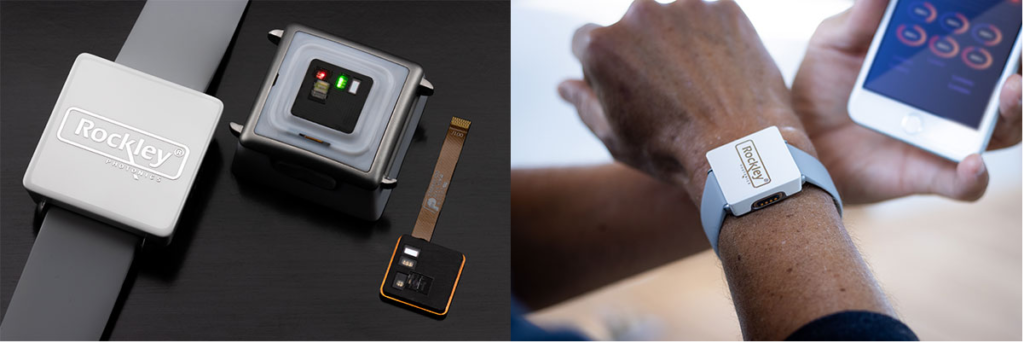
The likely future of the Apple Watch and medical monitoring. Rockley Photonics, a silicon photonics company based in Oxford England and Pasadena, has debuted a sensor module that can enable wearable devices to monitor multiple biomarkers, including core body temperature, blood pressure, body hydration, alcohol, lactate, and glucose trends, among others. The module (exterior above far left and mid-right) combines with hardware and application firmware for consumer applications, such as wrist-worn diagnostics.

The mid-left-hand view shows the reverse (skin) side of the module with the photonic ICs and application firmware. Current sensors use green-light emitting diodes (LEDs) and the Rockley system uses an infrared (IR) spectrophotometer that generates a large number of discrete laser outputs from a single silicon chip covering a broad optical band which can penetrate underneath the skin. The module communicates with custom cloud-based analytical engines via a Rockley smartphone app (far right).  

Obviously, Rockley is seeking to commercialize this through partnerships with consumer electronics companies in digital health and fitness monitoring. Rockley is a key supplier to Apple for sensors. Release, FierceHealthcare 

Financially, on 9 August they closed their SPAC with SC Health Corp. of Singapore after the UK courts approved the business combination. As of 13 August, it is trading on the NYSE as Rockley Photonics Holdings, Ltd. (RKLY). Rockley received $167.8 million in gross proceeds, including $17.8 million from SC Health, as well as $150 million from the financing completed in connection with the announcement of the business combination, led by top-tier institutional investors including Senvest Management LLC and UBS O’Connor and participation from Medtronic. According to their 22 July shareholders letter, all their revenue is attributable to two companies: Apple and Hengtong Rockley, a Chinese joint venture, and an accumulated deficit of $298 million.   Release

Home care rocked: Honor Technology acquires home care provider Home Instead

Honor Technology, which provides tech-based management services to home care agencies, has acquired home care provider Home Instead. Home Instead, the world’s largest network and international franchiser of home care services, has 1,200 offices in 14 countries with 100,000 caregivers (and largest in the UK with 13,000). Home Instead will retain its name and operate as a subsidiary of Honor. No financial or management terms were disclosed, but the valuation of the company will top $2.1 billion (£1.5bn). 

It’s a bit like the guppy swallowing the whale. Honor is only six years old, compared to 25-year-old Home Instead. Honor, which started out as a West Coast-based on-demand care company, now provides an operational platform to generally smaller home care agencies for services such as billing, scheduling, staffing, and other back-office functions for a negotiated share of its agency partners’ revenue. The guppy has to date a modest $255 million in financial backing, including last October’s $140 million Series D, from firms such as T. Rowe Price, Baillie Gifford, and Andreessen Horowitz. Supposedly the deal was inked in months, starting with a speculative phone call between Honor CEO Seth Sternberg and Home Instead CEO Jeff Huber.

Home Instead definitely saw value in Honor’s analytics, which profiles caregivers’ motivations to find the best fit for what shifts and duty suits them best. Recruitment and retention of caregivers is a major worldwide problem. According to LaingBuisson’s article on the acquisition, the UK alone has a shortage of 4,500 caregivers. This also converges into staffing health systems’ moves into hospital-at-home care. Martin Jones, Home Instead’s UK chief executive noted that ‘The hospital of the future is the home. And our future will be fuelled by a vibrant, respected workforce delivering care with skill and compassion.”

“To drive innovation, Honor will substantially increase its investment in research and development through engineering and technology. Honor and Home Instead also plan to extend their advocacy and social purpose initiatives. The combination will empower professional caregivers and enable millions more older adults across the globe to receive the support they need now and in the future.” 

It’s a huge deal in the sleepy home care business, and it vaults Honor into a position to shake up the home care business even further. Honor release, Honor blog, HomeHealthCareNews, McKnight’s Senior Living  Hat tip to reader Adrian Scaife. Laurie Orlov in her Aging and Health Technology Watch also has an interesting take on the acquisition being exactly right. 

News roundup: update on UnitedHealth/Change Healthcare DOJ check, Tunstall adds new CTO, Amwell’s gloomy second half, Teladoc’s Aetna deal, Fitbit and LifeScan diabetes

Just the news, no deals. UnitedHealth Group’s $13 billion acquisition of diversified health IT/imaging/payments company Change Healthcare has hit another snag. Back in March, the US Department of Justice requested specific information as part of DOJ’s review of the merger under the Hart-Scott-Rodino Antitrust Act (HSR). Both UHG and Change have agreed with DOJ to not certify compliance with the request before 15 September, then wait an additional 120 days, based on a 7 August Securities & Exchange Commission (SEC) filing. This could be shorter if DOJ formally advises them that their investigation is closed. Announced in January as a giant addition to UHG’s Optum unit, this now looks like the sale will close sometime in December–if it is not derailed. Becker’s Health IT with a brief recap. This was not a good week for UHG as they had to pay $15.6 million to settle a US Department of Labor finding that they did not pay out-of-network mental health claims at parity, wrongfully denied others, and flagged still others for utilization reviews. FierceHealthcare

Tunstall Healthcare announces a new Group Chief Technology Officer. Gary Steen joins Tunstall from broadband provider TalkTalk where he was Group Managing Director for Technology. He will lead Tunstall’s innovation and development function globally including all solutions and products from Tunstall’s technology delivery centres in the UK, Sweden and Germany. Previously, he was with MDS Global, a software services business active in Europe, Australia, and the US. Tunstall release.  Hat tip to Jenny Marston at Lucky North.

Amwell projects that Covid-19 will depress second half telehealth results by 200,000 visits and $8 million. CEO Ido Schoenberg MD made this surprising projection on the second quarter investor call, but the projection may be sound. His rationale is that there will be not much of a cold and flu season, as the latest virus variants will have people masking up and social distancing (and presumably avoiding indoor crowds. As we’ve noted previously, the Brothers Schoenberg tend to be contrarians on various headline trends (e.g. looking askance at Amazon Care biting into the enterprise telehealth business and hospital-grade in home care). One would assume that if more stay away from in-person care, telehealth would increase beyond the current claims rate of 5% especially in mental health which is half of telehealth claims. But this could be some clever sandbagging for investors, as he went on to say in the call that if the impact of Covid isn’t as bad as we think, there’s always the flu! FierceHealthcare

Amwell’s frequent sparring partner in various courts, Teladoc, announced that they would be powering Aetna Virtual Primary Care for their Aetna members in national self-funded employers. This is a trifecta of Teladoc’s physician-led care team model, Aetna’s provider network, and CVS Health services at MinuteClinics and where available, CVS HealthHUBs. The virtual visits will have no co-pay for as well as select in-person CVS Health services. CVS Health release, FierceHealthcare

Fitbit is, believe it or not, still around. They announced a partnership with LifeScan diabetes monitoring to integrate its health tracking apps with the company’s glucose monitoring devices for diabetes management. The Fitbit tools that track activity such as daily activity, nutrition, and sleep will provide tracking of impact on blood glucose levels. FierceHealthcare

Hearing voices: Cigna-Ellipsis AI-powered voice stress test; UCSF/Weill neuroprosthesis decodes attempted speech

The Next Voice You Hear? Two advances in voice analysis and restoring speech to those who’ve lost it.

The first is from Cigna International based in Hong Kong which through speech and choice of words can determine your stress level. Your Editor took the Cigna StressWaves test, which requires 90 seconds of answering a question based on one of four topics. To her utter shock as she’s rushing to get out an article or two after a busy day at work and the loss of a good friend in the past week, she was told her stress level was low! The StressWaves test is followed up with an email with your results and a questionnaire pitching Cigna’s health insurance. The test was developed for Cigna by machine-learning medical technology company Ellipsis Health. Other Ellipsis tools for clinicians can quantify anxiety and depression symptoms with 2-3 minutes of speech for initial screening and ongoing monitoring. Mobihealthnews.

The second is about restoring a measure of communication to people who have lost the power to speak through decoding their cortical activity. The research by a team from the Weill Institute of Neuroscience and the University of California (among others) implanted a subdural, high-density, multielectrode array over the area of the sensorimotor cortex that controls speech. This was performed on a person with post-brain stem stroke anarthria (the loss of the ability to articulate speech) and spastic quadriparesis. What the neuroprosthesis did was decode directly from the cerebral cortical activity while the participant attempted to say individual words from a vocabulary set of 50 words. Using computational models plus a natural-language model on next-word probabilities in sentences, the researchers were able with a high degree of accuracy to decode full sentences from the cortical activity. The New England Journal of Medicine article is available in abstract but paywalled for the full study (limited free access with registration). The clinical trial was funded by Facebook and is on ClinicalTrials.gov here for the device and related neurological studies. Also Mobihealthnews.

News and funding roundup: patient outreachers Relatient, Radix merge; health apps top 350,000; Morgan’s $50M in Vera Health; Communicare247, Doro, TeleAlarm join Scottish Digital Telecare’s list

Patient engagement meets…patient engagement. Two relatively small players in patient outreach, Relatient and Radix Health, are merging. By no coincidence, the former announced that they received $100 million in growth equity capital from Brighton Park Capital and its affiliates. Brighton Park led an undetermined investment round for Relatient in November 2019. No valuation or management transitions were announced.

Tennessee-based Relatient sends text messages to patients as appointment reminders, patient chat, and broadcast messaging. It is a 2020 Best in KLAS winner for Patient Outreach. Relatient claims that in 2020 it sent 200 million messages and integrates with over 85 practice management systems and electronic health databases. Atlanta-based Radix Health has a somewhat different software set for patient scheduling, contactless check-in, appointment reminders, and reminders for medical groups, health centers, and hospitals prior to procedures. Earlier this year, Radix rolled out a Covid-19 vaccine location and scheduling system for their mid-sized and large provider clients, which by February scheduled 200,000 appointments and about 100,000 vaccinations. Both companies were founded in 2014. The merged organization will be headquartered in Franklin, Tennessee, with offices in Cookeville TN, Atlanta, and Pune, India. Release, Mobihealthnews

Consumer health apps top 350,000. The IQVIA Institute for Human Data Science latest report on digital health trends tracked over 90,000 released last year alone. Managing health conditions makes up nearly half (47%, up from 28% in 2015) of apps. About two-thirds of digital therapeutics and 40% of digital care products treat either neurologic or mental health conditions. At this point, who’s counting? And are all of them working? Mobihealthnews, link to IQVIA report (registration and download required).

JP Morgan Chase’s new Morgan Health invested $50 million in Vera Whole Health, a western US primary practice group. Vera Whole Health operates on a membership flat-fee model and is fully at risk in a value-based, technology-enabled coordinated care model. Morgan Health adds to Vera’s coffers after the majority sale of the company to CD&R for an undisclosed amount and a valuation at $400 million. JP Morgan sunsetted its unsuccessful three-year joint venture, Haven, in January, but remains interested in health for profit and for employees, who will be given the opportunity to join Vera. Healthcare Dive, Mobihealthnews

Communicare247, Doro, and TeleAlarm receive Scottish Digital Telecare nod for digital alarms. Communicare247’s Archangel Care Cloud, Doro’s CareIP Mobile, Eliza 4G, and the icareonline platform, and the TeleAlarm TA74 GSM and TeleAlarm Cloud Services have been added to the Scottish Digital Telecare Security-Assessed Suppliers Scheme. They join Alcuris and Enovation, as reported in the past two weeks. Communicare247, Doro, and TeleAlarm releases.

News and funding roundup: BioIntelliSense ‘stickers’ $45M, Exo ultrasound scans $220M, Enovation gets Scotland OK, WellSky snaps up Healthify, Cerner’s good quarter despite VA

Sticker shock? BioIntelliSense, which has been flying under the radar for over a year [TTA 17 July 2020] since inking a deal with Philips to integrate their BioSticker sensors into their post-acute remote patient monitoring (RPM) systems, scored a $45 million Series B funding for a total of $82 million since 2018. Lead investor is Chimera (UAE) with participation from 7wire Technology Partners, Mary Tolan of Chicago Pacific Founders, James Murren, formerly of MGM Resorts International, as well as Pendrell Corporation, Royal Philips, and Fresenius Medical Care North America.

BioIntelliSense has two wearables: the BioSense on-body sensor for 30 days of continuous vital sign monitoring, and the new BioButton for up to 60 days of RPM. The BioButton is touted for Covid-19 monitoring. “Temperature checks have proven to be unreliable and even amplified testing (PCR) has proven to be ineffective in identifying the virus in the early days of infection.” The button will be connected to the BioMobile screening survey app which will feed the user the latest CDC health screener and then scan for ‘subtle physiological changes’ in temperature, respiratory rate and heart rate at rest. The app generates a non-PHI report indicating ‘cleared’ or ‘not-cleared’. The BioSticker is 510(k) FDA-cleared; the BioButton is not, but is being marketed as an enterprise solution for employee health clearance. Mobihealthnews

Hand-held ultrasound gets ultra-funding. The Exo hand-held ultrasound snagged a hefty $220 million in Series C funding for a total of over $320 million since last year. Their point-of-care tool includes nano-materials, sensor technology, and advanced signal processing and computation in a platform called Exo Works. Exo is in a crowded field pioneered by GE Healthcare’s Vscan [TTA 27 March] back in 2010, but including Butterfly IQ, Mobisante, and Philips LumifyMobihealthnews

Enovation also approved by Scotland. With our news from Alcuris last week that they were selected by Scottish Digital Telecare as a security-assessed supplier, Enovation (formerly Verklizan), notified your Editors that they also were selected. Our quote from their management is from Andy Grayland, Chief Information Security Officer, Digital Office for Scottish Local Authorities. “The Scottish digital telecare security-assessed suppliers scheme reviewed a submission from Enovation for an Alarm Receiving Centre application. The assessment panel was very impressed with pre-existing security security culture and standards within Enovation. Both this assessment scheme, and Enovation’s positive response to it, will help ensure that vulnerable telecare users across Scotland are protected against the threat posed by cyber criminals when using these services.” 

WellSky to acquire SDOH provider Healthify. WellSky is a provider of software, analytics, and services for community care. Healthify builds and manages accountable networks for SDOH services, working with health plans, providers, and community partners in all fifty states. Previously, Healthify had raised $25.5 million in five rounds from 2013 (Crunchbase). Healthify is the fifth company WellSky has acquired since 2018, the last CarePort Health for $1.4 billion in 2020 (Crunchbase). Terms were not disclosed. Closing anticipated in Q3. The release does not indicate management transitions or HQ location.  

Despite their VA troubles and layoffs, Cerner had a very good quarter indeed: revenue up 10%, adjusted EPS $0.80 versus $0.63, exceeding analyst expectations for both. They laid off 500 employees in the quarter and eliminated 300 open positions, which will deliver $70 million in annualized savings. plus half their owned space is now unneeded so up for sale. Their Department of Defense EHR rollout is going well with 42 commands and 663 locations with 41,000 activated users. The Coast Guard’s deployment will be completed this year. As to VA, “results of the VA’s strategic review focused on governance, training, and readiness rather than Cerner-caused problems.” More in the lead article in HISTalk 8/2/21. Cerner’s announcement, transcript of earnings call on Seeking Alpha