Short takes: Owlet Dream Sock FDA clearance; Best Buy-Mass General partner for at-home care; Amazon offers Prime members deeper One Medical discount

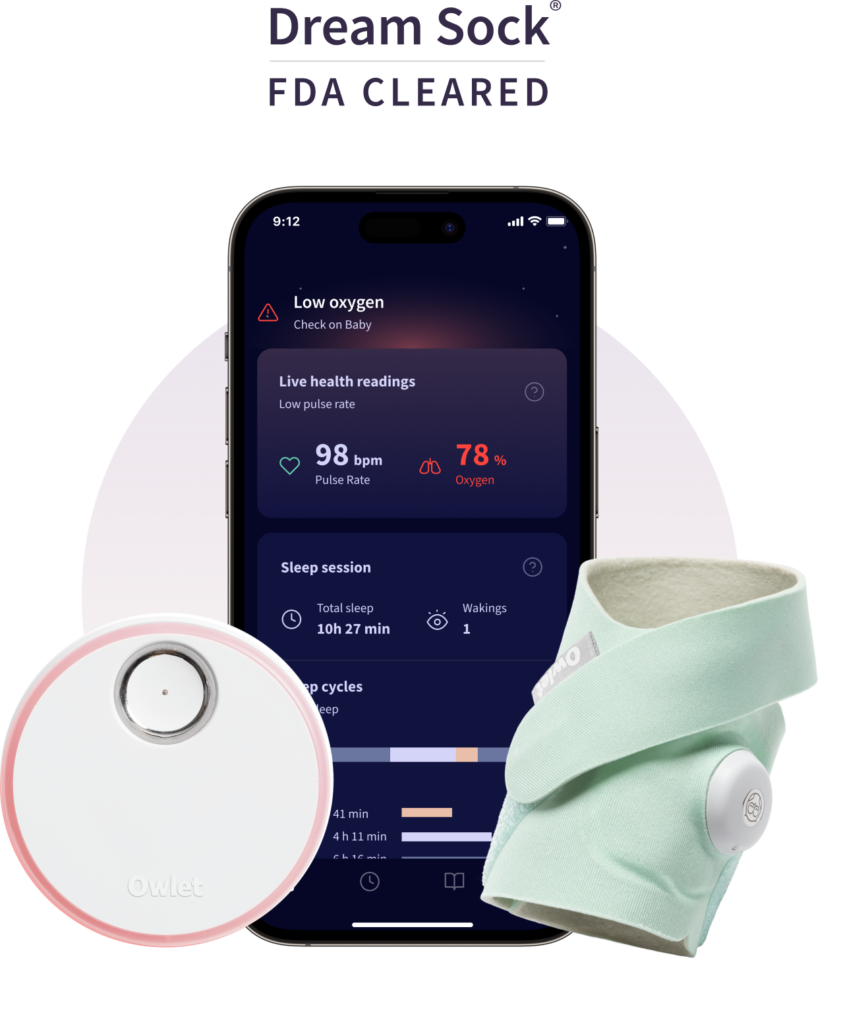
Some really good news for Owlet. The Dream Sock finally got to the mountain top and received de novo FDA clearance for pulse oximetry. To date, it is the only over-the-counter medical pulse oximetry device for the baby market. This adds to the device’s Baby’s Live Health Readings, including pulse rate and oxygen saturation level. The platform also provides Health Notifications, which send alerts to a smartphone with lights and alarm sounds if baby’s readings fall outside of preset ranges. Existing and new Dream Sock buyers will be upgraded to the new features by end of 2023. The Dream Sock is for use with infants 1-18 months and 6 to 30 pounds. Pricing observed for the current Dream Sock is in the $300 range. Owlet release

This follows FDA clearance for the prescription BabySat in June [TTA 21 June]. That is scheduled to be introduced later this year in the US only. The non-prescription Dream Duo, which combines the Dream Sock with a baby cam, will continue to be sold. 

Financially, things have improved a lot since last year. The stock as of 11 July was restored to NYSE listing, but it required a reverse split and an 18 month compliance plan, Currently, it’s trading at about $4.80 which is NYSE compliant, up from well below $1 in June. Also in July, they hired a new president and chief revenue officer, Jonathan Harris, from recently acquired air purification system Molekule. In August, they reported a Q2 adjusted EBITDA loss of $4.3 million, narrowed substantially from prior year Q2’s $16.7 million. This was achieved on lower revenue of $13.1 million versus last year’s $18.3 million. Q1 revenue was $10.7 million. Q3 will be reported on 13 November. Release  Having followed them since the ‘telehealth for the bassinet set’ days of 2012-2013, their continued independence, and their focus on baby health, this Editor continues to wish them bonne chance.

Mass General Brigham’s hospital-to-home and home care programs get a Best Buy boost. Mass General plans to integrate Best Buy’s delivery capabilities for their Healthcare at Home program in several areas. For Home Hospital acute care, Best Buy will supply the Current Health remote patient monitoring program to build out a technology-enabled clinical delivery model that connects patients to nurses, paramedics, advanced practitioners, and physicians. For Home Care, Best Buy will supply Lively Mobile Plus personal emergency response system (PERS) and leverage out capabilities such as Geek Squad to supply Mass General Brigham (MGB) patients with delivery of home-based care and logistics management for the care team. MGB plans to introduce Best Buy as part of Home Hospital in five Boston-area acute care hospitals. The program is for patients with heart disease, chronic obstructive pulmonary disease (COPD) and infections. While their Home Care operation is stated by MGB to be the largest certified provider in New England, the Home Hospital program can presently cover only 33 patients at a time. MGB’s goal is to shift 10% of inpatient care to patients’ homes over the next five years, so expanding capacity and capabilities are critical. FierceHealthcare, Mobihealthnews, MGB release

Get your One Medical now, just $99 per year or $9 a month! It’s an offer hard to refuse for Amazon Prime members. It’s half off the annual membership of $199, with additional members up to five for only $6 a month or $66 annually. What Prime members get is 24/7 virtual care access without further charge through their app that includes video chats with licensed providers plus their “Treat Me Now” service, fast care for common issues like cold and flu, skin issues, allergies, and urinary tract infections. It does not include any One Medical in-office services, if available in the member’s area. The 200 million+ Prime members were briefly offered in February a $144 membership but apparently this new incentive is not only at a deeper discount, but also longer term or permanent.

Time to make that $3.9 billion acquisition pay off. This push is clearly to build up One Medical membership, which stood at only 836,000 members at end of 2022, and build up cash flow. Amazon is not reporting on the success of the earlier discount offer. A question this Editor has–if 1 million Prime members signed up–that’s only a 0.5% rate–does One Medical have the telehealth capacity to serve these patients, especially at peak usage such as cold and flu season?

Prime members are also able to access Amazon Care, which is virtual only, cash-only by medical event asynchronous telehealth services. If a Prime member goes in person to a One Medical practice, they do take insurance. FierceHealthcare, Healthcare Dive, Amazon Prime offer page

Thursday news roundup: dimming SPACs, hospital-at-home pilots in DFW, Connected Health debuts bespoke home care services configurator in NIR

The prognosis for SPACs? Like Lucas electrics, dim. Too many went public on last year’s overdose of moonbeams and celery stalks at midnight, to this year’s plummeting share prices and red ink. Not only are SPACs now targets of Federal, including SEC, scrutiny, but they have Elizabeth Warren, the Senatorial Scourge of Finance, after them promising legislation with even tighter regulations than the SEC. But let’s face it, most SPAC’d companies have yet to stumble their way into profitability. From financing Hero to Zero in two years. This short article in PrivCo’s Daily Stack will confirm all of this.  

Hospital-at-home pilots in the Dallas-Fort Worth, Texas area. Biofourmis is piloting an initiative with Wise Health System for its Hospital@Home end-to-end solution that combines artificial intelligence (AI)-based remote patient monitoring (RPM) technology and clinical support services. This is to qualify for Centers for Medicare and Medicaid Services’ (CMS) Acute Hospital Care at Home program. Select patients can choose to be admitted to home versus the hospital, then monitored by the Biofourmis Virtual Bed Kit based on a wearable biosensor feeding into a digital tablet pre-loaded with the patient-facing Biovitals Hospital@Home app. Wise’s staff will visit the patient at least twice daily to conduct in-person examinations, assessments, and additional testing as needed. Wise Health is a four-hospital, integrated care network. Biofourmis release

What you pick is what you get. Domiciliary care provider Connected Health is debuting Connected Health 2.0, a ‘home care configurator’ which will enable clients and families to build a package of services for home care. Launched during Carer’s Week in Northern Ireland, it custom-packages physical care, wearables, medication devices and virtual care services. Once the client or family member configures the care package, Connected Health calls them to review suitability then follows up with an on-site risk assessment in the home before service begins. The Irish News article is light on details like when it begins in Northern Ireland, but Connected Health’s timetable is to roll it out in the UK and Ireland over the next two years.

News/deals roundup: Connect America finalizes Philips aging/caregiving buy; Amedisys-Contessa $250M hospital-at-home; UK’s Physitrack $20M IPO, Dutch motion tracker Xsens

Kicking off our week….

Connect America closed today (6 July) the purchase of Royal Philips’ Aging and Caregiving line of business. This includes the top basic personal emergency response system (PERS) device provider, Lifeline. Purchase price by Connect America’s owner, Rockbridge Growth Equity, was not disclosed. For Connect America, they now top 900,000 subscribers to PERS and monitoring services. At this point, the combined business will have 1,500 employees and 3,000 provider partners. Lifeline also includes services such as 24/7 response with their products: the HomeSafe traditional home PERS with and without AutoAlert fall detection and GoSafe2 mobile PERS with AutoAlert.

There is no indication from the company release or the brief Mobihealthnews article on whether the Lifeline brand name or others from Philips will be retained. Lifeline’s history dates back to 1974, with Philips adding the AutoAlert, HomeSafe, and GoSafe product after their purchase in 2006. Other undisclosed considerations are integration and rationalization of the current Connect America PERS and monitoring products with Lifeline. There is also a promotional partnership agreement with AARP that likely–but not necessarily–will transfer with the purchase. This Editor can tell you that a seat at AARP’s poker table requires a tall stack of chips.

Our earlier article on the acquisition profiles Connect America, Lifeline, and the decline of traditional/mobile PERS with the rise of accessible wristwatch and band forms that don’t scream ‘I’m at risk of falling and not being able to get up!’

Home healthcare provider Amedisys announced their $250 million acquisition of Contessa Health, extending into hospital-at-home and skilled nursing-at-home. As our Readers who looked at Ziegler’s analysis [TTA 25 June], this is a hot and tech-driven care area. Amedisys is claiming that they are the first home health, hospice, and personal care service provider to expand into Contessa’s business, which is hospital-at-home and skilled nursing facility (SNF) at-home including palliative care services launched recently with Mount Sinai Health System (NY). Contessa will operate as a separate division of Amedisys, which plans to invest in both the future growth of Contessa and their proprietary informatics platform CareConvergence with the aim of creating a “premier home-based health system”. The acquisition is expected to close on 11 August. Contessa has both hospital partnerships, which are the bulk of Amedisys’s client business, and joint venture/payer partnerships. Amedisys release, Hospice News

The UK’s Physitrack quietly went public with a raise of over $20 million. The IPO was listed on 18 June on the Nasdaq First North Premier Growth Market (Nasdaq Nordic, Sweden and Finland) earlier this month with an original offering of SEK 40 ($4.69) per share with 4.4 million shares in the offering. The market value is estimated at SEK 624 million ($72.5 million). Unfortunately, you cannot look beyond this investor page if you are in the US, Australia, Canada, Hong Kong, Japan, New Zealand, Singapore, Switzerland, South Africa, or South Korea as citizens of these countries cannot invest in their shares. Physitrack is a digital physical therapy plus patient engagement company headquartered in London with offices in Santa Monica, Houston, and Utrecht. It was in the first group of the NHS’ Digital London accelerator program and now is distributed in 100 countries serving 1 million patients. Mobihealthnews, Baker McKensie (legal advisor announcement)

And keeping it physical, Xsens, a Dutch 3D motion capture and attachable sensor company for therapy and ergonomics study, is extending into Automatic Reporting as part of its online MotionCloud platform. A full report, graphs, and a digital recording of an avatar completing the movements can be available to physiotherapists, health specialists, and ergonomic consultants in under two minutes. In addition, they announced a new Awinda Starter system which has their proprietary motion-tracking technology at a more affordable price. Xsens press release, Mobihealthnews

News roundup: CES’ early beat, CVS-Aetna pauses, digital health fizzes, Yorkshire & Humber Propels

The start of January can be a slow–or busy–time. There are, of course, the avalanche of announcements made at JPM and just starting CES, which has become a part-healthcare show with hundreds of health-related exhibitors. At this point, this Editor confesses that there is not much that has caught her attention or that she–and Readers–haven’t heard about before, but the bulk of the coverage will come out next week. A lot of what is on the floor are still gadgets–and they come and mostly go. In better news, there was a Hospital at Home panel kicking off the 10th year of the Digital Health Summit on till Friday which illustrates their maturing into issues such as AI, workplace wellness, and aging. All this may be moving forward and coming a lot closer to reality than say, in 2017. But Jake, it’s CES–this year, if it folds, rolls, is retro, has a healthcare spin, and 5G, it’s on trend at CES.

CVS-Aetna grinds to halt. The partial government shutdown has affected the DOJ’s filings with DC Federal Court Judge Richard Leon on the consent decree from October. Judge Leon is reviewing the decree under the Tunney Act requirement that the merger meet the public interest. It turns out that the DOJ cannot supply documents as the Antitrust Division was furloughed–non-essential . This means little for the actual merger as it has already happened, but it slows down a fair amount of functional integration. Prediction: DOJ will not move forward with this until at least one month after the shutdown ends–our bet is April, with the cherry blossoms. Seeking Alpha

Fizzy, not bubbly. That’s Rock Health’s verdict on This Year In Digital Health Funding. No Bubble Here! While Rock only takes a piece of the picture (US only deals, over $2 million), it came in at $8.1 billion–a full $2.3 bn or 42 percent–over 2017, as projected in Q3 [TTA 11 Oct]. The deals continue to be bigger and fewer–368 versus 359 for 2017, which is barely a rounding error. More on this next week.

Propel@YH debuts. Returning to the UK, Yorkshire and Humber’s Academic Health Science Network’s (AHSN) first digital health accelerator program will be providing guidance and support services for pioneering developers with innovative digital and patient solutions. Eligible organizations will have either an existing presence in the region or are willing to establish one. Six organizations will be chosen to take part in a six-month program focused on human-related design, clinical safety by design and understanding NHS procurement. Announcement and AHSN website.

A basket of reflections, considerations on CVS-Aetna: Epic, Cerner, the model, and hospitals’ role

[grow_thumb image=”https://telecareaware.com/wp-content/uploads/2017/12/canary-in-the-coal-mine.jpgw595.jpeg” thumb_width=”150″ /]With the holidays and the end of the year coming in a little over two short weeks, there’s plenty of room for thoughts, reasoned speculation, and some unusual takes on the CVS-Aetna merger. This Editor remains in her belief that among us, there’s a bit of exhaustion and an attitude of ‘wait and see’ around the topic among us. The canaries have a case of the vapors….

Let’s sort through some of the more interesting POVs expressed of late by our fellow pressies, which Readers can consider in between cups of good cheer and bites of All That Food. Bear in mind that this merger has a long road to go on a hard road, with potholes marked DOJ and (in this Editor’s opinion) HHS, before it’s a done deal in 2018.

  • A big win for Epic. Currently the EHR for CVS’ MinuteClinics and most recently the care management programs of CVS Specialty, Epic is bullish on the opportunities in what their VP of population health termed the ‘gray space’ in the patient experience outside of the traditional sites of care. In October, CVS added Epic’s Healthy Planet population health analytics platform to learn more about drug dispensing patterns and medication adherence–this Editor believes in preparation for merger talks. The open question this Editor has after all the glow in this article is how Aetna’s varied systems (e.g. ActiveHealth, Medicity, and others) would integrate into Epic, and the price of poker, because with Epic it’s never free. Ask any hospital. Healthcare IT News.
    • Certainly, their main competitor Cerner is feeling the heat after a slowdown in its VA plans, the single largest EHR implementation ever. Congress has held up initial funding making the contract effective (Washington Technology). It is geometrically more complicated than their simultaneous DoD implementation, with $10 billion estimated over 10 years (FCW). Other wrenches in the works: a fresh CliniComp lawsuit against Cerner based on infringement against their 2003 patent on remote hosting, and their appeal of the no-bid award to Cerner [TTA 23 Aug] against VA. Kansas City Business Journal, Healthcare IT News
  • Is it going to increase cost? It might. And what about info sharing with providers? A Harvard Medical School professor opined to Marketplace that instead of self-treatment at home for a cold, the patient might actually traipse to a MinuteClinic for care, thus driving up healthcare costs. This resembles the RAND logic around telemedicine consult expense we deflated in a series of articles back in the spring. Information sharing with regular providers is a bigger issue which urgent cares, telemedicine, and clinics already are dealing with. The paradox is that integration with a payer, with a retailer’s ability to track ancillary purchases such as OTC meds and DME purchases, might actually help that issue. But will it? Will a combined CVS-Aetna share information or hoard it, further disempowering patients? This Stat article calls on Mark Bertolini to promote shared information, engagement, and accountability to balance the scales.
  • Do we really need hospitals? If they don’t change, we might need a lot less of them except for highly specialized treatment. And this is likely a good thing. The HBR points out that CVS-Aetna is hardly the only threat to the traditional hospital–there’s Johns Hopkins’ Hospital at Home program for older adults, UnitedHealthcare’s growing network of providers under OptumCare, including the recent deal for DaVita dialysis centers, and free-standing, low-cost “neighborhood” hospitals, almost like pop-up stores. The article doesn’t mention ‘consult stations’ like Europe’s H4D, which is proving that the kiosk idea isn’t dead. 

The reality is that we won’t know what this merger entails until it actually happens, if it happens–and its final shape will take years to mold. Related: CVS-Aetna: the canary says that DOJ likely to review mergerAnalysis of the CVS-Aetna merger: a new era, a canary in a mine–or both?CVS’ bid for Aetna–will it happen, and kick off a trend? (what will Amazon and other retailers, including supermarkets, do?)