


 Danaher closing the Masimo acquisition for a eyewatering $9.9 billion in early June definitely flew under this Editor’s radar. Let’s catch up. As your Editor “Alibi Ike’s” on this (blame it on an airshow, not an injury!), beyond its $9.9 billion “Hollywood Ending” deal in February, here’s the ‘need to know’ about the medtech giant’s final deal for Masimo and the latter’s future.
- The completion was 10 June, when Masimo stock was delisted at a final price of $179.95 (MASI, Nasdaq). The closing beat the expectation of H2 2026 by a month.
- The Danaher offer was $180/share (DHR, NYSE). When the offer was made, Masimo stock was trading around $130. This made for a very good deal for long-suffering Masimo shareholders and Politan Capital, which forced out owner/founder/CEO Joe Kiani in a blistering September 2024 proxy fight. Masimo shareholders approved it in May.
- Masimo will operate as a brand and division under Danaher Diagnostics, led by EVP Diagnostics Julie Sawyer Montgomery with Masimo CEO Katie Szyman continuing as CEO of the division.
Danaher updated its full-year 2026 guidance on 21 July with its Q2 earnings release. “For full year 2026, the Company expects non-GAAP core revenue will increase in the 3.0% to 4.0% range year-over-year. The Company is also increasing its full year adjusted diluted net earnings per common share guidance to a range of $8.45 to $8.60 versus previous guidance of $8.35 to $8.55. to incorporate Masimo’s expected contribution.” The $150 billion market cap Danaher is likely to pursue other acquisitions as well.
Competitively, it positions Danaher against industry giant Medtronic in patient monitoring, specifically in pulse oximetry and related technology. Masimo’s pulse oximetry and patient monitoring devices overlap somewhat with but extend Danaher’s existing Radiometer products in blood gas analysis and testing. Denmark-based Radiometer is stronger in European markets while Masimo is primarily US/Canada based. There is also diagnostic segment overlap with Beckman Coulter Diagnostics. It also expands Danaher’s offerings in sensor-based technologies and overall to integrated delivery networks, or IDNs. Other Danaher products within Diagnostics are Leica Biosystems and Cepheid. Given Danaher’s extensive and existing footprint in diagnostics and a legitimate fit, Masimo may get some long-overdue capital development and real management attention.
Courtesy of Editor Ted Green at Strata-Gee, in closing out the Masimo/Sound United file at his consumer electronics/AV custom integrations business newsletter here, this is how Danaher’s current products and Masimo’s complement each other in diagnostic market segments.
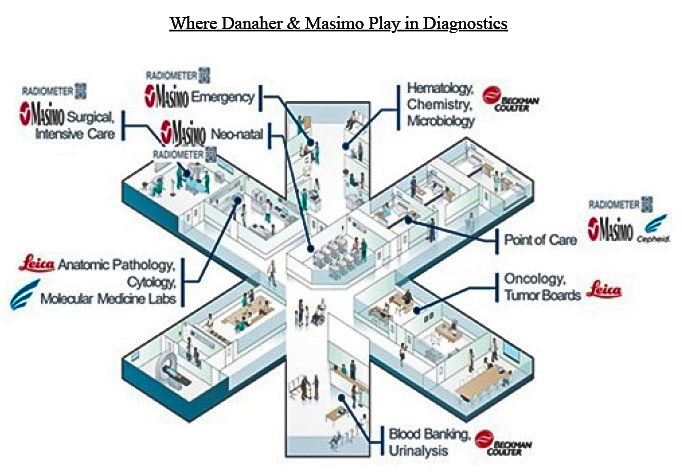
One caution for Masimo’s independent operation is that Danaher will now start executing on $125 million of annual cost synergies and more than $50 million of annual sales synergies by the fifth full year after the deal closure. “Cost synergies” usually mean shared corporate infrastructure, supply chain efficiencies, and streamlined back-office operations, although Danaher to this point has not filed any WARN notices for Masimo in California or Federally. Another caution is the meshing of Masimo’s corporate operations and ‘culture’ with the Danaher Business System methodology, as Masimo’s recent history has resembled a roller coaster ride at an amusement park with pieces coming off and the occasional passenger doing an aerial. Danaher closing release, MedTech Dive, Yahoo Finance
What’s left in LitigationLand?
- The Apple Watch litigation ended with a Federal win for Masimo. It won the Federal patent infringement case in November and was awarded $634 million in damages. A Federal appeals court rejected Apple’s request for a new trial last week. Orange County Business Journal, paywalled. 9 to 5 Mac
- Contrary to this, in April the International Trade Court (ITC) refused to reinstate the import ban on the redesigned Apple Watches imposed in December 2023. Reuters Whether Danaher will continue to pursue this isn’t known, but given the win versus Apple and the Danaher emphasis on diagnostics, the ITC import ban on a consumer product goes far down the list in importance.
- The Kiani lawsuits over his separation are proceeding in Orange County (California) Superior Court. These are over compensation owed to him when Kiani was ousted as CEO. His argument is that the employment contract is ambiguous about the timing of payments and that the unpaid compensation qualifies as wages. Judge Thomas Lo ruled last month that the suits could continue. The stakes are not small. The contract contained a $450 million severance payout. Kiani is seeking an added $100 million in damages from the company’s former six board directors affiliated with activist investor Politan Capital Management. Kiani is represented by Marshall Camp of Hueston Hennigan LLP. OCBJ In March, Judge Lo disqualified Quinn Emanuel Urquhart & Sullivan LLP from representing the six board members because the firm had originally defended Kiani’s employment agreement and violated ethics around confidentiality and loyalty. Daily Journal-Cal Lawyer
- There are other lawsuits active in Delaware and Washington, DC.
And in other June news, Masimo gained FDA 510(k) clearance for an opioid-induced respiratory depression detection capability integrated into the Radius VSM wearable continuous patient monitor. It uses Masimo’s smartSET pulse oximetry sensor platform to identify early signs of respiratory compromise in hospital patients receiving opioid therapy. Release
One more TTA Hat Tip© to Ted Green of Strata-Gee for being an excellent inside source on Masimo, the agita around the (sold) Sound United, and the culminating proxy fight between Politan Capital and Joe Kiani. Here’s his history of Masimo’s “wild and crazy ride”. He now returns to being THE newsletter for professionals in the consumer electronics/AV integrations business!


 NeuroPace, which developed an implanted brain-responsive neuromodulation system for patients with refractory and drug-resistant epilepsy, announced the result of their nine-year long-term treatment study.


Most Recent Comments